If you see the site being up again, or this entry appearing in your old, stinky RSS aggregator… DON’T PANIC.
I’m not back.
I just need to fish some old entries for the next couple of days.
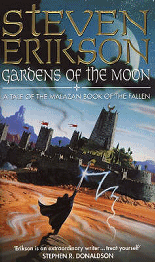
His first fantasy novel, Gardens of the Moon (1999), constitutes the first of ten projected volumes of the Malazan Book of the Fallen. His style of writing tends towards complex plots with multiple point-of-view characters.
It is an epic fantasy, wide in scope and encompassing the stories of a very large cast of characters. Each book tells a different chapter in the ongoing saga of the Malazan Empire and its wars. For the first five books, each volume is self-contained, in that the primary conflict of each novel is resolved within that novel.
However, many underlying characters and events are interwoven throughout the works of the series, binding it together.
HRose: Erikson’s series should be under ‘epic’ in the dictionary. With timelines spanning 100000 years and more, and tons and tons of characters, many of which who are ancient themselves.
My personal favorite. I love the expansive and interesting world Erikson has built. That being one of your criteria I don’t think you can go wrong.
The other bonus of Erikson is that he’s fantasy of his own devising, and isn’t Tolkienesque. His take on gods and magic is pretty awesome, and unique to boot. He turns the idea of undead on its head, there is no ultimate good or ultimate evil, and there’s startlingly few stereotypes. Even when he delves in to a plot involving a young kid being caught up in things above him, he manages to take it in places that you just wouldn’t expect.
I do like Erikson too, but the far-flung epic feel drags in parts. That could just be me in that I only have time to read sporadically. The Malazan books are certainly not ones you skip merrily through. You have to pay attention and invest yourself in them. You are definitely paid off, though, because the detailed world he creates is nothing short of amazing.
This is the seventh novel in the Malazan Book of the Fallen series. It is everything you hoped for if you have been following this story from the beginning. The sheer scale and grandeur of this tale is breathtaking. Again you will question who are the “good guys” and who are the “bad guys”.
Martin and Erikson are absolutely the giants of the genre at this point.
One huge plus between Martin and Erikson though- Erikson is putting these out on an almost annual basis. There is a very real possibility that his entire ten book series will be released before Martin gets his sixth book out.
Erikson commonly gets compared to George RR Martin thought the two really aren’t that similar IMO other than the scale of the work and, in most opinions, relative quality. Both authors tell a fairly gritty tale but Erikson seems more concerned with history and magic while Martin seems focused mainly on characters.
Erikson’s strength is in his world detail. The world of the Malazan Empire has an incredibly detailed backstory and its the primary focus of the series. His books take the “in media res” concept very much to heart- there is no true beginning and most readers find themselves fairly confused with the first half of his first novel, Gardens of the Moon. He doesn’t slow for explanations or introductions- the world is already in the midst of a major continents-spanning war and most of the characters already have histories with one another that is only hinted at. You just have to accept that you’ll be confused and trust that you haven’t missed anything. By the second half of the book things start to click and you get a pretty good idea of the scope of what Erikson is trying to get across.
His best asset, IMO, is the sheer scale of the events. He also has some relatively interesting characters. One huge plus is that each book is relatively self-contained- there is a genuine finale and following books often take place in different times and places than previous ones with a few overlapping characters. Consequently each book is relatively satisfying without engaging in cheap cliffhangers.
Erikson other folks have described. Huge time scale, lots of gods and other major powers futzing with things. Enormous, dramatic conflicts. I’ve found every book so far to be rough getting into (he sometimes spends 5/6ths of a book building tension and weaving threads before the big shit goes down.) but increasingly compelling to the point of obsession the deeper into them I get. There’s nagging things that keep popping up and back down again before I can entirely identify them. But he’s telling much too good a story for me to really care.
Another big hell yeah for Malazan. There is just nothing else quite like it out there.
Tearing into ‘Memories of Ice’ by Erikson. Gotta love a book that has a 300 thousand person army of starving cannabalistic peasants laying seige to a city.
And another reason it deserves the “epic” title (which I didn’t see anyone else mentioning in this thread but they may have and I missed it) – the depth of character and location interaction is so broad it’s almost silly. You meet what look like minor throw-away characters in one book only to find they are the major player three books later.
Or you find a bizarre scene that is visited by many different groups of characters at different times, but the scenes don’t appear in order in the sequence of the books. You may find the gruesome mysterious aftermath of a battle in book 2, then read about the battle itself in book 5. I found myself constantly going “WAIT! Is that how that got there?” and shuffling through earlier books to remind myself of how things were connected.
And my last bit of fanboy praise – the characters are freaking GREAT. Ericson is not afraid to kill of major characters, and he creates new major characters in just about every book, and yet almost all of them are clearly drawn with distinct personalities and are quite memorable.
I think Erikson is the most complete fantasy writer out there today. Some authors are good at world building, some are good at characterization, but Erikson isn’t just good at both, he excels at both.
Erikson also does some really unique stuff with structure and narrative that I haven’t seen a lot in the genre. It’s not straightforward in any way. For example, the first book takes place on a certain continent with certain characters then Book 2 moves to a completely different continent with mainly new characters. Book 3 then acts as a sequel to Book 1, and Book 4 to Book 2.
Then there is an all new continent and characters in Book 5 and now Erikson is drawing all of those threads together in the latter half of the series.
The result is that the whole enterprise is basically a puzzle where the reader is making the connections between these seeming disparate storylines.
Especially since Erikson abhors any type of exposition describing the world and it’s history. It’s left to the reader to put together so readers of the first book often feel like they are missing something and starting a series in the middle. Another cool technique Erikson uses is that he hides some secrets and twists in plain sight which can makes re-reads quite enjoyable when you see how much he had laid out in advance.
Highly original. Very little of his world-building even reminds me of things I’ve read before.
I agree they’re an acquired taste, and not the easiest reads, but the chaotic insanity and excess of the whole concept is sort of exhilarating.
And the plotting is pretty extraordinary. By the time you get to book four and see how the throwaway random comment in book two was actually a reference to an event which was experienced in book three and had been foreshadowed in book one it can boggle the mind nicely.
Martin isn’t really high fantasy- it’s all very realistic with minimal magic. Erikson, on the other hand, really excels when it comes to epic, magic heavy battles.
Erikson’s world can probably be compared to the mythology of Ancient Greece but set in a medieval period- Gods and Ascendants (basically demi-gods) are main characters and frequently interact with mortals.
Erikson is a master of lost and forgotten epochs, a weaver of ancient epics on a scale that would approach absurdity if it wasn’t so much fun.
The sheer scale of the author’s vision is nothing less than astonishing. And the ease with which he seems to navigate through this grand epic of mortals and gods never ceases to astound me.
If you are not reading A Tale of the Malazan Book of the Fallen, you are missing out on what is possibly the most ambitious fantasy series to ever see the light.
War is a constant — from continent to continent, century upon century. Erikson’s universe is a violent one, Gothic in intensity, without clear demarcation between good and evil. It’s perhaps more like the real world, then, than most fantasy, which so clearly differentiates between light and dark. Not the kind of story I would read to my son before bed — death and pain abound, along with magic and wonder.
Gods are always messing with mortals in Erikson’s work, but the mortals also, by their patterns of belief, create their own gods, their own greater powers.
Give me, instead, the evocation of a rich, complex and yet ultimately unknowable other world, with a compelling suggestion of intricate history and mythology and lore. Give me mystery amid the grand narrative. There’s no need to spell it all out; no prefaces, please, elucidating the history of Middle Earth as if to students in a lecture hall. Instead, give me a world in which every sea hides a crumbled Atlantis, every ruin has a tale to tell, every mattock blade is a silent legacy of struggles unknown.
Give me, in other words, the fantasy work of Steven Erikson.
And I’m fucking ANGRY with Robert Jordan.
When you have duties toward people, YOU CAN’T DIE LIKE THAT. I’m going to blame him and god.
 From a thread criticizing Steven Erikson. This is my comment.
