Warhammer client nerfed: call it a “fix”

Today I logged in after the patch to see if the stuttering problem was at least getting better.

Well, it was! Even in a scenario it was more playable. The stutter was still there, but much reduced to where it used to be, and definitely not a matter of perception. It really seemed better.

In fact Mythic confirmed this:

We have been listening to the Warhammer Community about performance issues players are having while they were in scenarios. While we had the servers down today, we applied a number of fixes designed to improve play in scenarios and make the experience better overall. Our goal is to make scenarios the best possible experience for our players.

Great.

But I had a few suspects. I noticed that the texture usage was noticeably lower, so I was wondering if those fixes were about reduced detail or something like that. Or maybe a better caching. It was odd because the stutter seems reduced even outside the scenarios.

Then a few minutes ago I noticed something: specular lights aren’t being shown anymore.

Specular lights are those shiny effects/glow on the terrain, or the red glimmer on metal items. Well, gone for me.

You know, that explains both the reduced texture usage and stuttering. I just wish Mythic was more honest about this and explained that the increased performance wasn’t due to “fixes”, but removed client features. And at least give us updates about their progress on what is really being done…

Mythic’s engineers should be able to do something more than go in the settings and turn off an option (while also causing the side effect of hardlocking all the graphic settings, which is kind of hilarious).

UPDATE: It seems hardware-based. On my other PC everything is turned on and working properly, while on the first PC I have BOTH lightmaps and specular lights disabled even if they are active in the options.

UPDATE 2: The patch fixed the previous problem, but the stuttering is back as it was.

Posted in: Uncategorized | Tagged:

Mythic really messed up: shortcut to victory

Something like a reblogging since Eurogamer put it in the most hilarious way.

The entire process, beginning with the capture of the contested zones, began in the early evening and was over by the small hours of the morning. This despite the fact that Mythic boss Mark Jacobs told Eurogamer in a recent interview that completing a city siege in one night would be impossible:

“We’ve laid everything out in a manner that your side has to accomplish a lot, so it’s going to take time. We’ve seen the other games out there where people can do things late at night while nobody else is on, but it doesn’t work that way in WAR. It’s impossible,” he said.

“It should be weeks unless we really messed up.”

So thrice wrong.
– It happened in less than two weeks from launch when they said it would take much longer
– It took just a few hours when they said it would take days
– It happened deep in the night when it wasn’t supposed to be the case

Tobold says it’s a matter of exploits and I’m not surprised since I got the impression that the endgame wasn’t tested thoroughly.

But for me that’s not the problem.

These points could be eventually fixed if one really wants to fix them. These are just transitions to a mature game. The REAL problem is that I do not think they are encouraging defense.

So let me state this bluntly: the game, in particular endgame big objectives, risks to become “hide and seek” events where Destruction and Order take turns at the bag of loot. Without any incentive for defense the game risks to be more rewarding for avoiding each other than to fight.

Shortcut to victory.

Or like in DAoC, where the “endgame rewards” were so trivial that the whole keep and relic warfare was forgotten and the game became just 8vs8 specialized ganking groups.

Posted in: Uncategorized | Tagged:

A wave

I read yesterday from Raph’s blog that Jeff Freeman died. It was a bad feel because I started reading and it wasn’t suddenly clear what happened, just a bad suspect. So I scrolled quickly the post and found out that the suspect was right.

I really felt awful. Then even slightly relieved when I read on Lum’s site that it wasn’t because of the job and that he was going to start at Zenimax next week. Then I felt hypocrite. If it was about the job I could more closely connect with that kind of frustration, but I was also thinking that I was considering it in a kind of selfish way. Which is what I’m doing again.

It was really unexpected. After so much time you read someone on the internet you get this stupid illusion of knowing him a bit, and I never perceived anything wrong. So it’s all about the smoke and mirrors, and the reality afterward.

I don’t have much to say. It’s just awful.

Both Krones and Brandon Reinhart wrote something more appropriate.

Posted in: Uncategorized | Tagged:

Quotes from The Lees of Laughter’s End

The Steel Remains made me drop completely Erikson’s novellas, the story was much more gripping. Now I’m back to finish what I started, and, oh, the writing… I love it.

This was how the world circled around itself, curly as a pubic hair, plucked and flung wayward on whatever wind happened by.

‘Panic is a common affliction when spirits awaken, Captain Sater. Like pollen in the air, or seeds of terror that find root in every undefended mortal mind. I urge you to mindfulness, lest horror devour your reason.’

‘Life is like a clam,’ Bird Mottle’s father once told her. ‘Years flitering shit then some bastard cracks you open and scrapes you into his damned mouth. End of story, precious pearl, end of story.’

Take a stick and jam it deep into the mud, just up where the waves reach on an easy day. Come back a week or two later and there’s a mound of stilts gathered round the stick on one side, and a faint shallow pit on the opposite side. Unless a storm arrives to drag yhe stick away, the mound grows, the hole slowly fills in.
That was Toll’s City.

Bauchelain paused, frowned at her. ‘You are hunted.’ Then he nodded. ‘As we suspected. What follows in our wake, Captain?’
‘How should I know?’
‘Describe your crime.’
‘That’s nothing to do with anything. It wasn’t even a crime. Not really. More like… opportunism.’
‘Ah, a short temptation to which one yelds, casting aside all fears of consequence.’
‘Exactly.’
‘A momentary failings of ethics.’
‘Just so.’
‘Expedience winning its war with duty.’
‘So would we argue, yes-‘
‘A defense based on the weakness of nature belongs to untutored children and dogs that bite, Captain. You and your cohorts are all adults and if you relinquished your honor then fierce punishment is righteous and deserves a large audience, a mob, if you will, expressing their most civilized glee over the cruel misery of your fate.’

One scream. A sudden widening of the eyes, a faint primordial shiver. The soul tenses, crouches, awaits a repetition, for it is in repetition alone that a face is painted onto the dark unknown, a face indeed frightened, frightening, wracked with pain, or -and so one wishes- in bright, startled delight. But alas, this latter entreaty is yielded upon so rarely, for such are grim truths unveiled, one beneath another and seemingly without end.

Life, as Bauchelain would well note -were he of any mind to voice comment- was ever prone to stupidity and, in logical consequence, atrocious self-destruction.
Of course he was too busy spilling an endless flood of seed into a barely sensate and in no way resisting Captain Sater down in his cabin, and this, as all well know, is the pinnacle of all human virtue, glory and exaltation.

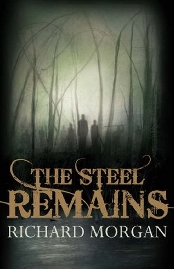
The Steel Remains – Richard Morgan

This book is all about the execution. Maybe you read other reviews, the common theme you find is that this novel was expected to be revolutionary or innovative, or at least overthrowing some cliches and conventions. Instead it is all about the execution. And the execution is excellent.

Richard Morgan was, to this year, known as a science fiction writer. I haven’t read any of his books yet, but know something about the reputation. He has a kind of “modern” writing style and approach. His stories aren’t of the fancy kind with space ships or alien races, they are tightly rooted to the modern world and sensibilities. Some politics, some personal character struggles. Maybe closer to cyberpunk if you want to have a vague idea (and the vague idea is all I have since, once again, I only read “of” Morgan, and not read his books myself). When you have this type of writer brought to fantasy you at least expect… something. An original note, a particular point of view, some spark of originality, of invention. Some nonconformism.

The book doesn’t exactly delude on that front. It CAN delude if you come with specific expectations, but if you let it drive you, then you’ll have a satisfying experience. In truth I don’t think Morgan here tried to be revolutionary, so I can’t even say he wasn’t successful because it’s more an expectation I see coming from the readers than the writer himself. To me this book reads a bit like a “classic”. Not a kick in the nuts of a genre. But an homage. A tribute.

There are aspects of it that clash together. While the plot and abstract themes tend to be within the genre (so it’s all already seen), it’s the execution to be brilliant and follow that “modern” thread and intent. Something like a “what if”. What if classic fantasy, with all its tropes and cliches, was invented today and written with today’s sensibility? That’s what this book is, and if it’s not about rabidly original ideas, it has a wonderful execution that makes it a wonderful book to read that I absolutely recommend.

“Fantasy”, as a genre, has its own role. Like a sociological, descriptive purpose. The way societies work, some visceral themes about humanity and its meaning. Steven Erikson said that he likes fantasy because it allows him to make a metaphor real, with all its strength. The symbolic power. So fantasy has a role today. This books just drags all of this closer. It’s “aware” of the distance there is between certain fantasy and the way we know and perceive the world today, and becomes an attempt to look at the same things that make fantasy “classic”, and see, describe them with the new set of eyes we have today. So, in a way, this book is actual. Both in the way some thematic aspects rise to the surface, and the way IT KNOWS it is entertainment, and goes for it without fears. It uses hands down all the tricks known for the effect, and absolutely succeeds. If you aren’t a purist.

I loved the book. It’s extremely readable and gripping, the kind that makes you sink in and turn the pages. You think that you are going to just finish the chapter, then read the first lines of the next and can’t put it down. It’s fun to read and really well written. The characters are good, the story mainly revolves around three protagonists, even if it always feels like the other two are a bit less prominent and less realized. Probably Morgan’s more obvious skill is also the one that could be seen as a weakness here: the dialogues. Personally it’s what made the book work for me. The dialogues are probably the less conventional part if you think of the genre, but if you accept the style it’s also where Morgan shines. The characters come trough, they become real. The way they talk to each other comes out of the page. You don’t feel like reading a book, but as if you are really there, listening to real men who really know each other. True friendship and complicity. On this particular aspect is as if you never feel that the characters are talking to the reader, but really talking on their own. Their feelings, their relationships, feel true.

On the other side the prose seems to go in the opposite direction, and probably as a choice. It’s “warmer”, there are some major infodumps here and there that feel even too heavy and clunky. The writer weighs in with comments and observations, becoming more a subject of the writing, more “talking-to-the-reader”. But it seems more a choice, as it offers the possibility to make the hidden parts more explicit and so “care” more for the characters and what they are. Morgan always seem to know exactly what effects he wants to obtain in the reader, and so uses all the tricks he knows to make it happen. Something like means to an end. Maybe, if I nitpick, too gimmicky, but it’s what I mean when I say he knows the book is also entertainment and is not ashamed of it. It’s not pretentious and comes out as better realized than most.

It also feels like he’s cooking. At various moments in the book I felt as if he was restraining. Like building things in potential. He shows you something, just the possibility of it, he hints at some crazy, unexpected twists, then steps back as if he didn’t want to rise the stakes just yet. He just shows, tells you he can do it, but not just yet. Before the book is over he already built various threads and possibilities that will flow on with the series, yet the story has its conclusion and feels realized on its own.

It’s so involving and well written that you can glide over some possible flaws. Possible because they are flaws as general rules, but I think here have an interesting role. For example the deus ex machina.

There are three HUGE ones in the book. The first is pointed by the characters themselves and laughed at, one is openly referenced, and the third comes last like a FREAKING epiphany and kept well hidden. Usually deus ex machina are proofs of a bad plot, here, similar to Erikson, the deus ex machina are subjects. In the sense that one main, but slightly shaded, theme in the book is the way all the story is piloted by some unknown hand. So not only there are deus ex machina in the book, but they are actually a part of the book, contained with it. And that probably will have a leading role for what comes next (since this is going to be a trilogy).

In particular the ending of the book is great. I actually found the “last battle” a bit underwhelming. I wouldn’t know what else to ask. It’s absolutely accomplished, but I kinda knew where it was going. I felt like I fell again in the trap. Because in the aftermath of the battle you have those ten pages left in the book, you read and expect to read just about the last salutations between the survivors. Yet, in the last FIVE pages, exactly when you don’t expect anything anymore from the book, it sends chills down your spine with a series of both implicit and explicit revelations that work a bit like Fight Club, making you revisit retrospectively the whole book under a new light. That was quite awesome and felt again as if the writer always had a very tight control on the book and the effect he wanted to have in the reader, even when you thought he missed.

It wasn’t a miss, it was a feint.

Morgan is like that. The pied piper of Hamelin. He seems to know exactly where your attention is, how you’re feeling, and so he is a successful manipulator. A trickster. He fixes your attention on one hand, while the other does the trick. As I said, sometimes this may feel gimmicky, but if you let yourself enjoy the book then it’s just a pleasure.

Warhammer performance woes

Edit: This is an example of a long thread, there are many of those on the forums, many players with the exact same problem (hard disk thrashing). If you look at the specs you can notice there isn’t a pattern (nVidia, ATI, doesn’t matter). So it’s really a generalized behavior that more or less affects everyone (depending on drive speed and video memory bandwidth). I had a slight improvement after I lifted the Windows page file from 2Gb to 3. Slight.

Another.


When I wrote my impressions on the game I was running the client on a brand new, near-top the line machine, and said the performance wasn’t that amazing, with some FPS slowdown in crowded RvR.

Today I mirrored the client to my old PC and I was surprised to see that the framerate is about the same (!) while the PC is four years old. I have about 30 fps, 20 in the quest hubs with lots of NPCs around. Obviously the more characters, the lower the framerate, but it’s playable.

What instead makes it *completely* unplayable is the constant hard disk thrashing. If I stand still I have smooth FPS, as soon I start to move in a direction the hard disk begins loading heavily.

Since the problem is weird (I expected lower fps, but not this caching problem) I started to research it a bit. I have 1.6GB free on this XP install, and the client uses between 1 and 1.2Gb of memory. My videocard has 512Mb. On standard settings the client only uses 256Mb, in all cases. This is also related to a bug (known by Mythic) as it seems that the client doesn’t detect the correct amount of video memory.

In any case they added that slider on the options. Moving the slider basically “overrides” the amount of video memory the client is going to use. From my experiments I noticed that at the higher setting it was using up to 400-430Mb of video memory.

The problem is that this does very little to reduce the heavy stuttering as you move around. That slider does NOT load an higher number of textures (so reducing the need of constant loading), it simply loads higher res ones (so you don’t see anymore blurry textures around you). So it doesn’t increase the number of textures, it increases their quality. This means that, no matter the slider position or other settings on that window, the hard disk thrashing is still there, almost unaffected.

On the new PC I also noticed this thrashing, but it was noticeable in heavy populated zones. And that PC had 4Gb of memory and a very fast HD too, so the problem was minimized. This just to say that I don’t think it’s hardware related, but a problem in the architecture of the client and the way the memory is managed. I remember when I was in Mourning’s beta (yeah, the vaporware game) and they didn’t have implemented yet some kind of threading system that would have prevented the loading from the HD to freeze the client. The result was that every time you changed direction the client would freeze for one second to load a different animation.

This thrashing problem feels somewhat similar. It’s like the loading from the hard disk thrashed the whole system and makes the game unplayable, while the *constant* need to free/load video memory makes it all worse.

As I said even at the highest setting the client doesn’t use all the video memory available. Usually you have that texture thrashing when the video memory is filled and so loading new textures requires to free some space. Warhammer client does this CONTINUOUSLY. Every step you move in a direction it starts swapping old textures out and loading new ones, even if you have free memory. Sometimes you don’t even need to move, turn south and it loads those textures, turn north and it is already swapping things out and back in. It’s insane.

This to say that I doubt you can find a “magic fix”. This seems entirely a client issue that only Mythic can investigate and figure out. On a very fast computer the problem is much reduced and so not ruining the gameplay, while on older machines it becomes really annoying. But it was there in both cases for me.

One thing I noticed is how much the client performance affects my “bias” to the game. When I was having these problems I logged out with a sour taste and the experience soured me even toward completely different elements. So, beware, sometimes the overall opinion and positiveness toward a game can be heavily influenced by a couple of things that do not work well. Like a chain effect.

Posted in: Uncategorized | Tagged:

Not good enough to hang out with the cool guys

Apparently running a blog for more than four years doesn’t get me even one humble spot in the blogger guild. They dismissed my application with a default message.

And they were complaining that Tobold got a free subscription with his blog! Me not even a guild invite from the same guys who were complaining!

Not that I’m too surprised. Not the first time I find unmotivated hostility toward me. “If you sit next to HRose you can’t hang out with us anymore!” Even nerds bully me.

Still, if you’re interested in joining myself and folks like Cuppy. Darren, and Shwayder, and aren’t known as HRose on the forums, here are the servers you should be interested in:

Thank you, fellow bloggers! I considered you friends!

;)

Posted in: Uncategorized | Tagged:

I told you so

This has become the most diffused internet meme associated with the HRose name. “I predicted it on my blog”. An expression that I never really used all that often but that I started using for laughs. There is really anything more irritating and arrogant than saying “I was right, I told you so”.

But sometimes it’s true. We can see at things superficially for shit and giggles, stay at the form. Or instead look at the merit of things.

Yesterday, during prime time, the Warhammer server where I created my character had a queue of 500 and a wait time up to an hour. Totally expected on my side, in fact I let the client sat there for the time and when I was finally in I had a very good time. With plenty of players participating in RvR and almost no lag. Ideal experience to me.

If it wasn’t for what I discovered later.

What I discovered later is that the “bloggers” guild I’d like to join hit the panic button, decided that Volkmar wasn’t anymore a playable server and moved to another one. I’m talking about this because it affects me. IT SUCKS to invest seven hours in a character and then be told to start over again. Especially because it’s the third time in less than a month and I’d rather punch my balls than going through the same content again. And AGAIN.

More so because I’m a kind of completist player and so I go and try to finish all public quests. Even if I’m restless there, doing the grind and hoping it’s quick. I don’t have ALTITIS. I like to grow my main character and stick to it. I like to invest the time so that I know it doesn’t get wasted because I switch a class or server. I look at the longer term and for me the choice of a well populated server, with lots of RvR activity comes before any other transitory problem. Because in six months the server may end up deserted, and I’m sure I’m going to regret having moved if it happens.

I’m not completely selfish. There are players in that guild that joined with the CE headstart and had characters up to rank 14, and still agreed to move. It sucks. And not just for me.

So lets look at it from a broader perspective. Server population balance and factional balance.

It’s years that I rant on this because I see it as a fundamental problem that severely affects *everyone*. It’s in the interest of everyone to find a radical solution. It’s not acceptable that every single time a mmorpg launches the servers are unstable, or the PvP sucks because of faction unbalance, or that guilds can’t organize well because they end up on a server with long queues, or that you can’t join friends because half go in a server and half in another. Or that you have to start over again a bunch of times because there is always some problem. One server is crammed, the other is empty.

I have a working solution for this and, while technically not simple, it is based on a simple concept: the player characters being an abstraction external and independent from the server.

First you create your character, then you move the character into a server. The server is no eternal bound, your character is.

A concrete example on the today’s situation:
My idea is once again to allow server travel regulated by strict rules. For example now Volkmar has long queues during prime time. In my idea there would be a portal/beacon in the game that lights up under specific cases. What kills these servers and creates all the problems is not that there are too many players and not enough servers. But that players tend to overpopulate certain servers while others are nearly empty.

This because it’s desirable to play, you know, with people. Especially for PvP. But it isn’t desirable if the server crashes and burns or if you have to sit in a queue for an hour when you have an hour and half to play in total.

But now think if that portal existed. My (hopefully it will be) guild now is asking me to toss away the seven hours I put in my character to create a brand new one in another server. It sucks. But if there was a way to use server travel and move my existing character to a lower populated one, I WOULD DO IT. And with me a MAJORITY of players who prefer moving than sitting in a queue.

If you allow players to police themselves they will. Because it’s in their interest to keep factions balanced and the servers queues-free. If they DO NOT do it, it’s because, like me, they don’t want to toss the investment they made in a character. And then move ONCE AGAIN because even the second-choice server is gone wrong and it becomes overcrowded or deserted.

But if you allow players to move, following some capacity rules, then they spread out if the server is full, and they converge again if it happens that the population decreases.

It’s the rule of communicating vessels they teach in school. Every vessel is a server, they communicate with each other under set rules:

Most persons would call this a system. If we add water to any vessel, there is a movement of water (a flow of matter) until the water has levelled out. There is also a flow of potential energy until each milligram of water on the surface has the same potential energy as any milligram on the surface of another tube. An increase or decrease of water in any tube affects the water in all other tubes according to well-known laws of physics.

This happens BOTH for population balance AND faction balance. Spread out among all servers.

Yes, having rules means that the portal/beacon is closed sometimes and so you can’t always move where you want. But this is preferable to not being able to move AT ALL.

Technically it isn’t simple, but I think this is a problem so significant to deserve the work it requires. Obviously it can’t be easily done now, but it was (and it’s years I’m repeating this) doable if this was set as an original goal.

We saw it’s possible. My idea sits between WoW’s “manual” transfers and Guild Wars immediate ones.

Warhammer would have been a MUCH better and more successful game if it was developed with that goal. Because players activity and factional balance are indispensable to have fun in this game.

Posted in: Uncategorized | Tagged:

David Foster Wallace, why he died

I’m pissed when people die.

Especially, I’m pissed when people die and had some true talent that goes wasted. You’ve got responsibilities in that case. Then he also died the day of my thirtieth birthday, and he is my favorite writer. His words are like a drug for the brain, they open it up, thoughts processes accelerate and meaning comes often through epiphanies. He is the only writer who (successfully) tries to write the way the brain thinks. And it sucks you in.

Now everyone in the world who recognizes his name is wondering, “why did he do that?”

I did too. In the attempt of trying to answer the question, I went and read the 50-odd pages story titled “Good Old Neon”, published in the “Oblivion” collection. I’d toss some quotes around but I read it in Italian and so it wouldn’t made a lot of sense here.

It’s a story of a suicide, written from the point of view of the suicide and it reads as a confession of the failure of his life (“my whole life I’ve been a fraud”) and the reasons that lead to the fact, one instant after the fact, or even during it. What passes through the mind in that exact moment. In the whole immanence of it. Only to reveal in the end, classic Wallace shocking way, that he, Wallace himself, is imagining the whole thing. Wondering why the man, one of his high school brilliant classmates, killed himself. What passed through his mind, imagining a possible story.

It comes out as a prison of the mind. Something that lures you in and then drags you into a bottomless, dark pit, and it’s scary. Because of meaninglessness, of redundancy. And yeah, also fascinating.

This dilemma, in which every layer of self-knowledge is nested inside yet another layer that scrutinizes it mercilessly for inauthenticity, is a Wallace trademark. When, not surprisingly, these contortions drive the narrator of “Good Old Neon” to suicide, he is revealed to be a childhood acquaintance of “David Wallace,” and the story itself an effort to imagine his inner life on the part of Wallace, who has recently “emerged from years of literally indescribable war against himself.” This, of course, suggests that all of “Good Old Neon” is merely Wallace’s solipsistic effort to attribute his own miseries to a man who might have killed himself for entirely other reasons.

I really wish I could quote because there’s a part that I think is the real core of it all. The way the actual central thought is “cliche”, and the way Wallace hated it because of it: the impossibility to communicate.

Everything Wallace-an is trapped into paradoxes. What kills Wallace is what he was talented doing. Writing, communicating. Yet, the man who could do it like no other, exudes frustration. Read the last line from the link above. “if you really think about it, how clumsy and laborious it seems to be to convey even the smallest thing.”

The way he writes, the way he thinks, can lead where he wants. He IS god in the way he can say everything and nothing. A mind so powerful that defies every kind of formal limit, and yet is trapped within strict formal limits. Everything is hyper-logical, but to the point that lacks any stability. There is no top and no bottom, no sky and ground.

Frustration and “failure”.

How irritating and pretentious can be reading things out of context. Just to prove a false theory. So lets do it again.

2005 Kenyon Commencement Address – May 21, 2005

Probably the most dangerous thing about an academic education — least in my own case — is that it enables my tendency to over-intellectualize stuff, to get lost in abstract argument inside my head, instead of simply paying attention to what is going on right in front of me, paying attention to what is going on inside me.

As I’m sure you guys know by now, it is extremely difficult to stay alert and attentive, instead of getting hypnotized by the constant monologue inside your own head (may be happening right now). Twenty years after my own graduation, I have come gradually to understand that the liberal arts cliché about teaching you how to think is actually shorthand for a much deeper, more serious idea: learning how to think really means learning how to exercise some control over how and what you think. It means being conscious and aware enough to choose what you pay attention to and to choose how you construct meaning from experience. Because if you cannot exercise this kind of choice in adult life, you will be totally hosed. Think of the old cliche about quote the mind being an excellent servant but a terrible master.

This, like many clichés, so lame and unexciting on the surface, actually expresses a great and terrible truth. It is not the least bit coincidental that adults who commit suicide with firearms almost always shoot themselves in: the head. They shoot the terrible master. And the truth is that most of these suicides are actually dead long before they pull the trigger.

Worship your intellect, being seen as smart, you will end up feeling stupid, a fraud, always on the verge of being found out. But the insidious thing about these forms of worship is not that they’re evil or sinful, it’s that they’re unconscious. They are default settings.

The writer: making the reader feel as if every character carries some pieces of himself. “My name is Legion, for we are many.”

Every man is alone. This is another cliche commented in “Good Old Neon”. But it can kinda work like a magnet. You can “align”, and somewhat make communication pass. You never really give something yours to someone else. It can’t happen for we are finished, there’s a dermatological barrier that cannot be passed. But in some ways you can be a mirror. You can imitate in your mind some state of mind that you recognize in someone else. So, hypocritically, you can pretend to know what passed through someone else’s mind. Know how he felt.

It’s a lie, but it a lie with the best approximation of Truth it’s possible to aspire to.

It’s sucks that Wallace died and I’m pissed. The most irritating, pretentious, hypocritical thing I could do to him is pretending to know what passed through his mind.

So I did it. I wrote what passed through his mind.

Posted in: Uncategorized | Tagged: ,