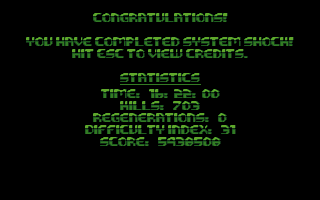
I finally completed System Shock. I’m so relieved, it was like a burden.
(this is long but you can go read the last paragraph, where I explain the big deal)
(the game is available here. I’ve played it just fine on W7 64bits.)
I bough this game back then when it was released, and since it was released in 1994, that’s almost 20 years to finally kill the Shodan bitch. That was also my 1st PC 486 2DX 66 (well, my first computer was a Commodore 64, but I went right form that to a PC), bleeding edge, and my very first game was Ultima Underword (that I also never completed, but was close, down to level 6-7, the game taught me English). Actually it’s more like 19 years, since I remember I bought the CD-ROM version. That was back when the CD-ROM was a very new technology and no game really used it. I think I went to buy something else, probably Doom 2 (I got that one later and things were never the same), but I only found System Shock. The problem was that I already played all of the 1st level, which was included in the demo, so I had already seen a good chunk of the game and I didn’t even like it so much. But Doom 2 wasn’t there, so I bought System Shock. It was a good choice because the CD version of the game had lots of good things added. Full voices for the logs and e-mails, more games from the cyberspace, and I think more variety in the textures because I remember that between the floppy demo and the full version there was more “damage” shown on the panels of the level. The only problem was that it took me quite a bit of work with autoexec.bat and system.sys to be able to make everything work along with the sound. Oh, and I also managed to “hack” the game to see the ending, by mixing some demo files with the full game, so by completing the level 1 demo it played the final CG scene instead. I don’t think I’ve made past level 2 at the time. In these 19 years I restarted the game many times, but I never managed to complete it. I remember only one good attempt, many years ago, I even wrote down my own log with all the mails ordered by time, and I remember I reached the flight deck (level 5), but no further than that. System Shock 2 instead never appealed me, it looked like crap and it seemed just like a crappy remake of the ambitious first with lots of features cut.
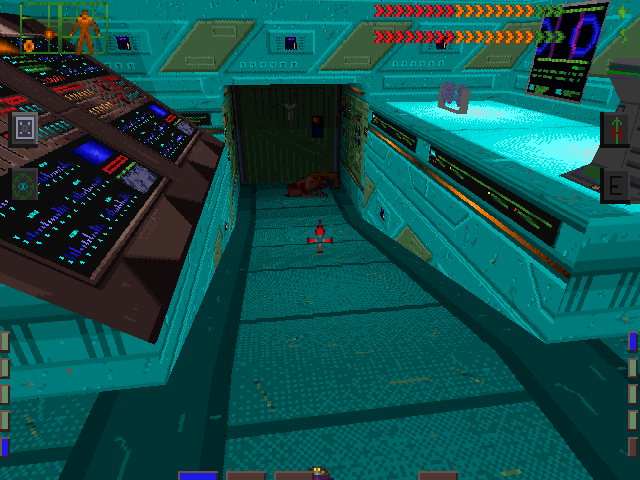
I’m so glad I finally finished it because there’s a sort of contradiction I feel. From one side it’s really one of the greatest games ever made, still absolutely playable and with an excellent design. It’s still excellent today. But on the other hand it’s one of the playing experiences I hated the most. I’m GLAD it’s over. Playing this game gives me a sense of dread and of almost obsession. It’s so good that I find basically impossible to play feeling detached, and even if the game is actually really easy. When I go to sleep and close my eyes I immediately see the station, the cameras, I hear the blips and beeps. You are completely alone in this space station. The whole place is crammed and claustrophobic, you only see the pixely space from small windows, very rarely. You crawl through vents all the times, while hearing robot noises, doors opening and closing, and jammed elevators. The robots that try to kill you can respawn in certain locations, so you can never totally clear a level and feel safe. Even if most of the time you play basically in god-mode (every level has a lever that when pulled will bring you back to life when killed) and of the 703 monsters I killed the great majority of them was done with them stuck in a place while I shoot leaning from a wall. Zero risk.
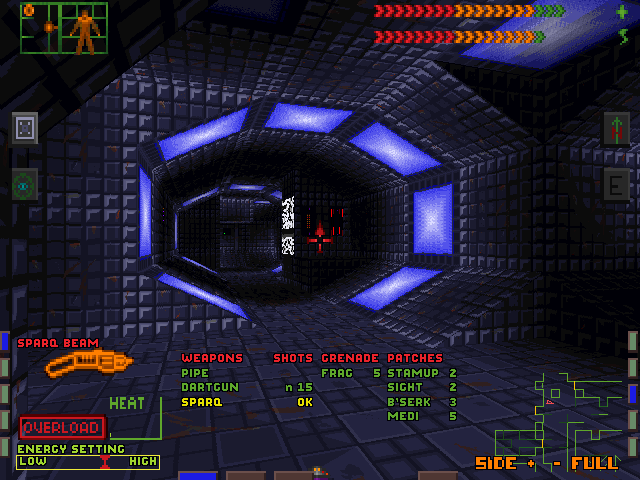
In fact one of the peculiar things of this game is that it has a custom like difficulty. From 0 to 3 you can set individually the difficulty of puzzles, the combat, the “story”, and cyberspace. I set everything to max minus the “story”, because at max difficulty it gives you seven hours to finish the game and it plays like a speedrun. What they used to say is that if you set combat to 3 and everything else to 0 you’d basically get a game like Doom 2, but that’s far from true and the reason why either you play at max difficulty or you just have a crippled game. The engine here is the problem. Doom 2 is based on performance and execution. Big levels that turn into mean arenas. System Shock instead is “true” 3D, but it feels like a crammed Minecraft, in some ways. It uses for the most part these cubes as basic building blocks and has plenty of irregular rooms with small niches and ledges and slopes, hidden places and whatnot. You need to examine every inch. It’s full of buttons, screens and devices and stuff to get, like munitions, access cards, mails and so on. So where in Doom you’d enter a room running in (or sidestepping), kill all the monsters, and be done with it, in System Shock it’s a step by step approach. Every inch is slowly conquered. It’s as if you have to physically touch every square inch. As a shooter it would suck, the levels are too complex and clunky designed for the monsters to navigate them competently. They are deadly, but they barely move. This is a game that went overboard with the virtual reality kind of goal. Your head can move up and down through three discrete levels, then with a slider you move the eyes, from all the way up to all the way down. Posture controls are as crazy: you can stand, crouch or lay down, and in all three cases you can lean left or right through a couple of degrees. You can also run and jump, and the game uses a sort of physical simulation, so when you shoot you are pushed back, for example, you cannot suddenly stop if you have already some acceleration, and so on. But overall the navigation is clunky and fiddly, so combat doesn’t rely AT ALL on dynamism. It relies on finding the right angle so you can shoot while the monsters can’t.
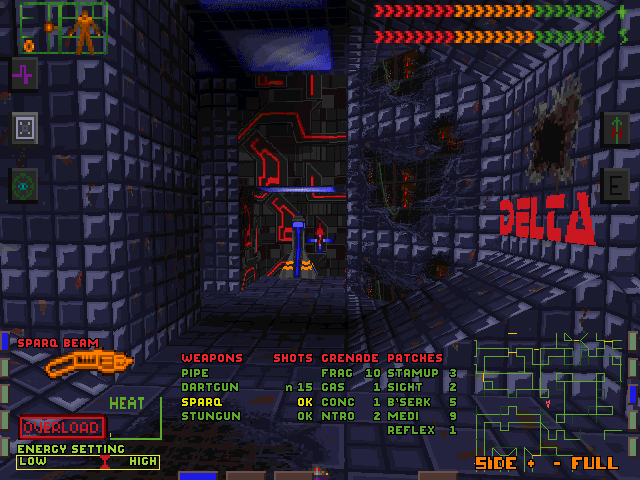
Thankfully, now one can play the game in some ways much better than how it was possible at the time. True high resolution doesn’t work, but 640×480 works well even in full-screen mode (and I’ve still got a CRT monitor, since it runs on Dosbox I guess you can use a scaler too, if you want). At the time even on my decent PC I could only really play at 320×200 with the viewscreen in a window. That added a whole new level of burden on top of the claustrophobic feel. Plus now there are patches that redefine keys and add mouselook, so controls are infinitely more responsive. Originally playing this game could feel exactly like playing Octodad nowadays, or control an actual human being through a gamepad.
Of course this isn’t Doom 2, but a true RPG. That’s what the gameplay is like. Right at the start you are in a small room. The engine shows you it can do slopes and animated walls, and if you click on those walls you get a label that says what they are, you can even try to “use” them. On the right you have laying around some tiny health patches to pick up, something you’ll do often through the whole game, inspecting dead bodies, or looking behind 3D objects to find if something is there. There are two doors, both locked, but one has a switch near it. You press the switch and one door opens. Within the small niche you find more tiny stuff to loot, and e-mail reader, a pipe to use as a melee weapon. Using the e-mail reader you get for the first time an idea of the context, and with the access card you find there you can open the other door, right near a device that if clicked restores your health. Again and again. Then some innocuous robots come to you and you destroy them by swinging the pipe. Since you have a mouse-like cursor, you can aim at stuff, like shooting at some robot that is in the corner of your view, instead of shooting only in the center. The door to get out of this room is locked, and this teaches you to use number pads, and retrieve access codes from the audio logs you get in the e-mail reader.
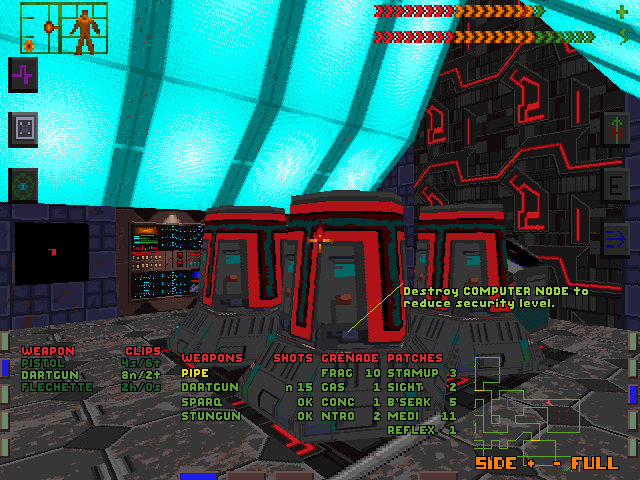
This is the design. Fiddly controls for your persona. Inch by inch explorable space, where every steps requires you to look at objects to pickup, switches, monitors, doors of various shapes, force walls, force bridges, sections of levels that move to reveal more robots (monster closets). And also hidden spaces revealed by clicking on fake walls (luckily you figure these out by looking at thee map or keeping help enabled that flags interactive stuff around you). Then there are puzzles to solve to open some locked doors or elevators or whatever. I think they come in two flavors, one has wires of various colors, like blue, yellow, red and magenta, and you have some 4-5 connections on either side, with a green bar on top that shows you how close you are to the solution. It means you move the wires between the connections, trying combinations while looking at the bar, if it increases its level it means you made a right move, so you proceed with trial and error till you finally get the solution. The other type instead has a circuit with a pattern and “X” or “+” signs. You can click on each, turning the “X” into “+” and back again. It would be really easy, but the tricky part is that every time you click on one it has an implicit connection with the others, so even the nearby slots change. So to solve these you have to figure out how they are connected, and even here through trial and error you’ll finally find the right combination.
“Health” comes in two flavors. Actual health and energy, both fundamental. Health is straightforward and can be restored through medikit patches you find scattered around, 1st aid kits (that are more rare and use a physical limited slot, instead of the normal patches that instead you can accumulate without limits), or a special device that you actually only have on a few levels. It’s there at the start of level 1, but on level 2 it is broken, and some levels have none. Energy instead can be restored infinitely through some charge stations scattered around a level. Sometimes not immediately available though. Energy is used for energy weapons, that you can rely on to spare munitions for when you don’t have a charge station nearby. But energy is also used for the “hardware devices”, like the shield, the lantern (to explore very dark places), jump jets and even the radiation suit when you explore parts of level with radiation.
Before you conquer a level, Shodan owns it. This means that some doors, switches or other things may be locked, including the charge stations. You lower Shodan security by destroying cameras and blowing up CPU nodes. When the security is 0 you can go (almost) everywhere, unless the lock was cyberspace-dependent. This creates both a non-linear experience (since you can explore the convoluted levels as you want), along with a degree of control, since the designers can lock away an area until most of the level is cleared. This on top of another kind of non-linear progression: by using the elevators you can go back and forth between the levels, and you actually have to, since the story locks away parts of levels to explore much later on. This means that most of the experience feels like being trapped in some middle spot. Threatening things are ahead of you, but also behind. You never feel safe even when you are. When you save the game you always feel a sense of dread as if you saved at a point of no return, trapped within two ends, a dead-end of sort, even if the risk is (almost) never actually there. It’s the game that makes you feels so. Always alone, trapped in this station, without a clear idea of where you are supposed to go, or what to do. Without knowing if you actually can do it. You don’t know if you will will manage to win the game or miserably fail. The game seems to close on you, all the time. You don’t know if the weapons, munitions, batteries or health patches are enough. You are always trapped in this threatening flux. Until the very end.
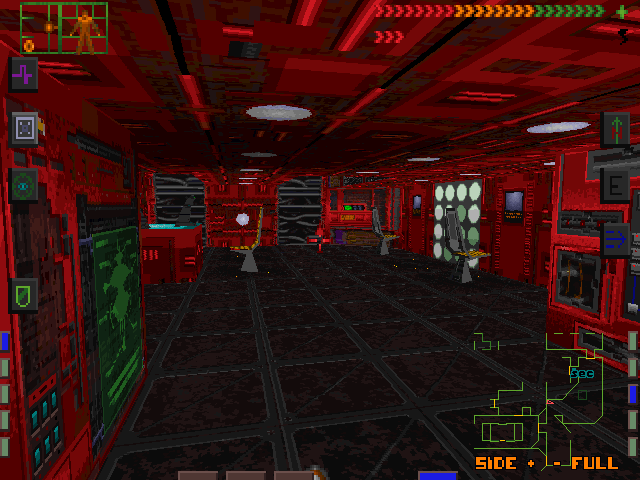
On the other blog I made a parallel between the flow of System Shock and Final Fantasy 13, but that flow is really clever. The audio logs you find scattered have a date, but you stumble on them in a non-linear fashion. Their dates are jumping between the last nine months, so you get to puzzle together how the things escalate up to the point where the game starts, and compose pieces of stories into one. Some logs arrive at key points through the story to guide the player onward. Initially you just gather weapons, explore the level, destroy the cameras, until you find the CPU nodes and fight back a bunch of robots Shodan sends your way. Then you are sent down to level 2. This level is more spooky and more convoluted. You don’t get right away access to charge stations and health restore things, and some zones are locked away, so the situation is more muddled and confusing.
The first goal is explained through logs: you have to power up the station shields and then fire the lasers, so that the lasers hit the shield and are destroyed. This requires a few level jumps. Cyberspace on level 2 unlocks a section of the level with the CPU nodes and elevator to the Reactor level. But before going there you have to retrieve an isotope still on level 2, in a radioactive room, then go to the reactor level. This level is not very easy, a few room traps and some quirky and labyrinthine design, but it has a charge station and health restoring thing easily accessible. Then you have to input the laser override code, that can be obtained from level 2 cyberspace, I think, and the isotope needs to be placed in its place, and a switch pressed. So you have to find the room where you can type the laser override code, and then the room where the isotope goes, with robots around every corner and some respawns. This leaves an area of the reactor level unexplored because of high radiation. But then back to level 2, and a room that is now full of robots. If you press the laser button before going to reactor level and bring up the shields, the lasers are fired anyway, and Earth is destroyed. Bad end. But if instead the shields are up, the lasers blow up. Good job.
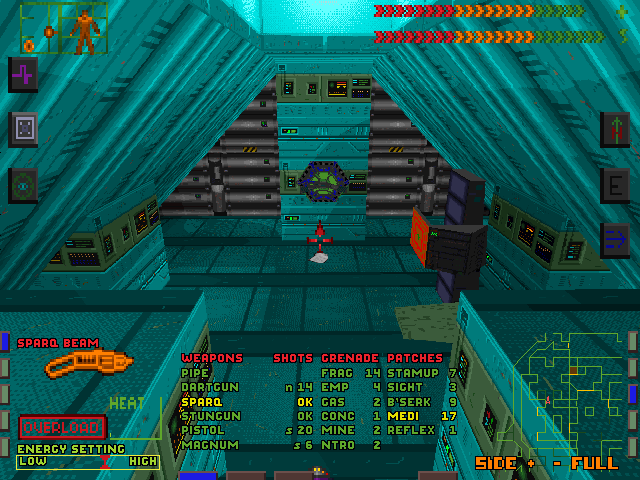
But on the way back to the elevator you get a new mail that says Shodan has a new plan, about unloading on Earth a mutation virus. This is the longer mission in the game. You go down to level 3, that has a number of highly resistant and almost invisible (and respawning) amoebas as monsters. The level is small and very dark. Big parts of it are inaccessible. There are a few devices and objects that are left unexplained. Plus, it gets even more non-linear. From level 3 you can also go to level 4, 5, 6, through two different elevators, so if you want to go 6 right away you can. In fact I think I did level 5 and then level 4. Level 5 is the flight deck. It has some rather big rooms and escape pods that are locked away. It’s not a hard level but the layout isn’t that simple to figure out. Level 4 is also fairly simple, but it has some tricky traps, like having a room only accessible by jumping through a kind of ramp with the movement boost activated, but when you finally land on the room two side doors open and robots attack you. There are also other tricky switches to reach and figure out how to go through certain doors. One for example is first locked by Shodan security, and then by an access code. You get the access code by finding around and listening to two audio logs, one giving you the first number of the code, the other the last. So you are left with trial and error to figure out what’s the middle number. Exploring level 4 gives you an suit that protects from radiation.
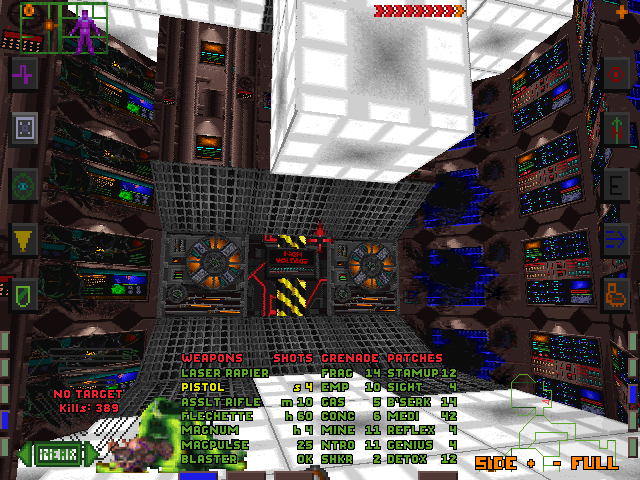
With the suit you go to level 6, that is actually rather big and with lots of mean robots. More dark rooms, more traps. A tricky session of cyberspace. From level 6 you get access to four sub levels, the Groves, Beta, Alfa, Gamma and Delta. One of them is already gone, so they are actually three. These are smaller levels filled with (respawning) mutants. It’s not all that simple to figure out what to do here. The story says that Shodan is experimenting his mutation virus in one of the Groves, so you must eject it from the space station. But it’s not so easy either because the switches are overridden. You have to go in each Grove, find the switch, flip it, and then finally pull the master switch back on level 6. On top of this, one of these Groves is filled of radiation. Even with the suit the radiation still gets to you, so you have to explore to find the switch, fight an insane amounts of (quickly respawning) mutants, and do it as quickly as possible to spare health as the radiation gets to you. I hate this part.
But even when all this is done you still have quite a way to go. The master switch won’t work (where there’s also Edward Diego to fight, who’s like a secondary big baddie in the game, and whose room has a teleportation pad that if you enter you are permanently stuck. It’s supposed to be a shortcut to the center of the level, but I think I must have skipped it in cyberspace, but I don’t want to go there again) and it will tell you have to repair a relay. I actually read a walkthrough, here and there, not because I really needed it, but because it helped feeling I could do it and verify I was doing everything correctly, but I’m guessing this part could be the most tricky to figure out without any guide. You have to go back to level 3, now the sections of the level are open. There’s a room that has always been accessible that now delivers a new log, the log says a certain relay needs to be repaired. To do so you have to go to another room, input the number of the relay reported on the log, and the thing then says you have to insert a demodulator on the same relay, that can be found on the same level. So the tricky part is not only to realize you are supposed to go back to level 3, but also use these weird objects and devices you found long before in the game without figuring out how to use them, or even if they had a real purpose. Level 4 also had plastic explosive that is only used later in the game, so this is a rather complex structure of fiddly bits and back and forth. Once you explore the rest of level 3, find the relay and replace the interface, you can then go back to level 6 and flip the switch… and it’s still not done.
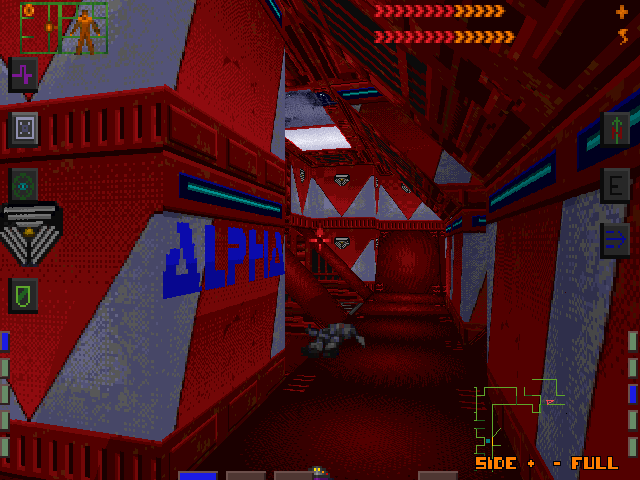
You go back all the way to the Grove you need to eject, where there’s another switch, and there Shodan releases more mutants at you. Finally you flip this other switch and the Grove is ejected. After doing this the elevator between level 6-7 works again. You get more messages saying Shodan’s new plan is downloading itself on Earth through some antennas. So you have to blow up the four antennas on level 7. That’s why you need the explosives, and to get them you have to go back to level 4. Fortunately the respawned mutants and robots on that level are an easy thing, mostly out of the way. Aaand you are on level 7. Another tricky level with some doors blocked or locked, plus other traps and triggers in the vein of monster closets. Three of the antennas can be blown up relatively easily. But one of them is another trap. You install the explosive and Shodan traps you in the room, so you blow up with the antenna. To escape you have to go to the door/force field and solve a puzzle. It’s actually not a puzzle, you just have to press a bunch of “x”, but you can’t do this fast enough. So you either cheat your way out by flipping the cyborg conversion that makes you respawn there every time you die, or you use the “reflex” patch that slows down time. So you have time enough to solve the puzzle and disable the door lock.
Huff, are we done yet? Nope. You can get to level 8, but the room there is locked. Before you can access the level you have to blow up the reactor. To do this you have to go ALL THE WAY UP to the reactor level. I don’t know why but this pained me so much. Not because it’s boring backtracking, but because it feels like you never get anything behind you, never get out. You escape from the nest of bees, and now the game asks you to jump BACK into all that. This game is all about this tension, trying to finally escape, find the safe spot. And then the game wants and FORCES you to leave the safe spot and jump again into the fray. Not only but you are supposed to go through ALL levels, because in every CPU node room there’s a monitor with a number, and you need that number on each level to input the code on the reactor level. This is actually fairly simplistic and quick, but for me it’s too much emotional stress. You can’t get a code from a walkthrough since this code is different for every game, but fortunately you only need the code, so I mustered the courage by just loading a savegame and quickly go retrieving the code, without the constant (and self-imposed since not actually needed) hassle of sparing munitions and health patches. With the code and radiation suit you load the game where you left it previously, and go all the way to reactor level, and into the zone left behind during the first go because of radioactivity. Lots of robots but the procedure isn’t complex.
More complex is instead the return since Shodan fills the level(s) with mutants and robots. Plus from this point till near the end of the game there’s a frequent screen shake and rumble because the station is supposed to blow up soon. The goal now is to go down to level 5 where the escape pods are and use them. Level 3 was filled with robots and since I knew I was done with those levels I simply put up the shield and ran right to the next elevator. Then level 5 is quiet, but near the escape pods there are a bunch of new robots and there’s Edward Diego to fight. The first time I actually bypassed him by just pulling him back in the room, and then run right to the escape pods, but then I decided to do it properly. I mined the area where he was supposed to come out, used a reflex patch to slow time, and then finished him with the lightsaber. The escape pods are obviously blocked by Shodan, so you are told instead to go down to level 8 and find a different way out of this mess. This level has a very huge central room and weird layout, but it is not too hard. There’s a section of cyberspace almost impossible to find, and it’s necessary to open a part of the level, but that zone is completely useless, so it can be skipped. Once the level is explored fully you can access a central section through a force bridge, that has some radiation. Past this point doors lock behind you, so it’s a point of no return. As you reach the elevator to level 9 Edward Diego appears again for the last time, and when you finally kill him more mutants arrive too. On the body of Diego you find the access key to use the elevator, and so reach level 9.
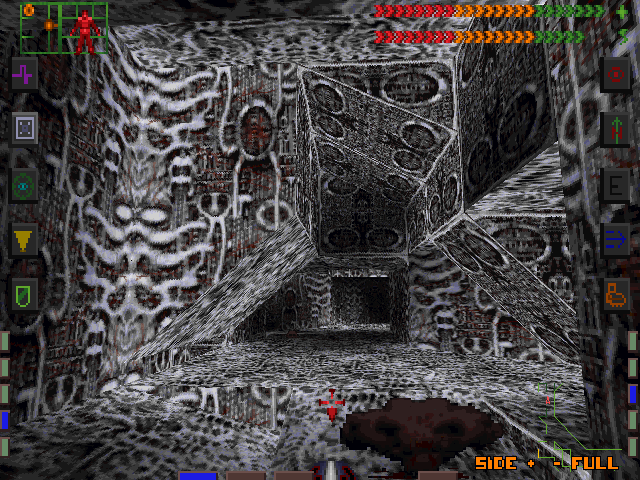
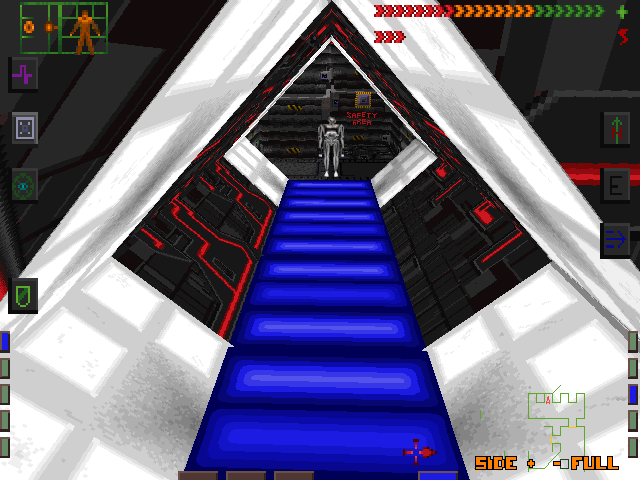
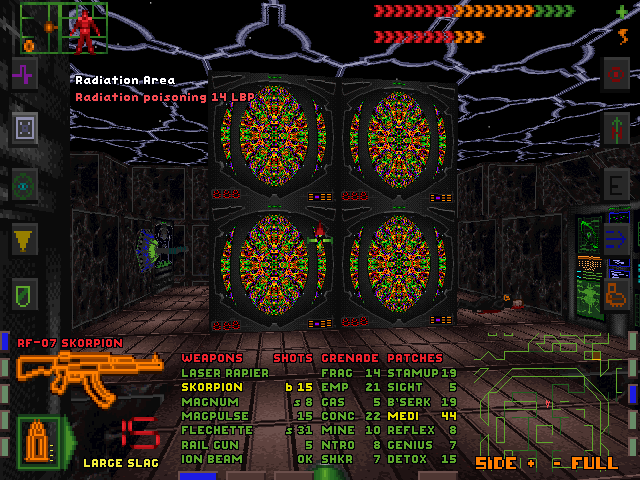
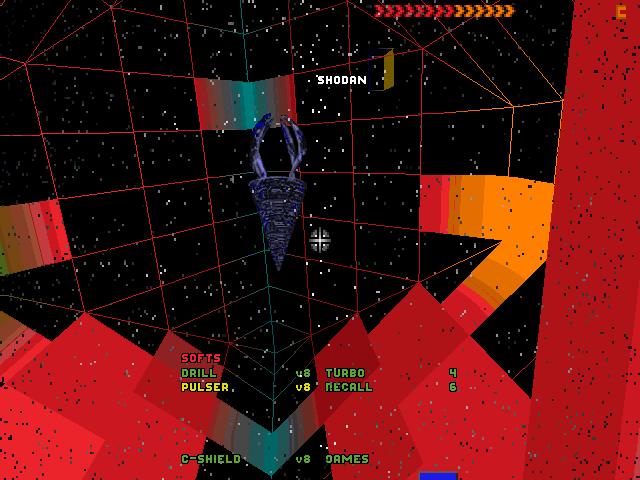
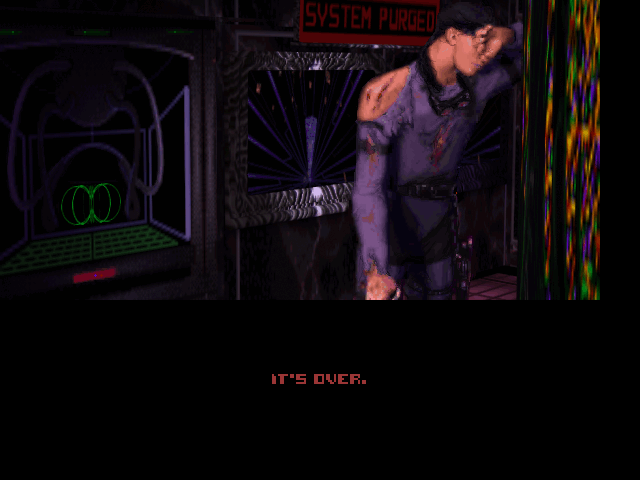
As you are in level 9 you receive a video of the level detaching itself from the main station, and then another with the main station blowing up. Level 9 is Shodan’s headquarter. So now you can’t go back anymore. You just have this last level. Actually it’s probably the easiest. It packs you with munitions of every kind, health packs everywhere, recharge stations. The only tricky part is there’s no cyborg conversion, so if you are killed you are killed. But as I said you are filled with stuff. There’s a very tricky chunk of level where you go through tiny tunnels filled with respawning bombs. You have to find a circuit and solve the puzzle there. It’s a rather mean area since: there’s some radiation, so your health and energy go slowly down (energy because of the suits that protects you, health because the suit doesn’t protect you fully), plus bombs continue spawning and come to you. So you have to find the puzzle and solve it as quickly as possible while also be ready to shoot the bombs when they come. Shooting things WHILE figuring out the puzzle. I used the shield too, but the shield uses power, and power is needed for the radiation suit. Or I could have used a “Logic Probe”, a device that solves puzzles automatically. Instead I simply first found the solution, wrote it down, then reloaded and tried to do the whole thing in the best way possible (lots of the game for me was doing things, then loading a savegame and do them better). After two other, more easily accessible puzzles are solved, you get access to a room, where you need to install a chipset (easily found elsewhere). That’s where I got momentarily stuck. I couldn’t find any cyber node to connect and go fight Shodan. It took a while to figure out that now there was a small passage to a big central section. This room is filled with mean cyborgs AND radiation. But at this point of the game I was so packed with stuff that I could have gone through another two games from beginning to end (you can see some numbers in the image here below). The cyborgs are easily destroyed, so what’s left is only cyberspace and Shodan. Even this last part is fairly trivial, so thankfully if you made so far the devs decided you deserve to finish the game instead of frustrating you further. The cyberspace here is fairly complex and can take a while to solve, but you could simply go right up to Shodan. All you need is keep shooting, really simple. While you fight with Shodan the screen fills up, navigation in cyberspace is also extremely hard, so this could have turned into a NIGHTMARE, but instead Shodan’s image stays right in the center of the screen, so you are only required to shoot. The end is abrupt. The second before you are shooting, the second after you are seeing the CG ending.
But the point of all this is that it’s a rather awful experience. Just too tense and stressful. You never feel “safe”, with all the back and forth and constantly moving goals. It’s also the most direct experience in a game. Nothing is “faked”. All the fiddly, interactive bits make for a game that is extremely hard to predict. When you play a game like Doom you know what can happen. You know the tools that a designer has and the ways monsters and level design can work. Outside of those possibilities nothing exists. In System Shock instead everything is modeled. There are so many devices and variations, you never know what to expect. Every room a potential death trap. The fact that it’s so non-linear, that you can go back and forth, that you are always in flux within this environment, all this means you never know EXACTLY where you stand. You can’t “clear” a level. You can’t be absolutely certain you haven’t missed something important along the way, missed some important step of the mission. You never know if you have stored in your inventory enough stuff to finish the game or if you wasted too much. You don’t know if you left behind some important object that you risk not finding again. It’s a game of constant anxiety, and full simulation. You are alone with this sense of claustrophobia, walls closing on you, trapped with this mad and evil AI, respawing robots and (apparently) dwindling resources. You want to escape as fast as possible, but the game always push you back deep into the ugly places you just came out from. You came out from hell, but you realize you have to go through once more. It’s so mean, so unsettling. Now I’ve finished the game, but thinking about loading even a saved game fills me with irrational dread. The fact I completed the game didn’t purge it of horror. This is an achievement of the game I can’t explain.
I’m done with this. And it’s one of the greatest games ever made, and most unique experience. It can be clunky, but its design has so many different aspects they they build together one of the most, if not the most, complex games ever made.