Anomander Rake

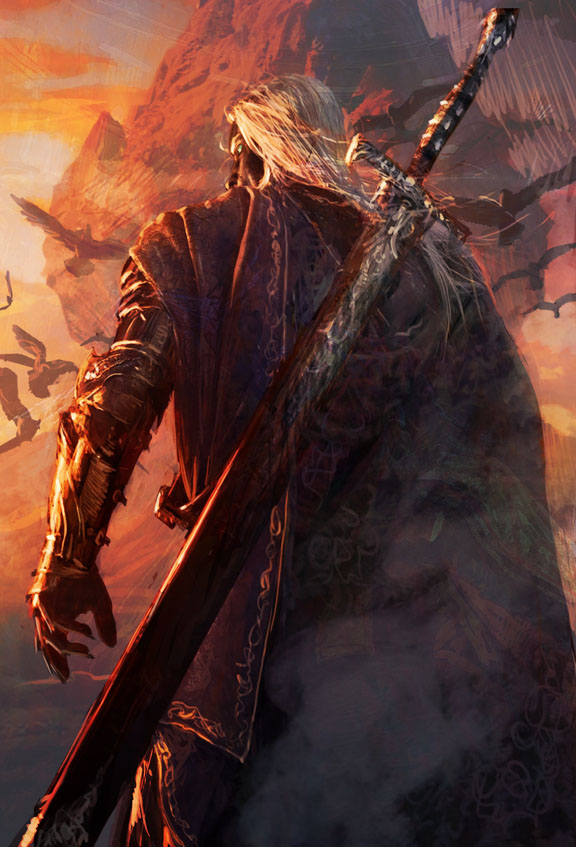
After all the complaints for the first time Steven Erikson gets good art for a cover of his book:

Sadly it is only for the super collector edition of Gardens of the Moon for “just” $125. One wonders why good artists can’t be used for those editions that are supposed to sell a lot more and face larger competition.

The image shows Anomander Rake, in the background there are his Great Ravens and that flying mountain is Moon’s Spawn. Anomander Rake is actually supposed to sit on top of it.

The sword he shows there is supposed to be even bigger, and misses particle effects:

A two-handed sword was strapped to Rake’s broad back, its silver dragonskull pommel and archaic crosshilt jutting from a wooden scabbard fully six and a half feet long. From the weapon bled power, staining the air like black ink in a pool of water.

Fantastic Four #554

I’ll just say this, the story is already seen, but three pages and the sense of wonder that the series had lost for years is back.

Mark Millar is one of the best writers comics ever had, along with Morrison, Moore and Gaiman. Bendis is good as well, but these other writers have the talent of being able to write about EVERYTHING.

Posted in: Uncategorized | Tagged:

Blizzard: our game design is one year and half behind bloggers

Cosmik on WoW’s Honor Points, about one year ago:

The first curious thing is that you don’t get your honor points immediately. Instead you get an “estimate”, which tends to be far too low, and then get your real honor points the next day. Imagine experience points worked that way! “We estimate you have gained experience for two more levels today, but come back tomorrow for the exact value and the actual reward.” I wondered, if honor points are given out on an absolute scale now, why would it take one day to calculate the honor points? It’s better than the previous once-a-week calculation, but still not very logical.

My reply, one year ago:

Yeah. That question is gold. That’s exactly what I was wondering a week ago on Q23, we are on the same line. No one could really understand this and the best guess is that it’s all STILL because of those FUCKING diminished returns. My god, sometimes Blizzard is so absolutely stupid that isn’t believable.

This can really make sense only in Kalgan’s mind, because for the rest of the world this is blatantly flawed. And at this point isn’t anymore just flawed, but also completely unexcused.

NO ONE STILL HAS A CLUE ABOUT HOW THIS SYSTEM WORKS.

THAT “best guess” was the friggin cause of all the fucking mess the Honor System was.

Proof coming from TODAY‘s patch notes (currently 2.4).

* Diminishing returns on honor for kills is being eliminated.

HENCE:

* Honor will now be instantly calculated, and available for player use.

My point still stands:

I’ll tell you what you should do: you should demote that designer who is responsible for all this and replace him with someone who has at least half a clue. I do not want Kalgan fired. But I DO want him REPLACED. At least. Take his own responsibility for all this shit.

But, even more important, why the fuck PvP has to always receive this treatment? I mean in general, why the fuck PvP has always to be the afterthought? Why it always has to have the worst, careless design?

If your average bloggers figure out game design better than a team of senior designers who are paid to do that job professionally and have better insight about how the game works, then something is wrong.

Admit your failure on this system, and face your responsibilities.

Posted in: Uncategorized | Tagged:

Mark Jacobs says: mentoring systems punish new players

He replied to a point I also suggested for Warhammer. I can’t stay silent when he says such absurdities.

The proposal is about something like a mentoring system where players can access lower tiers (levels) of the game. So “delevelling” their characters to play along with friends who aren’t in the exact same tier. My proposal was more complex but that’s the main point.

His reply:

That’s one I’ve always had mixed feelings about as a designer. The pros for doing that are obvious but the cons are what concern me. If players can easily move down in levels to help other players, I worry that new players will have a harder time getting in groups. After all, if you could choose an experienced player playing at a lower level or a new player playing at the same level, you’ll go with the experienced player. His/her knowledge of the game will always be an advantage to you and to h/h. So when the new player is LFGing or wants to get into the fun in a situation where the number of participants is limited, h/h might have a more difficult time of it in this system. Like I said, I have mixed feelings on it.

One wonders. Because the main reason for that system to exist is to reduce the gap between veteran players and noobs, while Jacobs thinks it has the exact opposite effect. This can’t be “opinion”, either one or the other state must be wrong.

His thesis is that noobs should to play with noobs, because if there was a veteran player then all noobs will want him in the group. So the noobs will be sitting out of groups? Wait, it doesn’t work.

His thesis is that in a world where there’s a majority of veteran players and a few noobs, the few noobs wouldn’t get in groups because they are, well, noobs. And in competitive, limited PvP (which is a flaw in itself and much discussed in forums) no one will group a noob.

Okay. So to solve this we remove veterans from this scenarios and what we get? A few noobs exactly as before, with the exact same grouping possibilities as before. So he fears that veterans group with veterans and noobs with noobs. Hello? In every game already happens. And the mentoring system (whatever the implementation) has absolutely nothing to do with that.

Really, Mark Jacobs sucks at game design. That’s not complex reasoning, it’s logic. The two worse alternatives are:
– Veteran players who can’t go back in tiers, so they group together at higher tiers.
– Veteran players who can go back in tiers, so they only group together among themselves because they don’t want noobs.

How this scenario affects a noob who’s looking for group? In no foreseeable way, because in the first case there are no veteran players to group with, and in the second there are, but they won’t group with him. So how this is detrimental to his group possibilities? Since Jacobs fears that a veteran player won’t group with a noob he FORBIDS him to do it. So he is absolutely sure that there isn’t the RISK that a veteran player may group with noob who can’t find a group. Like if this could help.

Letting players go down in tiers has the only effect of keeping lower tiers more populated than they would if you could only more forward in tiers (everyone with a minimal MMO experience knows that lower zones become deserted over time). This means that the pool of players available for grouping INCREASES, if you let players move down instead of only up. The more people may be picky and not willingly to group with noobs, but this doesn’t decrease the numbers of noobs in the system. And you can be sure that, even if in small numbers, some veteran players *will* be willingly to play with noobs, especially if the system is well designed and rewards this behavior.

So the best and worst case oscillate between “only few more players available”, and “a lot more players available”. In ANY case a mentoring system has a negative effect on the grouping possibilities of brand new players. In fact it is a partial solution.

The problem that Jacobs sees there has NOTHING to do with the mentoring system, and a lot to do with an intrinsic flaw of the close PvP system they decided to use. Moreover this flaw is foreign again to the mentoring system itself and WILL be present in ALL tiers.

Eldaec on F13 discussed this for months. How a “sport” PvP where results are charted and projected on the overall campaign will have a strong negative impact toward new players, because their participation may be detrimental to the result of the faction.

That’s what you get when your “war” is faked. That’s what happens when you OPEN that gap between veteran players and noobs because you designed a system that PUNISHES THE PARTICIPATION OF NOOBS TO PVP. With or without a mentoring system.

And that’s also the MAIN reason why that “game design” will feed the hatred of veteran players toward noobs that want to play and finish to ruin the “performance” of the experienced team.

Mark Jacobs, get a clue. A mentoring system, in all games and in all implementations, is MADE TO HELP NEW PLAYERS. It is made to let people play together without levels being unsurmountable barriers. It is made to reward interaction between veterans and noobs. It is made to build with the time a welcoming community opposed to an hostile one.

It is made to keep the game accessible and playable after the first burst of players at launch is over.

YOUR OWN PvP system, instead, the one you defend. THAT’s the source of hostility between players and the opening the gap between noobs and veterans. That’s the one that promotes SELECTION instead of INTEGRATION. And that’s the reason why the “war” in Warhammer won’t even be close in quality to the war in DAoC. Where realm participation was ENCOURAGED instead of being detrimental to the battle.

Make everyone a favor, let real designers do the game design, and you just think to management.
Posted in: Uncategorized | Tagged:

Sanderson reviews “heritage”

I mean Brandon Sanderson, the one who’s going to complete Robert Jordan’s last book in the Wheel of Time.

On his blog he’s writing down comments about his reading through the entire series before he starts doing the real writing. Quite interesting.

I’ll probably only do one post for the first book, then, which is a tragedy, since it has long been one of my favorites of the series. I also feel that it will be VERY important to writing Book Twelve. The Wheel turns; ages become new again and ideas return. I feel that the last book of the series should have numerous hearkenings back to this first book; that will give a sense of closure to this section of the Pattern and fit with the motif of the Wheel’s turning.

That’s just my gut instinct, and I’m not promising anything specific or even referencing material from the Twelfth Book. I’m only speaking of my general feelings as a writer, but Mr. Jordan’s notes are far more important than any of my instincts.

On this point I disagree. The WOT is also a growth novel. From the point of view of Rand the main theme is about how things escalate and get out of hand. So while he always thought he would become “adult” in his village, he doesn’t return and is rather forced to grow and start seeing everything under a different light. Along with despair and responsibility.

This to say that, imho, the first book should return in the last as a distant memory of childhood. You look back at things with some curiosity and fondness, but, as it happens, also with a sense of estrangement. It’s a weird mix of feelings, and it’s also shared ground between ALL readers. As all of them started reading this series so long ago, and looking back is both familiar and yet very strange.

So more of the sense of “closure”, I would give it a sense of mismatching. Things that won’t return, along with a sense of loss. I think that a complete “happy end” without tradeoffs doesn’t fit well the series.

On the rest he writes I agree, especially on his view on Nynaeve.

What’s wrong with Erikson’s prose?

I finally started reading “Gardens of the Moon”.

Through the pallor of smoke ravens wheeled. Their calls raised a shrill chorus above the cries of wounded and dying soldiers. The stench of seared flesh hung unmoving in the haze.

On the third hill overlooking the fallen city of Pale, Tattersail stood alone. Scattered around the sorceress the curled remains of burnt armour — greaves, breastplates, helms and weapons — lay heaped in piles. An hour earlier there had been men and women wearing that armour, but of them there was no sign. The silence within those empty shells rang like a dirge in Tattersail’s head.

For all the smells and sounds surrounding Tattersail, she found herself listening to a deeper silence. In some ways it came from the empty armour surrounding her, an absence that was in itself an accusation. But there was another source of the silence. The sorcery that had been unleashed here today had been enough to fray the fabric between the worlds. Whatever dwelt beyond, in the Warrens of Chaos, felt close enough to reach out and touch.

On the plain below, the bodies of Malazan soldiers covered the ground, a rumpled carpet of dead. Limbs jutted upward here and there, ravens perching on them like overlords. Soldiers who had survived the slaughter wandered in a daze among the bodies, seeking fallen comrades.

Just at page 60 as writing notes on the wiki is taking quite a bit of time. I probably read on forums and blogs more about Erikson and his series than all the words written in the first book. So I know well what to expect, the criticism and so on.

One aspect people complained about is the prose. I also found those critics often enough to believe that they are actually founded.

But I’m failing to understand what is that people don’t like. I expected the writing to be more uneven and crude than what I found.

Scott Bakker on worldbuilding

What a kickass interview:

As a diehard grognardian world-junkie myself, I obviously disagree.

Worldbuilding either is or is not “necessary” depending on the effects the writer is hoping to achieve. Of course Harrison would say that worldbuilders, such as myself, are trying to achieve the wrong effects. Detailing a world beyond the technical requirements of the story, the implication is, simply turns readers into literary shopkeepers with inventories to keep and no meaningful choices to make. Thus the frightening psychology: apparently the worldbuilder’s goal is to cretinize their readers, keep’em dumb and distracted so that they can be better exploited by the powers that be.

For Harrison, who is an avowed post-modernist, the reader should be continually confronted with the performative as opposed to the representational function of language. They should be reminded (apparently over and over and over) of the power of words to spin realities, to the point where the work becomes a multifarious, promiscuous, meaning event (albeit one that is too often generated by the most mechanical of po-mo tactics, elision). Forcing the reader to draw whole characters out of fragments, narrative arcs out of discordant events – to “fulfill their part of the bargain” – this is the true way to make the reader an active part of the process, and so a critically minded, enlightened citizen.

I don’t know whether to laugh or yawn anymore. For better or worse, readers without literature degrees tend to hate this stuff. They like coherent characters and stories and settings. So when you start screwing with “representational expectations” (in other words, unilaterally rewriting the “bargain”) by and large all you end up doing is preaching to the choir, writing for people with literature degrees, which is to say, for people who already share your values. In other words, you simply end up catering to their expectations. You become an “upscale” version of the very commercial entertainers you continually denigrate.

We’re hardwired for this shit, which is why you see the same pattern repeating itself over and over in every sphere of cultural production. Every sphere has a self-styled elite who both identify and flatter themselves via their values, then criticize others for not sharing those values. “Our values are the values and you guys are losers because of this and this and this…”

Also some infos about the upcoming duology, now a trilogy (first book probably not out before 2009):

Well, I can’t say it’ll be a duology anymore, because in the course of writing it ended taking a parallel form: the story breaks into three natural parts. The first book, The Judging Eye, does the same kind of frame-setting work that The Darkness That Comes Before does in The Prince of Nothing – only without the super-steep learning curve! The second, The Shortest Path, will be a travelogue, much like The Warrior-Prophet, and the third… well let’s just say we’ll be a long time cleaning the fan! One difference, I think, is that the relative lengths of the books will be inverted. The Judging Eye will be the shortest, and I anticipate the final book will be far longer than The Thousandfold Thought, which picked up on the doorstep of Shimeh. This could complicate things, since I would like to include an updated Encyclopaedic Glossary. Maybe I’ll have to break down and do a separate omnibus – but that just feels like a cash grab. Cheesy.

There’s more to read beside these quotes.

New kids on the block

On Westeros boards there’s a fun thread of the kind of “Who’s stronger, the Hulk or the Thing?” Just about new fantasy writers.

Abercrombie is dominating. See? My opinion can’t be that crazy if it’s so widely shared.

Can’t comment about the others since I haven’t read them. But I really doubt they can top my preference.

By the way, there’s still Scott Bakker who may still have wiped em off (considering what I’ve read on that forum), but he wasn’t as recent, so out the poll.

Posted in: Uncategorized | Tagged:

Mediawiki needs this

Mediawiki is the engine of the well known Wikipedia, that you can download to make your own specialized thing.

I installed it because I figured out that I could keep my notes about Erikson’s books (I started now) better organized. I know there’s already a wiki for it, but the first page I opened was filled with spoilers.

So I decided to install one here locally where I transcribe my notes. Then I also thought how it could eventually be made useful to others. Because in the end it would bring the same problems of the other.

My idea is not too complex, but I wish to know some php programming to make it work. Basically you use a “cookie” on the browser with the user preferences. These preferences are: book read, and page. The idea is that Wiki only shows all the informations that are part of what you read. For example if you are at page 300 of book 4, you’ll see all that is known till that point, with the rest hidden.

And on the side of the wikipedia you make this work with simple syntax, so that you write down on the wiki adding page and books tag. So for example you are writing an entry about a character and divide each section with updates and new information with a book & page tag, so that this ideal module would them display only “safe” infos.

Now I’m wondering about a compromise, to obtain a similar result, but without php programming…

Posted in: Uncategorized | Tagged: