EverQuest Next: Recap

Using a forum post to clarify my position, and this will probably be enough for quite a while.

Calelari: HRose, do you ever plan to make your astounding game design genius available to world and actually do something? This constant pissing in everyone’s cheerio’s was tiresome years ago. Now it’s just sad.

On another forum someone wrote: “It always amazes me how people who have been looking forward to the next big thing and getting burned by it for like the last FIFTEEN YEARS keep getting suckered in by… the next big thing.”

Or: “So far they’ve been vague enough to make people think of grand possibilities, but the likelihood of those possibilities coming to fruition is slim at best. Like EQ’s planes, back when it was in beta they were giving interviews and mentioning the elemental planes and how awesome characters could get to them and find these amazing places. They basically made it sound like Planescape. What got delivered was not Planescape. The planes were just dungeons.”

I’ve been saying some hard facts clashing with pipe dreams and pies in the sky. The hard fact is that this announce showed no real game, it only tickled players’ fantasies and relied on imagination to complete the idea of a game that isn’t there.

I simply stated:

1- At this point the game can’t be judged (positively or negatively) because they only showed suggestions, instead of a real game.
2- This is practically Vanguard dev team being recycled.

While #2 isn’t a definite condemnation, it’s a good reason to keep expectations and hype low, and skepticism high. Those NAMES are names one should identify with OLD AND TRITE AND DERIVATIVE, because that’s what they’ve concretely done in the last decade (or more) regardless of fancy claims. Vanguard was through the roof with the hype, at the time. It also was all about “suggestions”, smoke and mirrors that never became a concrete game. I just have a longer memory than the average forum guy and not easily distracted by commercial ads.

The UGLIEST sign about EQ Next is that they only hinted at things like voxel and total destructible terrain while COMPLETELY AVOIDING all the concerns and side effects that such features bring up. As always in these cases, it’s more important to look at the side they don’t want you to see, than the side they show you enhanced with sparkly effects.

The piss in the cheerio’s already there. I just warn you before you eat them. Or at least spare you a couple of years of hype that will eventually come crashing down. Just as usual.

Everyone’s attention is probably better spent on something else (at least for a while).

EverQuest Next: Pie in the Sky

I was waiting the announce of EverQuest Next and I’m seeing the hype is now rising quickly.

My comment at this point is: “Too thick vaporware, didn’t see if there’s a real game in there.”

Slightly longer version: I remain curious about it, but what they showed is a spiked tech demo that can’t help understand what the actual game will be.

It’s curious that something similar happened with Brad McQuaid’s Vanguard, on different premises but with similar patterns. What is in common is that now the big public out there has an idea of the game entirely built on fancy expectations. SOE didn’t show an actual game, they showed suggestions about a possible game. Smoke and mirrors. Every potential player out there right now has his own personal idea of how the game will work, making it coincide with a personal ideal. Which has probably very little in common with how EverQuest Next will concretely work. Wishful thinking.

Roll back seven years ago, when Vanguard’s hype started to rise. Thankfully I have a site with hard memory:

Your report becomes: “Vanguard will be wonderful because it will be the game of your dreams”. And the game of your dreams cannot be bad, right? This is the sense of your article. A failing-proof slogan.

As long we deal with dreams we can be happy, but someday this EverQuest Next will have to launch. It will need to put fancy ideas into a coherent, pragmatic whole. That’s when all the different ideas people right now have of the game will have to crash down into one.

When you announce something you should announce something concrete. You should put the foundation of your product on the hard rock of solid ideas motivated as a coherent whole. Stuff you can touch and that surprises your target public because of its reality. Here instead we just have vague fluff thrown with a vague gesture just so your imagination fills the rest and makes of it whatever you like. It’s not a real game, it’s not a concrete thing.

Hence, EQ Next can’t be judged at this point. We know nothing more than before. We just saw some fantasy-style models moving within Planetside 2’s engine, and that’s it.

Seven years ago Vanguard claimed being a third generation MMO. I remind everyone that in 2013 we’re still stuck at generation 1.5.


Edit: The parallel with Vanguard wasn’t far fetched at all. Here’s what I found out:

Fun fact: EverQuest Next big guy (Darrin McPherson), aka Lead Designer, was Senior Game Designer on Vanguard, before moving back to SOE.

My primary focus has been the development of the Vanguard combat system and the design of our adventuring player character classes.

Before Vanguard he was at EA working on Earth & Beyond.

Same for Jeff Butler, who’s Creative Director on EQ Next. He was Co-Executive Producer and then PRESIDENT (of Sigil) on Vanguard. At least he was also an old timer of Everquest who moved to Vanguard with Brad McQuaid.

Anyway these are the real guys making this new game. Both of them coming straight from that amazing piece of game design and astounding success that was Vanguard. In leading positions on it, and even more prominent on EQ Next. An industry built on merit.

Oh, Moorgard too is back. Coming straight from that other astounding success that was Kingdoms of Amalur.

At this point I wonder why they didn’t hire Brad McQuaid too. He would fit in perfectly.

The problem with businessmen

I was reading this quote from an Activision exec:

It’s up to them to win the value argument. If you do a focus group of a gazillion people and you show them two prices for two competitive products, 100 percent always prefer the lower price. I think from a first impression standpoint the win goes to Sony, at least as it relates to pricing. Microsoft is going to have to win the hearts and minds and convince people that the higher price point is worth it, and that it provides really meaningful capabilities that will be meaningful to consumers. And it’s a long game, so I am sure that’s what they intend on trying to do.

While it’s not coming from Microsoft, you can imagine that it’s the mantra everyone repeats over there: we must convince people that our product is better!

That’s the epitome of what’s wrong in business management. All their efforts go into CONVINCING PEOPLES.

If they actually were building a console that they wanted to sell, “convincing people” would be a secondary objective. It’s very obvious for one who still has contact with reality, that the best way for Xbox to win back customers without changing that price is about delivering a BETTER product.

They’d do their best to have a smooth and fast interface, hassle free, with the customer in mind. They’d have an online infrastructure that is rock solid and never gets in the way. If they handle all this better than Sony, and if they are able to offer a BETTER SERVICE, then “convincing peoples” comes naturally.

People buy your product, are pleased by what they find, spread their opinion.

But nope. Being a businessman means seeing the world ass-backwards. They’ll try to persuade you the Xbox is a better product through marketing.

What happened with the Xbox in the last couple of weeks is instead the actual PROOF that you can’t convince people. These last weeks have demonstrated that this strategy IS A FAILURE. They tried as hard as possible to convince us how NEXT GEN the Xbox was, and how all its limits were indispensable to go INTO THE FUTURE.

Did it work?

Did they learn?

What’s the new strategy? Convincing people.

Posted in: Uncategorized |

Microsoft feeds you bullshit, and expects you to believe it

This annoys me quite a bit. When random people jump up to defend the corporation pretending to clarify matters, when instead they are bent on deception. And maybe are even on Microsoft’s payroll.

See this guy on Reddit.

It starts with:

I’m sick of seeing all the misinformation going around the gaming subreddits. It’s really frustrating to see people furiously hating the X1 without having all, if any, of the details. I’ll try and break this down for you guys so here we go.

Only that it’s filled with bullshit. A shameless attempt to justify what Microsoft is doing while relying on the technical incompetence of the average guy.

So let’s tear it all apart.

One of the X1’s main feature is the ability to install the disc directly to the hard drive and play it without a disk. Correct me if I’m wrong, but this is a feature many asked for when the feature was added to 360, but it was only to allow the game to run better.

Straw man argument. No one on the WHOLE internet has complained about the possibility to install games on the hard disk. This is not part of the discussion and it isn’t IN ANY WAY justifying the other aspects.

The trick being used here is already starting with wrong premises, so that the rest of the discussion is already derailed to serve the convenient purpose.

If you bought a disc based game, you can sell and trade it to any participating retailer. It means that game publishers will work out deals with retailers in order for the developers and publishers to take a cut of used games sales. Microsoft will not receive any money from these transactions.

This is uncertain due to the way Microsoft reconsidered their official position. They repeated more than once that a game changing hands would have to be “repurchased”. It could be that Microsoft doesn’t directly put a fee on the *transation*, but if there’s money that goes into paying the “license” for the game, that money goes to Microsoft.

So it’s just a way for Microsoft to take your money while hiding the fact behind smart use of words. “Microsoft does not charge a platform fee” but it can still (and probably will) charge the game fee.

It’s as if they draw the attention on one hand, while the steal from you with the other.

It’s instead funny that no one comments on the REAL issue: if the physical disc copy is always equivalent to a virtual/digital one, what’s the difference between an “used” and a “new” game? Bits aren’t consumed. A movie you torrent on the internet doesn’t get all scratchy the more copies you make. So what’s the point of buying an “used” game? Why should we care.

DRM–WHY?

As we saw above, you will be able install your games to your hard-drive and have your entire library available to play without putting the disc in the disc tray.

This is why the 24-hour check is required. Without this, many copies of the same game could be installed into multiple X1’s and it would be absolutely crumble game sales.

The drawback to this is not being able to game offline.

No, this is you being a fucking idiot. You are stating that the 24-hour check is REQUIRED so that one can install the game to the hard disk. Otherwise one could freely copy and play the game on infinite number of consoles.

You are stating this is the reason why the 24-hour check is required, and it is TOTAL BULLSHIT.

Why so? Because a very slight change of policy would retain the full possibility of installing every game, while making sure that (1) no piracy happens, (2) not require any constant online check.

How? By simply making sure that the new copy on a different console is ONLY activated AFTER the previous one is deactivated on the previous console. This simply means that before you can do this transition, you have to reconnect the first box to the internet and deactivate the game. This guarantees that only ONE copy is ever active AND that you can play offline indefinitely without online checks.

It’s like activating CD-keys on the internet. If the Xbox network knows your CD-key is active on some offline device, it will tell you that it’s “in use” and so can’t be activated on a new box. If you want to trade you’d have to deactivate the game on your system, and then trade the game. So that your CD-key is “freed”.

This requires an online check ONCE. When you activate or deactivate the game. After that you can play as long as you want. And the 24-hour online check IS NOT required.

As I’ve stated before, you will have the control to everything that the Kinect has to offer. If you don’t want it to hear you? You can do that. If you don’t want it to see you, you can do that. Don’t want it to listen for the “Xbox On” while it’s off, you can also do that.

If you want to learn more about the Kinect’s privacy settings, you can click this link

Yes, and you fail to understand (or pretend not to) people’s concerns.

1) No one TRUSTS Microsoft. That’s why whatever they write on their policy isn’t felt as a guarantee.
2) It’s written in policies that they can be changed at any time. And no one reads policies.

With that information given to you, what I believe is happening is simple. Microsoft is shipping a Kinect with every console because like this, if you own an Xbox One–you will aso own a Kinect. With this, I’m thinking Microsoft is ensuring the developers that the market is out there! In this move, Microsoft want the developers to explore the possibilities of the Kinect. They want newer innovations as they believe they’ve made a product with enormous potential. Why do you believe they were shoving the Kinect down everyone’s throat last E3? They wanted to expand their market.

I don’t know how much Kinetic costs. Say it costs $50. That means that Xbox ONE could launch at $450 instead of $500. I can assure you that they’d sell a lot more that way.

Most customers don’t care about Kinetic and Microsoft’s choice is to impose a standard that no one wants. It’s the same they did with Windows 8, imposing a style of interface that no one wanted.

Moreover, games based on Kinetic won’t magically sell, because people who don’t like Kinetic won’t magically start loving it. Bundles of shit you don’t want NEVER worked in any market, regardless of what market it is. When it’s about hardware it’s even worse. People want stuff that does one thing the best way possible. They don’t want “packages” put together through dumb marketing surveys that tell you what you’re going to like.

Same mistake being repeated = what happens when bureaucrats end up at the top positions. That’s what happens in a corporate-driven industry. The guarantee that incompetents end up at the top, imposing dumb choices on everyone.

P.S.

Just think of everything that can be developed for the Kinect. For example, Dead Rising 3 will have a feature where it will listen outside of the game through the Kinect. If you make a loud sound while playing, the zombies will hear you and they will come after you. This is the kind of thing Microsoft is looking for with the Kinect, innovation.

Most games out there that rely on “stealth” have HORRID game design. Like Metro: Last Light. Or Dishonored. They rely on the fact you can do all sort of unrealistic noise before they notice you. It would be great if a stealth game for the first time would actually make NPC reacts the way a player would. And put them and the player on equal footing (or at least try to).

Kinetic isn’t required for good game design, nor will help it. It’s only required for “sensational” sounding bullshit like the one you described. It’s a fucking game. I want it to behave coherently with the actual game, not react to my own noise.

P.P.S.
Unrelated to this specific discussion but relevant. On the argument Xbox vs Steam: http://www.quartertothree.com/game-talk/showthread.php?72831-The-XBOX-One&p=3397199&viewfull=1#post3397199

Posted in: Uncategorized |

Wildstar – a game design lesson

Wildstar is an upcoming MMORPG by NCSoft. From the look of it, it seems they sank in it quite a pile of money.

It ultimately represents what’s truly wrong with the game industry, especially in the MMORPG branch: piles of money burnt on stupid game design (and stupid management as consequence).

Look at this video, showing a feature apparently well received: http://kotaku.com/wildstars-path-system-might-be-the-coolest-mmorpg-feat-509265563

This must be some comical failure of game design. It appears as a very nice thing but if you think about it for more than two minutes it’s revealed as totally stupid (and apparently the game designers only thought about it for 1 minute 59 seconds).

At the time we called this type of stuff “gated content/permeable barriers”. In the case of this game they decided to make something like the Bartle test into a CLASS SYSTEM. So that if you are an “explorer”: you’re given tasks to run between places or find hidden areas, or if you are a “scientist” you can examine stuff to learn about the lore.

So if you actually want to enjoy the diversity of the game you have to REROLL different characters.

I mean, the goal should be the EXACT OPPOSITE: letting the player enjoy directly all the game offers, and especially let one CHOOSE on which particular aspect to focus instead of forcing the experience into a linear and obligatory path (hint: Guild Wars 2 tries to reward different playstyles without shoehorning them into classes).

And at the end their idea is so ridiculous that in order to balance it, all these “custom” activities will be limited to silly trivialities, and in the end the system is pushed back to being irrelevant. That’s its potential: oscillating between irrelevancy on one side (because you need players to enjoy the best of the game fully, and so keeping the “gated content” as minor extra) and frustration on the other side (because every time you bump into something interesting BUT not “for your class” it’s like the game force you to log out and relog with a different character).

I mean, really, what’s wrong with letting players pick their favorite activities instead of shoehorning them into tightly defined boxes?


Since I have 5 minutes here’s a lesson on GOOD game design:

Game design is about being able to provide the HOWs and WHYs. That’s all. Good game design’s goal is maximize the good aspects, and minimize the suck.

Every idea usually has some of both, so let’s examine what we have here:

  • The good: the game offers interesting/varied side activities that don’t simply focus on boring and repetitive combat, and so possibly appealing different players enjoying different playstyles.
  • The bad: for some absurd reason they decided to shoehorn the playstyle into a forced choice at character creation, so putting a limit to the freedom of choice of the player. All the while without acquiring any other positive thing. It’s just masochistic (or clueless) design. Hence the "bad" is entirely removable.

The bottom line/design principle: players come in different types. MANY types. Different players enjoy different stuff. Your best interest is to accommodate the majority of them, and so give everyone something they enjoy. This also means that a variety of players require a variety of gameplay.

Now I can unfuck the system without even require a major retooling of the assets they have:

  • You remove the class "path" choice at character creation, enable all this content for all characters.
  • Within the game you add to the "character sheet" a "Path" tab. Under this tab you show all the paths available to the player.
  • Let the player check checkboxes corresponding to each path, which simply "hides" in the game content that isn’t selected (so that you can select all of them, or none, or whatever mix you enjoy).
  • Create a global "Paths" currency system, so that experience you gain in one path still goes into the same pool. Which means that you gain experience regardless what you decide to do.
  • Optional: add "perks" (special skills, gifts, or other bonuses) for players who especially gain their path experience in one path area.

That’s all. Applause.

Dragon Quest 1

I’ve taken a break from programming activities while also contemplating a possible split. The roguelike game on one side, and a reworked program that I could use simply to draw maps (even to use with old-school games that need mapping). Both of these need a programming component I still have zero knowledge about: how to read/write stuff to a file, so that I can save/reload (including the possibility to draw a dungeon instead of simply generating it randomly). I’ll get to it, eventually.

In the meantime I made a scheme of popular/classic JRPGs. Leaving aside the most recent entries on consoles. All the stuff in the chart can be emulated well on PC, so this is a list done for long-term preservation of these games, even if their respective hardware goes obsolete. The first number is the vote the game has on Gamefaqs (the site with enough votes to make them relevant), the next two numbers represent “hours of gameplay”, giving an idea about how long on average each game requires to complete (goes from main story to main story + some extras), and the last number is the number of votes, useful to consider how popular the game is.

Then I considered the mad plan of playing all Dragon Quest games in their order. I like setting up similar Epic tasks. They can range across all media. Like burning through the Battlestar series (I did this in December) or all five seasons + movies of Babylon 5, reading the whole Solar Cycle by Gene Wolfe, or all the ten Thomas Covenant by Donaldson, or the Dune cycle by Herbert (or Malazan, obviously), play the whole Shin Megami Tensei series across the various titles, read the HUGE, continuous storyline that unified all Marvel comics from 2004 to 2010 (starts with Avengers Disassembled), read the DC-side of Epic task, all the Crisis starting from the first, including all tie-ins (like 52), or reading the Morrison epic long cycle on Batman, play the Amberstar/Ambermoon epic duology of games on the Amiga (or the insane “Fate: Gates of Dawn”), or play World of Xeen, or Wizardry VII on PC, read Infinite Jest or Gravity’s Rainbow, watch all movies by Charlie Kaufman, study the Kabbalah (without spending one dollar), read the Chinese Epics like Three Kingdoms, or the five-volumes set of Dream of the Red Chamber (or the Japanese The Tale of Genji, or the Chinese erotic Jin Ping Mei, also in five volumes), or the historical 14 book cycle by Dorothy Dunnett, watch the critically acclaimed samurai trilogy of movies by Yoji Yamada (The Twilight Samurai, The Hidden Blade, Love and Honor, for a total of 6 hours and 20 minutes), watch or read all Once Piece, read Berserk, Eden, watch all Gundam and Macross series, or all Evangelion, watch all Haruhi Suzumiya in chronological order, learn to play the most hardcore wargames, watch all Kamen Rider series, watch in order the whole mytharc of X-files, or rewatch all Twin Peaks, or watch all Buffy, or Frasier, play/read the Nasuverse (includes Kara No Kyoukai series of seven animated movies), or the Muv-Luv series, or all of Umineko (80+ hours of “reading” on average), or better, first Higurashi and then Umineko, read all Sandman, play the Arkania trilogy of RPGs. And do not think this is even close to a complete list, I just got tired of adding stuff as I remember it.

Or study a programming language from zero and write a roguelike that consolidates 20 years of gaming in one game… All this just to say I enjoy setting up gargantuan, long-term tasks, and that’s way it’s absolutely required that I’m granted more than one life in order to do all I’ve planned. Just a reminder.

So last added to the list is playing these Dragon Quest games in sequence. The first three can be played on a SNES emulator and available in English thanks to some fan translations. The following three (4-5-6) make their own trilogy and re-released on the Nintendo DS, the 7th (probably the longest JRPG in existence) is on Playstation 1, the 8th on the PS2, and the 9th back on DS.

Putting some hours into Dragon Quest 1 has been quite interesting, and rather useful in the perspective of my roguelike. Playing old western RPGs is usually more annoying due to technical problems, glitches and general lack of ease of play, whereas the old JRPGs are technically “flawless” and essentially impossible to improve. The only difference with the modern ones is that their design is “scaled down”. And this makes them extremely interesting because it’s like seeing the building blocks directly. All following generations of JRPGs are simply about dressing up and adding parts.

Dragon Quest 1 plays flawlessly and is at the same time elegant and simplistic. There’s no party, just a single character to manage, you are given a bland mission, exit the first castle made of an handful of rooms, and are already on your own. The basic formula of the game is built as an economic system. Most of the game is played right on the world map, divided into zones, where you fight random encounters while you gravitate around towns. The most important “currency” the economic system is based on is the Hit Points. The more random encounters you go through, the more HPs go down, obviously. If you have Magic Points and an Heal spell then you can restore the HPs, but they are just two layers of the same thing, since sooner or later you’ll be out of MPs as well. The only way to restore both is to sleep at an Inn, and so go back to a village. During the fights on the world map you gain Gold, and with Gold you buy better equipment, pay the Inn, buy health potions. The difficulty and gameplay rises from the tension that is created by the need to be able to backtrack to a village (where you can restock), and the need to explore the world, so reach the next village, or go through a dungeon.

It’s actually extremely easy to find oneself in a bad situation because those random encounters are extremely frequent and in order to reach the places you are meant to reach you have to travel far away from the safety of a town. This means you could frequently realize you’re deep in a dungeon, lost (because dungeons are hard to navigate and the visibility extremely limited) and not likely to be able to backtrack quickly enough to a village. This economic system based on dwindling resources and the need to push further to reach a goal or find a new town instead of going all the way back comprises all gameplay the game offers. In villages you find a number of NPCs you can talk to, but they mostly offer a couple of lines of “flavor text”, or some bland lore, or tips. But you don’t have choices or quests being offered. The story doesn’t go beyond the classic “save the princess, kill the bad guy”. So what remains is going through the virtual tiers, leveling up to increase the HPs and MPs, gain enough gold to improve the equipment, which means being able to travel further away, so entering more dangerous areas that obviously scale along the player’s own progress. Eventually you’ll find a village where you can get special keys that open special doors in some dungeons. This is Dragon Quest 1.

What’s interesting for me is that I could implement all of this, almost an exact copy, with my current programming skills in my roguelike. I could make an exact copy of this game because the mechanics are straightforward and easy to grasp. This is already a skeleton of a game. When it works you have a structure and the rest of the work is about adding detail and depth. Seeing it work as a simple economic system reveals what truly makes the totality of the game. What you play with. The rest is flavor and dressing up.

When you plan and write a roguelike you have millions of ideas and complex things you want to do. But planning this from the top down makes it look utterly IMPOSSIBLE to achieve, and discouraging. Instead if you look at it from the bottom up, then it will be revealed as simple and linear. You need to know where things are coming from, dig in the archaeology of games to understand how things worked, and then you can quickly ascend to reach those places that are in your goals.

I’m only a few hours into Dragon Quest but it was a revelatory and constructive experience. At some point I couldn’t believe what I was seeing on screen:

I mean, finding a girl at a public bath that offers a “puff puff” for 20 gold? I had to search online to confirm my suspicion… And yeah, it’s more or less how it looks. This thankfully preserved by the fan patch, since the original Dragon Warrior games in the west had that dialogue cut. You don’t want kids asking their parents what’s a “puff puff”. I would have missed one famous and recurring gag of the Dragon Quest games ;)

By the way, I choose “Yes”. I got a puff puff, and wasted my 20 gold. Then I did it again.

Posted in: Uncategorized | Tagged:

(Mis)adventures in roguelike development: why old-school RPG rules

I’ll briefly explain here why the roguelikes are the occasion for the renaissance of old-school pen&paper ruleset. Why I believe this match is perfect.

The fact is that with the latest generation of games we moved toward the “analog”. The evolution of the Elder Scrolls games makes this fairly obvious to notice. The biggest failure of Morrowind’s combat (as well as Daggerfall) was that there were to-hit rolls. You swung your weapon and the game would roll to figure out if you hit your target or not.

This way of resolving combat is an heritage of classic pen&paper RPG rules, but the problem is that they do not make sense in a game like Morrowind. Those rules were made to simulate the entirety of combat. AD&D rules, for example, were abstracted to simulate an entire minute of combat with just one die roll:

Advanced Dungeons & Dragons 2nd Edition
A round is approximately one minute long. Ten combat rounds equal a turn (or, put another way, a turn equals 10 minutes of game time).

But these are just approximations–precise time measurements are impossible to make in combat. An action that might be ridiculously easy under normal circumstances could become an undertaking of truly heroic scale when attempted in the middle of a furious, chaotic battle.

When making an attack, a character is likely to close with his opponent, circle for an opening, feint here, jab there, block a thrust, leap back, and perhaps finally make a telling blow. A spellcaster may fumble for his components, dodge an attacker, mentally review the steps of the spell, intone the spell, and then move to safety when it is all done. It has already been shown what drinking a potion might entail. All of these things might happen in a bit less than a minute or a bit more, but the standard is one minute and one action to the round.

So during one minute a lot could happen, many attacks, feints and moves. But you can’t simulate all that, so you abstract it and concentrate it in one to-hit roll, leaving aside the details.

But in a game where you control your character in first person and decide how to move, circle the enemy and swing your weapon, then all those details ARE PART OF gameplay. It’s not anymore an abstraction of combat as if you controlled your character from a overhead perspective and moved in combat turns. The in-combat time is analog. Finely grained. And so it’s not a good idea, design-wise, to mix abstract combat rules with analog combat gameplay.

That’s why in Oblivion and Skyrim the to-hit roll was discarded. If you are in range and swing you weapon, your weapon always hits. And then think that if technology was advanced enough that it could simulate a full body, with internal organs and everything, then it would render the abstraction of “hit points” also unnecessary.

A roguelike is a different type of game, almost entirely “digital” and abstracted. The game-world is made of discrete cells, space and time are stricter. Your character is just a single letter printed on screen. All this makes abstraction required. You can’t manually swing your weapon, dodge and parry with precise timing as in Skyrim or Dark Souls, so you need game rules that simulate all of this internally. You need statistics that define your character and what it can do, options as decision at a higher level.

That means that a roguelike is much closer to the nature of old-school RPGs than how modern, “analog” games can be. It’s not an issue of “new VS old”. The old-school way is not surpassed. It’s just that we deal with two different genres, kinds of games. Cultural trends simply made one more popular because abstraction is always a barrier to accessibility (and that’s why first person shooters are popular too: as little abstraction as possible, no layers between you and the simulated world).

And that’s why I believe that rediscovering those old-school rule systems is the interesting thing to do, for roguelikes, instead of writing roguelikes that also hide mechanics behind layers of complex math.

If you STILL think this only applies to old games, then I point you to Project Eternity. At this moment they are right about to hit $3,500k. That’s a lot of money and people involved. One of the ideas sitting at the foundation of this project is to go back at party-based, top-down fixed camera of Baldur’s Gate. The consequence of that choice is making all I wrote here relevant for that game too. We’ll see if their game design is savvy enough to properly deal with it.

P.S.
Even the just released XCOM has overhead perspective and to-hit rolls.

(since you can’t post comments on this blog, use this just in case)

Posted in: Uncategorized | Tagged:

(Mis)adventures in roguelike development: Rule System

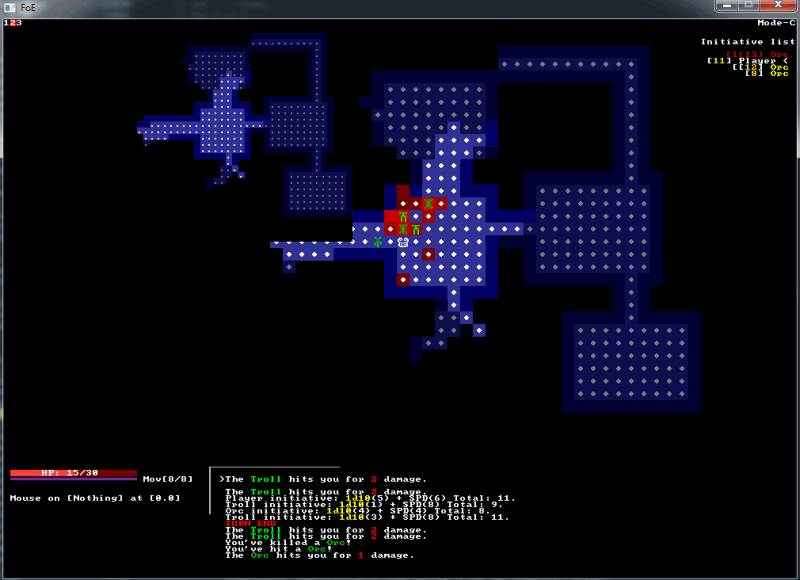
I’ve been silent here because I actually spent time doing stuff. I’ll eventually recuperate the “diary” but for now it already exists in a form: here.

That became a long thread.

In the meantime I wrote down some first high level design consideration that will direct toward the “system” I’ll use for the ruleset governing the game.


Following are a number of RPG classic systems that I consider interesting and whole mechanics I’m planning to integrate into my roguelike. So before moving on, I wanted to compile a simplified list of a standard type of attack in each of these systems. Just one attack, so not a whole combat turn.

DANGEROUS JOURNEY
(surprise roll d100)
– Initiative 1D10, subtract related speed component, add speed of action
– TO HIT: skill %. Succeeds if less than skill level. If lower than 10% of the skill -> critical. (plus modifiers due to cover/movement)
– (target can parry by spending one attack)
– Check for location. Roll another %. If under 40% multipliers to damage apply.
– Roll damage dice dependent on weapon. If critical, it does max damage the weapon can do, without rolling.
– Armor value is subtracted from damage (armor is locational and has values for different types of attack: cut, blunt, pierce, fire, chemical, stunning, electrical).
Note: if total damage exceeds a certain Wound Level (75% of total hit points), the target is dazed.

Considerations: two weak points. The first is I don’t like parry using attacks, since if you fight to win you’d rather try to kill the enemy as fast as possible instead of wasting attacks to parry. The other weak point is that location is random and can push damage quite a bit, so a bit too driven by chance.

WARHAMMER 40k
(surprise, DM decides)
– Initiative 1D10 + agility bonus. Initiative is rolled only once for whole combat, same order for every round.
– Can set a “stance”, like all out attack, or defensive stance, that affect hit rolls.
– TO HIT: skill %. Succeeds if less than skill level. (some environmental variables may apply)
– (target has one “reaction” slot to use to parry or dodge)
– Check for location. This uses the same to hit roll, but with reversed order. so a 15 to hit, becomes 51 for location. Location is just location, doesn’t affect damage.
– Roll damage dice. If roll a 10, roll to-hit again, if successful, roll a 10 to add to damage. If you keep rolling 10s, they all add up to damage.
– Armor value is subtracted from damage.
Note: if damage surpassed a certain level, it’s a critical with consequences.

Considerations: it’s more streamlined and has a free slot to use to parry or dodge, instead of wasting attacks. Has the nice trick to use only one dice for both to-hit and location, though it won’t matter in a computer implementation.

PATHFINDER
(surprise happens after initiative, may need perception rolls)
– Initiative 1D20? + dex bonus. Initiative is rolled only once for whole combat, same order for every round.
– TO HIT: 1D20. Succeeds if above armor class of target. Base 10 + armor + other bonuses.
– Roll damage dice. Armor only counts for to-hit and doesn’t absorb damage.
Note: a to-hit of 20 is critical if another to-hit roll is successful. Weapon type says how many times to reroll damage, usually 2x.

Considerations: it’s fairly simple. It has the usual realism issues of D&D. There’s no “skill” since you only get bonuses through stats and new levels. Armor doesn’t absorb damage, which means that if you fight a guy in full platemail with a knife and hit, you do as much damage as if the guy was naked. If you fight the same guy with a knife or a long sword, there’s also no difference in being able to hit him. There are a few combat maneuvers, but parry doesn’t seem to exist.

ROLEMASTER
– Initiative is fixed. No dices being rolled. It depends on various bonuses and conditions.
– TO HIT: % dice + attacker Offensive Bonus – defender Defensive Bonus. You check the value you get on a table with the defender armor value. Rolls are open-ended, so you keep rerolling and adding, as long you go above 95.

Considerations: that’s it basically. It all depends on HUGE weapon-specific tables that tell you if the attack fumbled, was critical, and how much damage it dealt. The good aspect is that attacks consider the defensive bonus of who is attacked, and before a turn you decide how to redistribute your Offensive Bonus to the Defensive. So there’s a granular type of defense where you decide how much to focus on defense and how much on offense. So “parrying” is just about relocating your bonus from offensive to defensive, and is not an active “action”.

HARNMASTER
(surprise, the DM decides)
– Initiative is a skill value. No dice rolls required.
– Attacker declares: target, weapon, (optionally) aiming (high, mid, low, -10 penalty), weapon aspect (if you want to exploit an armor weakness).
– Defender declares: Block, Counterstrike, Dodge, Nothing.
– TO HIT: BOTH parties have to roll % dice, and result is mapped on a simple chart. Simultaneous strikes are possible.
– Roll % dice for specific location (this can be slightly rigged by declaring a general aim above).
– For damage you usually roll 1D6 (regardless of weapon), add result to the fixed weapon damage, subtract armor absorption, and, if result is still positive, see on the Injury Table what kind of injury you get matching the value for the location.
– Injuries directly and immediately apply penalties to stats and skill checks.
– Death essentially comes from the target getting disabled or fainting.
– Healing, after successful treatment, is dealt for every single wound. Every wound has a chance of going down one level every five days.

Considerations: This is an odd beast. Armor not only just absorbs damage, but also makes one easier to hit. There are no hit points, and only wounds treated separately. Weapons can be used for different types of attacks, blunt/edge/point, and armor has different protection values against each. Which also opens the possibility to “Compound Layers”, meaning that you wear armor in overlapping layers and they all add up to the protection of that specific location. You could even attempt wearing a DOUBLE PLATE, this has some diminish returns, but would also give pretty huge penalties to attacks and defense. Classes are not restricted to certain weapon types. No levels. So it does a lot of things I like as a system.


After all that I’ll probably go with an hybrid system. I actually like Dangerous Journey general system as it seems well organized. For example every skill falls under some attribute. The attribute not only provides some basic value for the skill, or eventual bonuses to skill checks, but it also sets a maximum of expertise in that skill. So for example if you have Strength of 60 and use an attack based on strength, your skill won’t exceed 60. You can’t get better than that, if Strength is not improved first.

The hybrid I could make would be the character system of Dangerous Journey plus the combat system of Harnmaster. Since they both use % skill they integrate smoothly. I’d then have to simplify a lot the wound/healing system, since I can’t make a player wait idly for days for every small wound.

I was also considering a party system. Initially the idea was to have it abstracted. So you’d still only see one “@” on screen representing the whole party. Instead I thought that a real party isn’t much harder to do. The idea is: you still control one “@” normally, but as a monster is sighted you enter a combat phase. As the combat phase starts you get to “deploy” all your party characters in a small area around your main character. And during the whole combat you move the party members individually. Optionally, you can initiate combat even if no monster is around, and so you could split your party and move party members individually. So it’s a rather flexible system. I’m aiming to have up to four party members in total, including the main character.

I also started to deal with how progress happens. No levels. The characters earns XP points for successful actions like dispatching monsters, finding loot, completing quests, the usual. But there’s no level and XP points are used as “currency” (this is just one of the many mechanics I’ll borrow from Dark Souls). By spending these XP points you get chances to improve various aspects of your character (stats, skills). If the dice roll used to improve a stat is unsuccessful, you get no improvement but XP is still used up. If the dice roll is successful you get the improvement BUT the XP requirements across the board for further improvement go up. Still undecided about how to handle death, no permdeath, but there will be probably a way to lose XP, Dark Souls-like.

Only stats and skills that the character actively used can be improved, but you only need to use a skill once to be able to improve it (so you get enough flexibility to improve whatever you want, without having to “grind” skills).

In order to prevent save cheat mechanics, to avoid that one could reload the game if an improvement roll is unsuccessful, the game already rolls these improvements when an action is first made. And when the player decides to use the XP the game only “reveals” the dice roll it made long before. That way, reloading a game would only produce the same result. :)

(and there would be some time limits so that you need to wait at least a day before spending XP again to improve the same skill. Which means that the fasted path is to play the game normally instead of saving/reload scumming)

On iterative design development it is very likely, essentially guaranteed, that “wasting” XP on unsuccessful improvements is a frustrating rule that would be erased and the process streamlined. But we’ll see.

(since you can’t post comments on this blog, use this just in case)

Posted in: Uncategorized | Tagged: