Will write commentary about Warhammer Online

I got lucky today. Won a book and was invited to the beta of Warhammer Online. The latter isn’t so much about being lucky as I expect they invited most of everyone now that they launch in one month.

I actually had no plans to participate into the beta or even play the game at release (or write comments about it), but some things changed and it’s wise if I give a look in advance.

I didn’t see anything first-hand for now, just noticed I have a key for the beta and launching the torrent on the other PC to download the client. Since the NDA will be released next week I’ll do a write up as I expect to have something to say.

For once I’ll try to not write 100 pages of text and summarize what’s most relevant, both from the point of view of game design and the average player.

Firefox 3.0 later today

The new version of the browser is supposed to “launch” today, an hour ago to be precise. But currently mozilla.org, mozilla.com and the world record site are all down. And if you can manage to load the page, they are still not updated.

For those who have experience with launch day of mmorpgs, this is no surprise.

A moderator posted this on the forums:

As an IT Director I once reported to was known to put it, “You don’t build the church for Easter Sunday.” No amount of server hardware was going to be able to stand up to the zero hour onslaught and still be financially justifiable 12 hours later.

Posted in: Uncategorized | Tagged:

The Death of the New Gods

If you read comics maybe you know that the DC is doing another Crisis and that the deus ex machina this time will be Grant Morrison, with art done by one of the best DC has, J.G. Jones (who made also the 52 covers for “52”).

The whole thing starts this 28 May, with an introduction that set the basis, written by Morrison and the Bendis of DC (Geoff Johns) that is out in a few days. I wonder if any of this will make into the story…

Since I never read a lot of DC I made a grand plan of following the whole story since the first Crisis. Then go through Identity Crisis, Infinite Crisis and finally to this Final Crisis, to be published soon. A whole lot of reading that I never did. I’m still stuck at about issue 10 or 11 of the original Crisis. Very fine story, though, that didn’t feel stale at all.

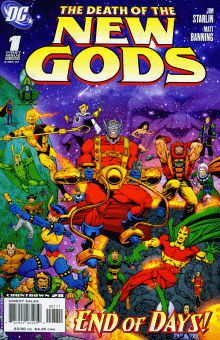
Recently I stumbled into this one series “The Death of the New Gods”, 8 issues all already out with story and art by Jim Starlin, who is part of the old guard and made a lot of those epic, cosmic crossovers for Marvel. I’m not entirely sure, but I suspect the plot of this series is also the premise of the Final Crisis. Something about the new-new gods and Darkseid.

What I didn’t know is that this segment of the DC universe, known as the Fourth World, was built by The King, Jack Kirby. And in fact in that cover you can see his typical insane heroes. Squint enough and you can see one in the background flying on skis. When is the last time you saw a so large groups of ridiculous heroes? Well, I couldn’t miss the opportunity.

In fact it is a wonderful series. Perfectly old-style but with a surprisingly good (and cosmic) story. There’s all the naiveté of the Kirbian age, but the author doesn’t take it too seriously and there are plenty of inside jokes about the cliches. The first issues are complex and confusing as they introduce so many heroes I’ve never seen and tie them back to years of continuity. But I love this old style stuff and the story is really intriguing, setting a number of mysteries that will keep you reading to discover them. Toward the end it loses a bit of quality as the story seems to slow down and you just get through a series of pompous fight scenes and info-dumps, but as a whole it’s a really interesting read that makes you look at these classic style stories with nostalgia.

A better introduction is written by Dan DiDio himself. So read it if you are interested. And then read all the eight issues as the series is a little gem of perfectly preserved classic.

Posted in: Uncategorized | Tagged:

Donnie Darko explained

I’m a bit late watching this movie, but here it is (if you haven’t watched this sci-fi movie you’ll have no idea of what I’m talking about).

The movie can only be understood through the online material. Here’s a starting point:

Like life, and much of Wolfe’s work, Donnie Darko can only be seen forward, but only understood looking backwards.

That said, the semi-official FAQ doesn’t really explain everything, and about those parts that don’t make sense it simply states: “this is open to interpretation”. Nope. It’s open to interpretation because you didn’t get it. Heh.

The real explanation comes from here.

This is my own paraphrase. EVERYTHING makes sense, is consistent, explained and never forced. There isn’t anything ambiguous.

First thing: the real theme of the movie is the demonstration of the existence of god. Which is the element that ties together all the plot threads.

Postulate: the space-time is an entity trying to preserve itself the same as all organisms do. It can happen that the system has a crisis, and the entity has means to counter and solve this crisis, the same way an human body develops antibodies and can heal wounds. Trying to preserve itself.

The space/time anomaly in the movie, generating the Tangent Timeline, is not caused by someone, or the random actions of someone, or weird super-powers. It is not due to something related to the characters in the movie. It is simply a natural phenomenon, like the fall of a meteorite. So the characters in the movies aren’t “special” by any means. They are simply caught in the anomaly. This is important.

Now. The anomaly is a danger for the integrity of the space/time entity. In the same way it happens to a human body if it doesn’t heal, if the anomaly persists for too long, the space/time sort of “collapses”. So the situation needs to be fixed within a set maximum time-frame.

The anomaly has also an epicenter. All those who are caught near the anomaly become the “antibodies” of the system. This means that ALL characters in the movie are “zombies”, lead by a greater will (space/time). If you could “interview” antibodies they wouldn’t say who they are, what is their function and so on. Because they operate unknowingly, unconsciously. They are simply manipulated. Unaware. They have illusion of life and conscience, but they can’t choose or really live.

This creates two groups. From a side, everyone in the village, the manipulated, zombie ones. From the other, our hero, Donnie Darko.

There’s one main difference. The manipulated ones have no real “conscience”, as they are manipulated, and have no special powers. While Donnie Darko has special powers (that allow him to fix the time anomaly and “save the world”) but also has the freedom of choice. This means that the manipulated ones, being just puppets, are lead by an all-knowing hand. So an hand who knows how to fix things. While Donnie Darko has conscience, but no knowledge.

So. Manipulated ones, who know how, but don’t have the power to. And Donnie Darko, who has the power to, but doesn’t know how.

The WHOLE movie is about (subject) the manipulated ones trying to induce Donnie Darko to do his task. A tutorial. They will try to make Donnie Darko do it. Force to do it. Induce.

Most of the plot in the movie is pure, awesome Deus ex machina revealed. Making all sort of things happen just to induce Donnie to do something.

For example: why the old crazy woman goes every day to check her letter box? Common answer: because she knows something, so she goes to check if a letter about that something arrives.

Nope. That woman is a zombie like everyone else. She checks the letter box to induce another character to say “someone should write her”, to then induce Donnie Darko to do it. This letter being sent would then, at the end of the movie, induce the old woman to find the letter, and start to read it in the middle of the road. Who consequently induces a car to arrive, dodge the woman in the middle of the road and kill Donnie’s own girl.

Why Donnie’s girl dies? To induce, once again, to make him do his task. Death and life of zombies don’t matter. What matters is simply persuade Donnie. Push him to “do the right thing”. That is: using his powers to fix the anomaly and save the world (so preserving the time/space self-preserving entity).

This introduces the theme of god. Donnie can see the future movement of people (the translucent tentacle coming out the chest). So he speaks with his teacher. Meaning: if I can see the future, then it means things are already determined before they happen. So this means that there is god, as someone who makes those choices and sets the plan. BUT. If, I, Donnie Darko can see where they will go, so having the power to *change* it, then who am I? What happens if I don’t do what they tell me (save the world)?

Teacher reply: I cannot answer because… (stupid reason). Of course he cannot. This is a scene about Donnie Darko (god’s tool) asking god (a manipulated one) what happens if he doesn’t do what the god asked him to do. Of course god can’t answer that. Taboo.

So, again, the movie is about Donnie Darko’s internal conflict: do I do it, or not? Do I fulfill my role or not?

In the scenes with the psychologist, Donnie says he:
1- Knows there’s time limit, so that things aren’t going to last. Something is going to happen (end of the world).
2- He doesn’t want to die alone.

He knows that when the time is come (the maximum time limit of the Tangent Universe), he will be alone. Him and his vision/tutorial (Frank/god). He will be alone because he knows that the he will have to make the choice alone. To do his task or not.

Added element. Everything that happens in the Tangent Universe isn’t in any way “normal”. It’s simply the realization of Donnie’s own wishes. He finds a girl, fucks her, is handsome, is intelligent, has success with everyone, kicks various asses. He’s basically badass all around, a winner.

NOT because Donnie’s really badass. But because that’s his own wish. He’s got powers. He has the power to realize all he wants. So he actually LOVES this Tangent, unstable Universe. Because everything is great for him.

This also explains a part that is rarely understood. There’s a point where Frank tells him (before he teaches him how to do his task, by opening a wormhole in the movie theatre):
Donnie: “Why do you wear that stupid bunny suit?”
Frank: “Why are you wearing that stupid man suit?”

Now, it makes sense asking someone *why* he’s wearing a bunny suit. Because there’s a choice, so a reason. While it doesn’t make sense to ask someone *why* he wears a man suit. Because it’s not a choice. You are born with it.

What Frank implies there is: nope, Donnie. You’re not just a man. You’re past that. You’ve got powers. You can be whatever you want. Why are you still sitting here, pretending to have a normal life (wearing a man suit)?

That’s the transition. Frank is “teaching” Donnie who he really is (god’s tool to do a task, with super-powers and all). In fact shortly after he teaches Donnie how to use his power to fix the anomaly.

Donnie has the choice. To recognize god and complete the task. Or still cling to his pretty but ephemeral life. Denying god.

Why does Donnie Darko die at the end of the movie?

To begin with, he has the choice to live. He could complete the task and still live. The task doesn’t require Donnie’s death. It only requires Donnie to “give back” his pretty ideal life, as that Tangent Universe would be “sealed”, solving the anomaly (god, aka the space/time entity, would cheer at this point).

So why he decides to die? It’s quite simple. As written above, he’s scared to die alone. He’s scared to follow Frank/god’s order and give up at least part of his life. But when he finally accepts the task, he also accepts the existence of god. He seconds the greater will, so he *affirms* it. By doing so, he’s not alone anymore.

He basically passed the test. Accepted god. Hence he transcends his own being. By doing what he does he didn’t *have to* die. But he’s so “past it” that his mortal body, girlfriend, family and EVERYTHING he cared about, are now pretty useless. He’s beyond. He recognized god and doesn’t need anymore a mortal life and body. Stopped to care about the ephemeral stuff of everyday’s life.

OR. He’s betrayed. Used as a tool, induced to believe he’s transcended. Induced to kill himself after his task was complete. Either you believe in god, rewarding people who comply. Or you believe in the space/time entity who operates to simply preserve itself. Kinda selfishly. And once the tool is used, it is tossed away and killed. Making the tool believe that he’s got a much better life.

Either you believe in god as a generous entity. Or you believe in god as a manipulative one. Or just a living entity preserving and caring for itself. Discarding parts of itself, as a process, same as we shed cells during our own life cycle.

The movie obviously stops there. It doesn’t show what happens if the anomaly isn’t fixed (it’s just the space/time entity making people believe that things would go very wrong if the anomaly wasn’t fixed. But maybe only selfishly). It doesn’t show what happens to Donnie’s “life” past death.

Quite a wonderful movie-idea. One of the most ambitious ever.

Problem is, the movie doesn’t provide the tools to understand itself. You have to read stuff online, read the “solution”. I think it would have been much better if these arguments were also real themes *IN* the movie. Instead of outside of it.
Posted in: Uncategorized | Tagged:

Fantastic Four #554

I’ll just say this, the story is already seen, but three pages and the sense of wonder that the series had lost for years is back.
Mark Millar is one of the best writers comics ever had, along with Morrison, Moore and Gaiman. Bendis is good as well, but these other writers have the talent of being able to write about EVERYTHING.

Posted in: Uncategorized | Tagged:

You bloggers, have failed

On other MMO blogs I read sometimes that there aren’t anymore arguments to talk about, or discussions to have. If you feel so, it’s because you failed.

I remember clearly why I started this blog. At that time it wasn’t simple to voice opinions. The Waterthread community didn’t have a good opinion of me and liked to ban me periodically and good discussions were going to be invariably lost just because they also periodically wiped the boards.

I started a blog because I wanted to voice my own opinions and build something on them. Not because I wanted to boost my ego, or because I thought my own opinions were indispensable for the world, but because what I wanted to say was different. In a similar way I was also looking for other voices out of the chorus. I started to read Lum when he was the voice out of the chorus. I continued following the community when he became the chorus. I continued looking for and reading those blogs with people who had something to say. I started my blog because I had something to say. A lot.

You may agree or not with what I wrote along the years, being interested or not, think it was utterly stupid or pointless. But it was different. I always looked for other points of view, then make my own opinions. There was this First Rule that made blogs interesting in their own way: THE HATE.

Today people will say that ‘teh hate’ is a thing of the past. The unconstructive hate. I always thought that the hate stood for something valuable: the critical point of view. *I* read blogs, Lum in the first place with his site and community, for a very simple reason. The voice out of the chorus was critical. It was subjective. But it was also honest and without filters. That was the point.

At the time mmorpgs were such a clusterfuck that you needed both consciousness of the thing, and find new solutions. Those “critical”, “hateful” communities figured out things way before the market itself recognized and adapted. They were AHEAD of everything.

So I sneaked there because it was extremely interesting, stimulating. It was alive. There were things to figure out, to study, to find solutions for. It was a “field” that was growing, becoming more important. And it was necessary to learn from those communities.

When I stopped writing about MMOs it was not because I was bored or because I ran out of things to write. But because life pushed me in another direction when instead I wanted to invest MORE time in this thing. The more I wrote the more I had things to say. Different things to say. Relevant in my mind, so on a blog to be offered to whoever was interested.

And today I read of bored bloggers, or complaining that they ran out of interesting arguments. Why are you writing on blog? I always knew my answer.

Today we have an higher number of bloggers. This will always be a good thing. Many are gamer blogs specialized in one game, mostly a tale of experiences in the game more than game design ideas. This doesn’t make them worse or better but from my point of view the today blogs are lacking what yesterday blogs had aplenty: the critical point of view. The desire to change. Make things better. Participate.

As with everything, the culture absorbs subversive attempts and makes them a popular trend shallow and alike. That’s my view on the blogs of today: shallow and alike.

Posted in: Uncategorized | Tagged:

Psh… I’m not back

If you see the site being up again, or this entry appearing in your old, stinky RSS aggregator… DON’T PANIC.

I’m not back.

I just need to fish some old entries for the next couple of days.

These months I’m also reading through Steven Erikson’s epic fantasy saga (10 books, 7 out now), then think if it could be made into a mmorpg.

They say it’s the Best Ever and the finest and most complex and intricate worldbuiliding ever made.

Ian Cameron Esslemont: I (and Steve) both believe that Malaz is vastly different from the general popular fantasy series of the genre. We deliberately set out to achieve this goal of convention challenge, contravention, and reversal. It is deliberately anti-heroic in a genre heretofore reserved for heroic indulgences all this because we have faith in the intelligence and discrimination of genre readers to recognize when they are not being talked (or written) down to. In many ways the entire series is an extended critical study of the genre itself how it works, why it works, how far can it be pushed to evolve? But all that is sub-textual and academic; foremost the books must and do remain a damn hair-raising read. If that falls down then it will all fall down (and deservedly so)

Erikson: The Malazan Book of the Fallen is a compiled history, warts and all. It’s not above brazen manipulation of events and facts, because, well, that’s the nature of the beast. By this, do I mean it as a way of squirming out of things? No, you’d all never let me get off that easily. I just love the feel of an uncertain history, as all histories are. If none of you had any questions, then I’d be worried.

Erikson: The second question: oh the sparks were all negative things, frustrations at the genre’s confounding predictability. Wanting to write something in fantasy I myself would like to read (and not just me, but Cam as well — the one reader who stays in my head as I write). Wanting to kick the tropes around, wanting to get rid of that endless quasi-medieval class-conscious blueblood crap. Wanting a fantasy world as multicultural as this one (the preponderance of white-skinned heroes and blonde princesses … man, what century is this?). Wanting a fantasy world with a history beyond the Dark Lord of three hundred years ago who’s found a rock that will help him rise again and do, oh, bad things; a world with geology and geography, etc.

Sure, there’s some good stuff out there, but it wasn’t enough. Maybe still isn’t.

Erikson: I probably play around with subtext a lot more than your run of the mill fantasy novel (at least those I’ve slogged through out of boredom or some similar reason); but the better ones out there do that as well. I was told, long ago, that the stranger the world you’re writing about, the clearer and cleaner the language must be — ‘windexed language’ as it used to be called (and maybe still is). But I found a way around that, by making certain characters players of language — in dialogue and monologue, and with those I can let loose on the linguistic games, puns, etc I can play with self-consciousness and metaphor and deliberately twisted analogy and simile. Messing around with voice is one of things that has always interested me as a writer. Multiple points of view unleash that like the hounds of hell. Also allows for plenty of misdirection, which is even more fun. Of course, every bit of writing, every sentence, every paragraph should function to serve more than one purpose. If there’s just one (advancing action) it should probably be short and precise; otherwise if it’s establishing setting, or if it’s dialogue/monologue/characterisation, it should carry more than one level of intent and communication. That’s a rule I follow, any way.

His first fantasy novel, Gardens of the Moon (1999), constitutes the first of ten projected volumes of the Malazan Book of the Fallen. His style of writing tends towards complex plots with multiple point-of-view characters.

It is an epic fantasy, wide in scope and encompassing the stories of a very large cast of characters. Each book tells a different chapter in the ongoing saga of the Malazan Empire and its wars. For the first five books, each volume is self-contained, in that the primary conflict of each novel is resolved within that novel.

However, many underlying characters and events are interwoven throughout the works of the series, binding it together.

HRose: Erikson’s series should be under ‘epic’ in the dictionary. With timelines spanning 100000 years and more, and tons and tons of characters, many of which who are ancient themselves.

My personal favorite. I love the expansive and interesting world Erikson has built. That being one of your criteria I don’t think you can go wrong.

The other bonus of Erikson is that he’s fantasy of his own devising, and isn’t Tolkienesque. His take on gods and magic is pretty awesome, and unique to boot. He turns the idea of undead on its head, there is no ultimate good or ultimate evil, and there’s startlingly few stereotypes. Even when he delves in to a plot involving a young kid being caught up in things above him, he manages to take it in places that you just wouldn’t expect.

I do like Erikson too, but the far-flung epic feel drags in parts. That could just be me in that I only have time to read sporadically. The Malazan books are certainly not ones you skip merrily through. You have to pay attention and invest yourself in them. You are definitely paid off, though, because the detailed world he creates is nothing short of amazing.

This is the seventh novel in the Malazan Book of the Fallen series. It is everything you hoped for if you have been following this story from the beginning. The sheer scale and grandeur of this tale is breathtaking. Again you will question who are the “good guys” and who are the “bad guys”.

Martin and Erikson are absolutely the giants of the genre at this point.

One huge plus between Martin and Erikson though- Erikson is putting these out on an almost annual basis. There is a very real possibility that his entire ten book series will be released before Martin gets his sixth book out.

Erikson commonly gets compared to George RR Martin thought the two really aren’t that similar IMO other than the scale of the work and, in most opinions, relative quality. Both authors tell a fairly gritty tale but Erikson seems more concerned with history and magic while Martin seems focused mainly on characters.

Erikson’s strength is in his world detail. The world of the Malazan Empire has an incredibly detailed backstory and its the primary focus of the series. His books take the “in media res” concept very much to heart- there is no true beginning and most readers find themselves fairly confused with the first half of his first novel, Gardens of the Moon. He doesn’t slow for explanations or introductions- the world is already in the midst of a major continents-spanning war and most of the characters already have histories with one another that is only hinted at. You just have to accept that you’ll be confused and trust that you haven’t missed anything. By the second half of the book things start to click and you get a pretty good idea of the scope of what Erikson is trying to get across.

His best asset, IMO, is the sheer scale of the events. He also has some relatively interesting characters. One huge plus is that each book is relatively self-contained- there is a genuine finale and following books often take place in different times and places than previous ones with a few overlapping characters. Consequently each book is relatively satisfying without engaging in cheap cliffhangers.

Erikson other folks have described. Huge time scale, lots of gods and other major powers futzing with things. Enormous, dramatic conflicts. I’ve found every book so far to be rough getting into (he sometimes spends 5/6ths of a book building tension and weaving threads before the big shit goes down.) but increasingly compelling to the point of obsession the deeper into them I get. There’s nagging things that keep popping up and back down again before I can entirely identify them. But he’s telling much too good a story for me to really care.

Another big hell yeah for Malazan. There is just nothing else quite like it out there.

Tearing into ‘Memories of Ice’ by Erikson. Gotta love a book that has a 300 thousand person army of starving cannabalistic peasants laying seige to a city.

And another reason it deserves the “epic” title (which I didn’t see anyone else mentioning in this thread but they may have and I missed it) – the depth of character and location interaction is so broad it’s almost silly. You meet what look like minor throw-away characters in one book only to find they are the major player three books later.

Or you find a bizarre scene that is visited by many different groups of characters at different times, but the scenes don’t appear in order in the sequence of the books. You may find the gruesome mysterious aftermath of a battle in book 2, then read about the battle itself in book 5. I found myself constantly going “WAIT! Is that how that got there?” and shuffling through earlier books to remind myself of how things were connected.

And my last bit of fanboy praise – the characters are freaking GREAT. Ericson is not afraid to kill of major characters, and he creates new major characters in just about every book, and yet almost all of them are clearly drawn with distinct personalities and are quite memorable.

I think Erikson is the most complete fantasy writer out there today. Some authors are good at world building, some are good at characterization, but Erikson isn’t just good at both, he excels at both.

Erikson also does some really unique stuff with structure and narrative that I haven’t seen a lot in the genre. It’s not straightforward in any way. For example, the first book takes place on a certain continent with certain characters then Book 2 moves to a completely different continent with mainly new characters. Book 3 then acts as a sequel to Book 1, and Book 4 to Book 2.

Then there is an all new continent and characters in Book 5 and now Erikson is drawing all of those threads together in the latter half of the series.

The result is that the whole enterprise is basically a puzzle where the reader is making the connections between these seeming disparate storylines.

Especially since Erikson abhors any type of exposition describing the world and it’s history. It’s left to the reader to put together so readers of the first book often feel like they are missing something and starting a series in the middle. Another cool technique Erikson uses is that he hides some secrets and twists in plain sight which can makes re-reads quite enjoyable when you see how much he had laid out in advance.

Highly original. Very little of his world-building even reminds me of things I’ve read before.

I agree they’re an acquired taste, and not the easiest reads, but the chaotic insanity and excess of the whole concept is sort of exhilarating.

And the plotting is pretty extraordinary. By the time you get to book four and see how the throwaway random comment in book two was actually a reference to an event which was experienced in book three and had been foreshadowed in book one it can boggle the mind nicely.

Martin isn’t really high fantasy- it’s all very realistic with minimal magic. Erikson, on the other hand, really excels when it comes to epic, magic heavy battles.

Erikson’s world can probably be compared to the mythology of Ancient Greece but set in a medieval period- Gods and Ascendants (basically demi-gods) are main characters and frequently interact with mortals.

Erikson is a master of lost and forgotten epochs, a weaver of ancient epics on a scale that would approach absurdity if it wasn’t so much fun.

The sheer scale of the author’s vision is nothing less than astonishing. And the ease with which he seems to navigate through this grand epic of mortals and gods never ceases to astound me.

If you are not reading A Tale of the Malazan Book of the Fallen, you are missing out on what is possibly the most ambitious fantasy series to ever see the light.

War is a constant — from continent to continent, century upon century. Erikson’s universe is a violent one, Gothic in intensity, without clear demarcation between good and evil. It’s perhaps more like the real world, then, than most fantasy, which so clearly differentiates between light and dark. Not the kind of story I would read to my son before bed — death and pain abound, along with magic and wonder.

Gods are always messing with mortals in Erikson’s work, but the mortals also, by their patterns of belief, create their own gods, their own greater powers.

Give me, instead, the evocation of a rich, complex and yet ultimately unknowable other world, with a compelling suggestion of intricate history and mythology and lore. Give me mystery amid the grand narrative. There’s no need to spell it all out; no prefaces, please, elucidating the history of Middle Earth as if to students in a lecture hall. Instead, give me a world in which every sea hides a crumbled Atlantis, every ruin has a tale to tell, every mattock blade is a silent legacy of struggles unknown.

Give me, in other words, the fantasy work of Steven Erikson.

Genabeckis Continent & campaign as main arc: books 1 & 3
Seven Cities subcontinent & rebellion as main arc: books 2, 4, & 6
Lether Continent and Tiste Edur: books 5 & 7

The problem is that each book fills or offers a different interpretation of the backstory, along with advancing the series arc. You also have groups of characters take off from one continent and show up in another.

Fairly important characters are introduced in book 1, that then have a subplot in book 2, one of whom pops up in most of the other books.

Book 5 is almost entirely standalone, with a new continent and entirely new characters (except for one guy introduced in book 4) but it’s set as 5 years back in the timeline.

Sometimes people recommend starting with book 2, Deadhouse Gates, because it’s gripping and has the least background requirements, but then other people say that’s a bad idea.

Quon Tali, the continent that the Malazan Empire comes from, periodicly shows up throughout the books.

And I’m fucking ANGRY with Robert Jordan.

When you have duties toward people, YOU CAN’T DIE LIKE THAT. I’m going to blame him and god.

Posted in: Uncategorized | Tagged:

The origin of the DC Universe

(I’ll trim the post later, now I’m tired)

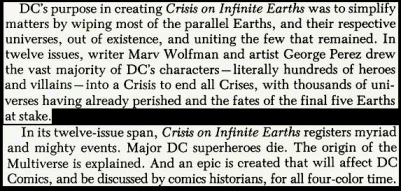
I’m reading DC’s classic “Crisis on Inifinite Earths” to be ready to tackle the more recent “Infinite Crisis” and I’ve noticed that the triggers of the “Crisis” itself are two different moments with a lot in common:

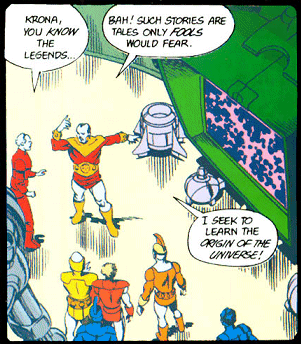
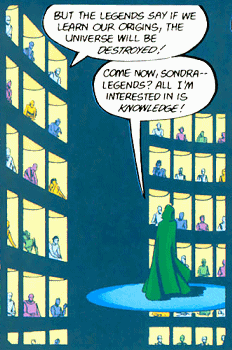
1- On planet Oa one of the most brilliant scientists decides to discover the origin of the world, in spite of legends that foretell destructions if this happens.

In Mark Waid words: “Ten billion years ago when Earth was little more than cooling gases, the inhabitants of Oa, at the center of the universe, were immortal and had the powers of the legendary gods. They always strove for continued advancement, but their science became perverted, for one of them, Krona, swore to discover the secret of the universe’s creation. Others warned him away, vowing that legends told of destruction to come to any who plumbed the mysteries of Creation.”


(From: Crisis on Infinite Earths #7, October 1985)

(click to continue reading)

2- Pariah, also himself a talented scientists, discovers the origin of Multiverse and, from there, up to the origin of the universe, challenging a similar prohibition.

In Mark Waid words: “Parah now takes up the tale, explaining that he himself came form an Earth alien to them all, on which he was the greatest scientist, responsible for weather control, and the destruction of disease. He soon discovered the origin of the Multiverse, and used that knowledge to discover the origin of the universe, despite the legends common to all planes that such knowledge would lead to destruction.”


(From: Crisis on Infinite Earths #7, October 1985)

In practice everything is set in motion by a “thirst for knowledge”. Now this passage reminded me the book of the Genesis in the Bible: live and prosper in the garden of Eden, but don’t touch the tree of knowledge or you’ll face God’s anger.

Why this knowledge has to be considered as “evil” or deceiving? There’s a first explanation ala “Swamp Thing”, ecologist, that says that unrestrained knowledge brings to disharmony, ruin and corruption. But it’s not like this theory holds well in the original “crisis”, where nothing is really explained about the reason why the act of the two scientists was so inconsiderate and unacceptable.

So it came to my mind a book of Niklas Lumann (a genius modern sociologist) that may reveal the “true” origin of the DC Universe, and the true reason why that thirst for knowledge couldn’t have been tolerated.

What Luhmann explain is that anthropolgically both religion and magic have a specific purpose: create “meaning” without being put in doubt (or, more or less in his words: erase the improbabilities of the communication system). He says that there’s a tribe where the problems of communication are being solved, or at least “structured”, by repressing the communication itself. The society’s essential knowledge, meaning what is worth of preservation, hence the knowledge of holy matters, is made accessible only to males, and to them only after a rite of passages that is structured in seven grades. The preservation of the secret delimits arbitrariness. In other words, the knowledge must be protected from communication, since it exists only as the result of this protection. Otherwise people would rapidly become aware that “holy bones” are just… bones.

In my own words: the “magic” itself is in the prohibition to investigate. Why? Because if you investigate you would soon discover that, well, there’s no magic. Luhmann says that these “prohibitions of knowledge” are a necessity to preserve the secret that we attribute to religion. Because the trick is that behind the magic curtain there’s nothing at all. Or, better, there is something. Something absolutely precious: what people think is there. Beliefs, hopes.

There are some tribes exploiting one trick: if you go investigate the “holy” you aren’t anymore “elected” to see it. So you lose the possibility to see it. Meaning: you can “see” only till you keep your eyes closed. Brilliant ;)

So knowledge and magic are in antithesis. One the opposite of the other, one annihilating the other if both exist in the same place. A bit like the story of the Monitor vs the Anti-Monitor. Matter and anti-matter. And, ultimately, the war between good and evil.

In practice the “magic” itself is in the denial to discover the trick. Being unaware. Because if you are skeptic and go discover the trick then you lose the right to that magic, as that magic effectively doesn’t exist if not when believing it, let’s say, “blindfold”. Without proofs ;)

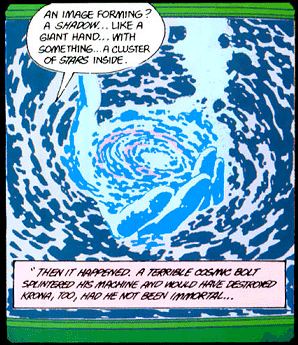
Now, what’s the “magic” to not be revealed in the DC Universe? Well, I was thinking about the image from where all begins. A “cosmic Hand holding the galaxies in its palm”:


(From: Crisis on Infinite Earths #7, October 1985)

What’s then this terrible secret that our heroes are forbid to discover?

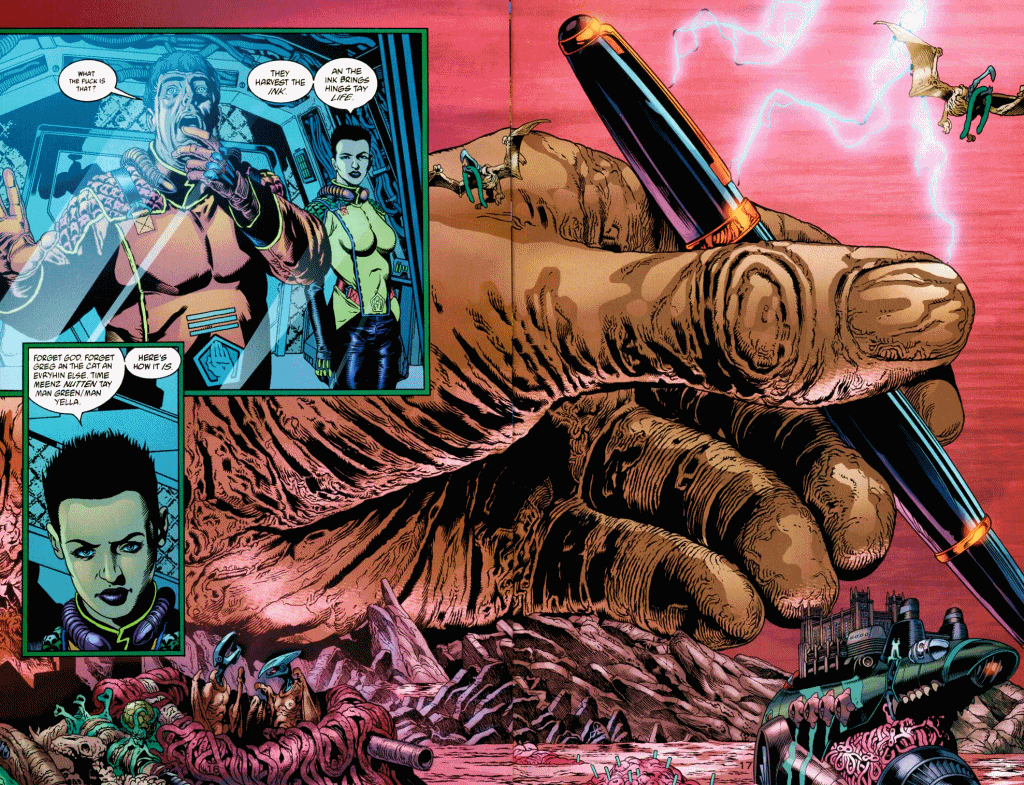
Simple: the fact that the universe was created by a writer(s), whose hand symbolically holds all the universe in its palm :)

What DC heroes cannot discover is that they are made of paper and ink, conceived by a writer and an artist. And they cannot discover that the “Crisis” comes from the practical need of bringing back the continuity and proliferation of alternate universes to a manageable level.


(From: The Official Crisis on Infinite Earths Index – Flood Control Comics – March 1986)

This fracture between universes that DC heroes fight against is just the meta-narrative representation of a real fracture due to the dispersion of universes, comic books, and conflicting continuities produced in the years, that they (the DC heroes) cannot see for what it truly is, but only in its fictional representation.

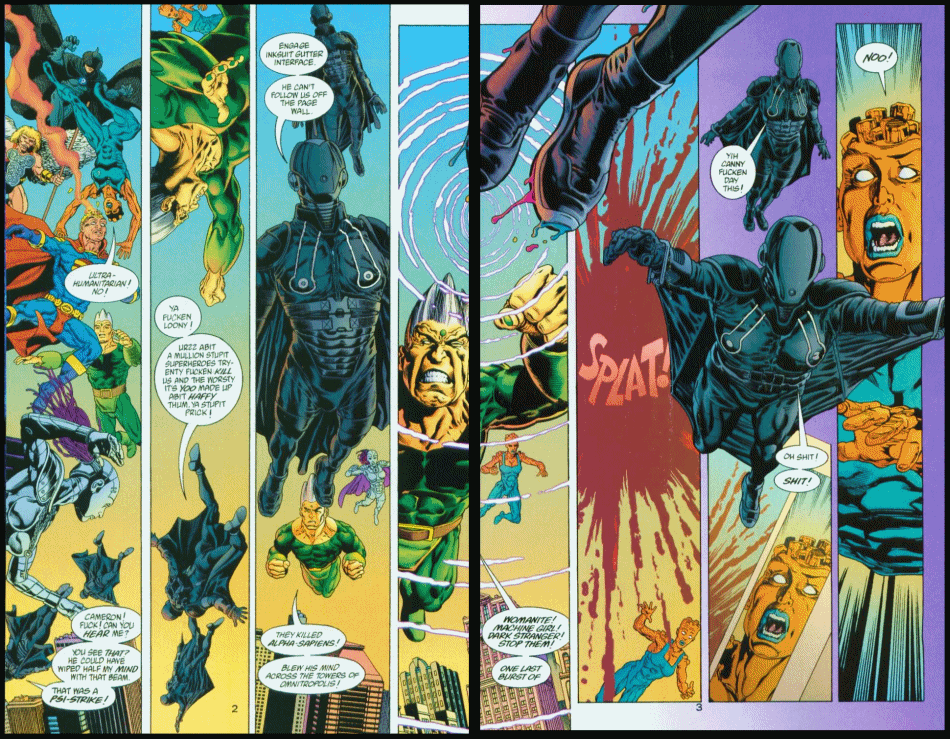
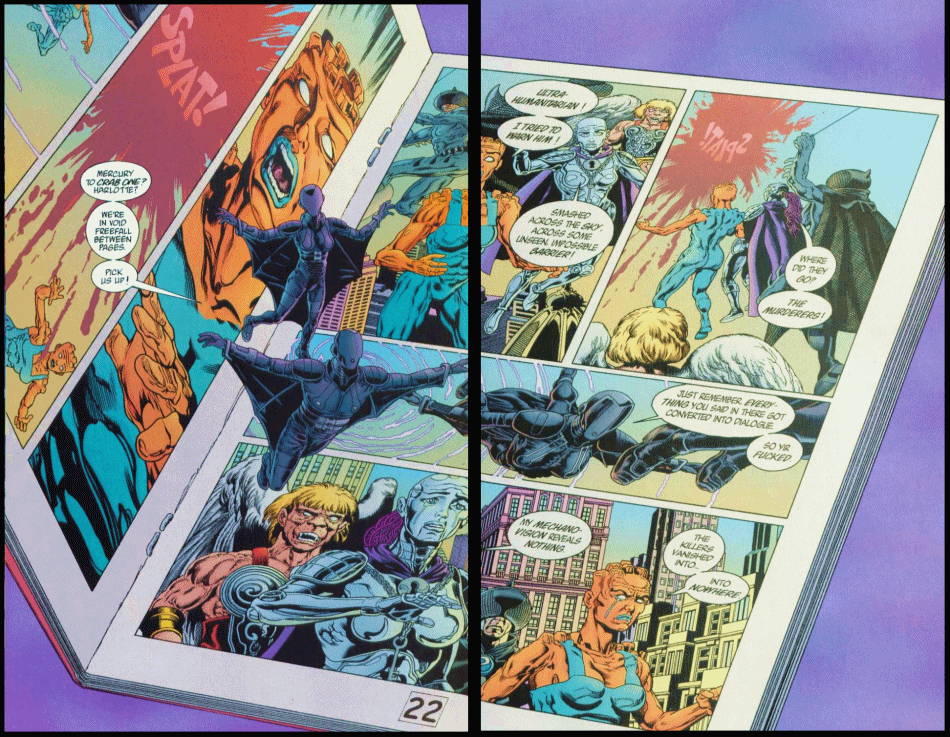
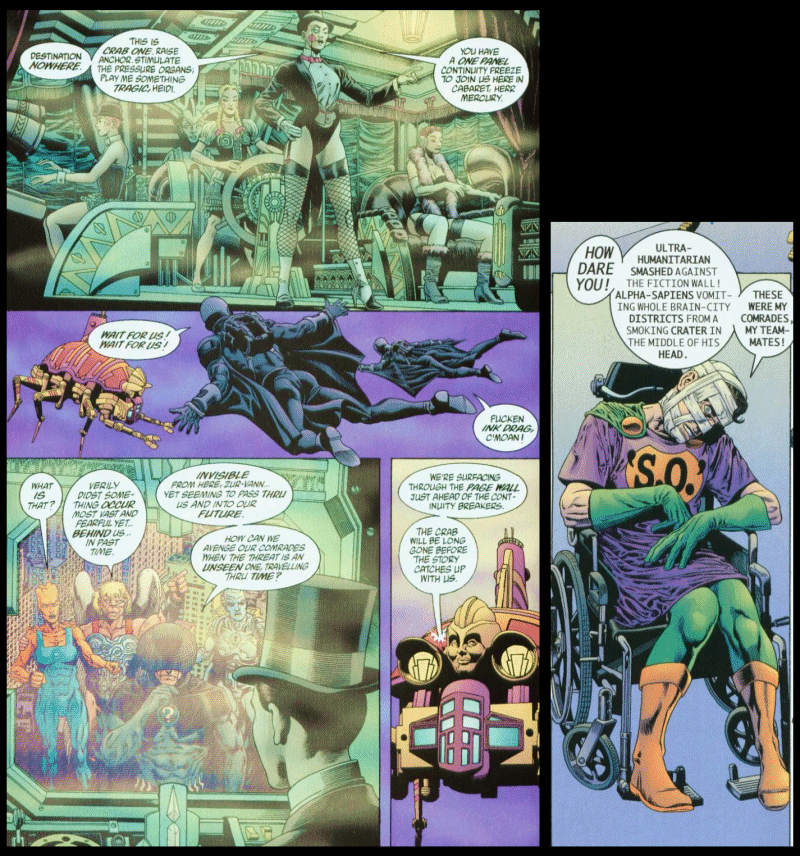
As if at some point they started to fight against the “void” generated by a rip in the page… Something that Grant Morrison knows very, very well:


(From: The Filth, book 3 of 13 – Vertigo – October 2002)


(From: The Filth, book 3 of 13 – Vertigo – October 2002)


(From: The Filth, book 3 of 13 – Vertigo – October 2002)


(From: The Filth, book 9 of 13 – Vertigo – April 2003)

They harvest the INK. And the ink brings hings tay life. Forget god. Forget Greg an the cat an everyhin else. Time meenz nutten tay man green/man yella.

Here’s how it IS.

Posted in: Uncategorized | Tagged:

Music Interlude

For me Gomez are better than The Beatles. No one nowadays has their versatility and absolutely fascinating swing. And Ben Ottewell has The Voice. God in music.

They now have a decent website and they released a while ago a 2 CDs compilation of B Sides and rarities that packs their VERY BEST stuff. I always said that their rare songs were their best.

It also has one pretty cover:

EDIT: Woot! The second CD starts with the acoustic version of “Rhythm and Blues Alibi”. That’s one hell of a song.
EDIT2: Okay, last edit. iTunes has an exclusive worldwide “Live Session EP” with six songs. Go there and shill $1 for “Whippin’ Piccadilly”, because that version is superlative. And if you like it get also “Get Miles”, that’s Ben Ottewel and this version is exceptional again. The guitar in the second half is amazing.

36 songs. If you have iTunes you can go a preview them to have a good taste of their versatility. Or download them from the internet, but just listen all of them in a way or another because they are wonderful. Tomorrow for the first time since years I’ll drive to a CD shop and come out with 2 CDs. The other being Momo’s about which I’ve talked a little bit a while ago.

Today she was again on TV, with one charming song. You can listen it through this site (La Madonna di Pompei), or directly from here.

Listen it till its very end, because it’s there the best part. One little gem. With a vague Yann Tiersen reminescence in the music (the one from Amelie Poulain, I hope you know who she is).

Posted in: Uncategorized | Tagged: