I randomly bumped into this and feel like I cannot abstain to comment, even if I probably shouldn’t because why should I waste time on this…
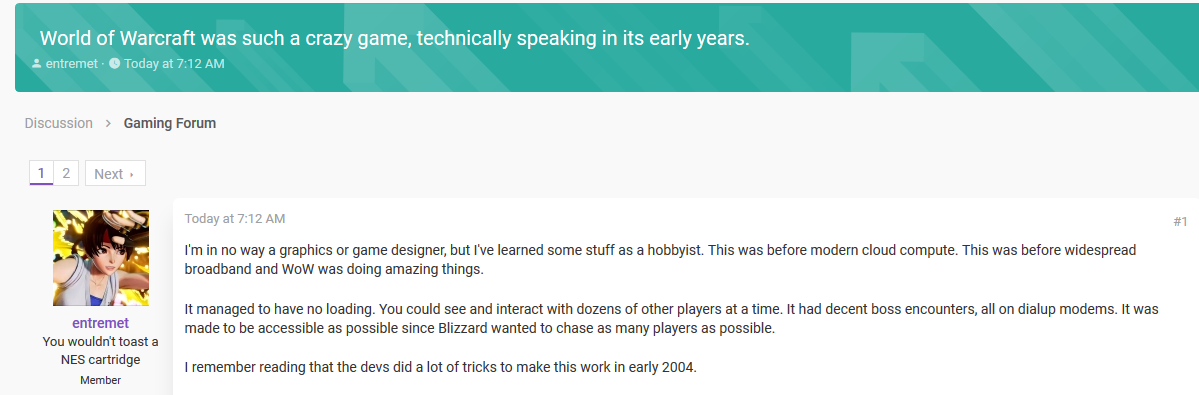
What!? No, it wasn’t.
“This was before modern cloud compute” should already qualify the statement, as if it has any pertinence. “This was before widespread broadband,” and that’s true. But this was also WELL AFTER Dark Age of Camelot, that I personally played on dial-up, from Italy, connected to US coast servers, in RvR battles up to 200+ players (at that point the problem was split evenly: FPS performance going sub 10, your connection lagging like hell, and the servers themselves crashing badly, even if you locally solved one of them you’d still be victim to the others).
While I wasn’t much of a player and it took me forever to reach “endgame” RvR/PvP (on top of the fact I picked the terrible Infiltrator/stealth class), I was in a guild named Samas Gildae that dominated the US server it was on. This despite being all players connecting from Italy and frequently with hardware worse than mine.
Quality and innovation, that are pertinent to WoW, are all but “technical.” But you need to have a good understanding of the wider context at that time.
MMOs at the time were ALL technical trainwrecks. When it comes to pure technology advancements, MMOs were far behind any other type of software. This because the MMO/online field was a sort of no man’s land that was pioneered and conquered by COMPLETE AMATEURS. Just as it happened in the early years for all the other types of games. There wasn’t an “industry”, just a bunch of ambitious kids with some hacked competencies. I’m going to be vague and imprecise about things here, and I don’t want to document shit, the intent is to give the general picture. Devs that worked at Mythic, on DAoC, came merely from successfully running some textual multiplayer MUDs. They had some barebone online technology, bought a 3rd party graphic engine, and managed to make their own EverQuest clone that somehow ended up better in many aspects. This because EverQuest itself was a technical clusterfuck.
Pick any other singleplayer game, and they were ALL miles ahead of whatever was available as “online game.” Making a MMO was complex not in the sense of requiring bleeding edge technology, but in the sense of needing a sort of “jack of all trades” competencies. A bunch of systems that went from graphic engines, running large databases, connectivity and so on.
A dev studio with absurd tech competence like, say, ID software just couldn’t make a persistent online game. Merely because tech was always hyper-focused. You do one thing, and you do it well. Whereas MMOs where “we do all things and we do all of them bad.”
That’s why MMOs were shit not only in technical quality, but even in design and ideas in general. There weren’t competent game designers, and this became a chronic problem (that Blizzard solved obliquely). The game designers were more often than not programmers that ended up filling those shoes. It all grew organically in a very misshapen form.
That’s WHY, when WoW was announced by Blizzard, everything changed BEFORE showing even a single screenshot: this time it was a well established, successful studio with a proven history and solid budget, so an “industry”, that for the first time stepped in to make an MMO, that, again, until that point had been the domain of complete amateurs that improvised themselves a business (again, both an impressive skill and also a liability).
This all reads like I’m going against my own point, that Blizzard and WoW did indeed innovate technically by merely bringing the sheer force of their previous experience, but that’s again missing the point. A good chunk of the quality of the “tech” of WoW was about stepping back. At the time of WoW release there were plenty of games with higher graphical fidelity. There was a giant hunger for games that pushed the hardware (and very fast hardware evolution, people think things move fast now, when truth is they stalled). WoW was extremely conservative. If most other games were quick to embrace large worlds with heavy LOD (what is recognized as pop-in of detail) WoW was the grand, large rendering distance with no noticeable pop-in (compared to, say, Star Wars Galaxies that was more technically advanced, and yet had large building materializing in front of your eyes). But because object complexity and texture resolution was lowered accordingly, and priority given to art style, scale, sense of wonder, rather than minute detail and high fidelity. Not because today the game is old and shows its age, but because it looked “old” WHEN IT WAS RELEASED. It just didn’t feel any less impressive, because art compensated, and because resources were allocated competently.
The user above saying “it managed to have no loading,” which is true. But I also remember during the beta, in the summer: taking a flight path from the Dwarven city Ironforge(?), down to the human one, how’s it called Stormwind? No loading, but when I started on my hardware I had max FPS, and when I landed I was at less than 10. Performance TANKED. Logging off and back in would reset it. This was explained as “memory fragmentation”. Specifically by loading a tons of small object dynamically, as you fly between several zones, memory builds up and leaves gaps, creating serious performance issues. A Blizzard dev asked us specifically to run some debug commands and send the results. If I don’t misremember in a matter of couple of days they released a few client patches that MASSIVELY improved performance. But memory fragmentation was still an issue. Just less impactful. Memory management would be a critical area, for games, for more than 10 years, and still today. No one knows how to write a good memory manager. Today indie studios use stuff like Unity whose main feature is managing memory “automatically.” Which is one of the main reasons why Unity performance SUCKS.
Expanding a bit more on the concept of the “cloud” and networking in general, this is the area where Blizzard DIDN’T learn the lesson. The lesson being to decouple the characters records from the world servers. They made the same mistake of everyone else, and ended up at release with servers crashing and burning, some of them staying offline even for weeks. Then rinse and repeat for every new expansion or massive update. When PvP was released, some time later, it became that well know and short lived open-world PvP, up north in that zone between the two towns, can’t remember names. But the game was laggy, servers started to have problems, and Blizzard had to essentially nerf and forget about the whole thing. It’s fine if you have a bunch of players scattered across several zones, it’s not good if they all meet in the same place. DAoC was all about it, and became somewhat resilient, WoW just broke down, over and over.
Nowadays devs are still stupid enough to repeat the same mistakes (the lesson I mentioned above is STILL rarely applied, but at least it does exist, see Black Desert), with the difference that the servers themselves are not privately owned, but borrowed from Amazon. Therefore there’s a much better viable capacity of rapidly scaling up (and then down) server needs, than what was possible when you had to buy and set up your own servers. Sure you could buy a bunch beforehand, but when players activity falls down dramatically (because it will, no matter the success), you can’t just let unused servers sit there. Those are costs that need to be optimized. Amazon, being 3rd party, can always dynamically allocate those servers to someone else.
Coming to the qualities and innovation that made WoW a juggernaut, first to destroy the competition, then to sink the whole “nascent” MMO genre into near total annihilation. These are all about very simple ideas and common sense. Ideas that WERE ON THE TABLE for anyone to take them. MMOs were driven by blindness, rather than vision. Devs were all too close to what they were making to have even a vague idea of a direction or a plan. Every single one of them with a serious case of impostor syndrome, fearing that their job was ready to be taken by someone else.
For example, one main WoW “intuition” was creating this highway for leveling and progression that was “questing.” Pick up quests in a hub, go out filling objectives and come back to collect equipment rewards and giant blocks of experience. Basic, successful gameplay loop. Of course it’s easy to see something working so well, but not as easy to INVENT it. The problem here is how questing was executed in other MMOs. There were NPCs all around, 90% of them completely useless or just being vendors. Text/dialogue was always skippable “flavor”. In Ever-QUEST quests would be given completely at random, in the sense your level 1 character could prompt a random NPC and get a level 30 quest. Nothing would give you this information, that completing this quest, for you, is IMPOSSIBLE. But you also got close to zero info about what this quest wanted from you, or what you’d get if you miraculously managed to complete it. As a “newbie” you had NO IDEA what to do. The game was opaque and fighting against you. In the end you’d exit a town, find some sheltered tiny corner of some zone, pull a single enemy nearby. Then sit down several minutes to recover HPs and MPs. Then REPEAT FOR HUNDRED OF HOURS. It’s not an exaggeration. You wouldn’t explore, because the world was deadly. You wouldn’t experiment, because a single death could set you back an hour of pure grinding. And you wouldn’t talk with NPCs because they were all garbage. You just sat in a corner, pulled the exact same monster you killed before, hoping not to aggro anything else or you’d be dead. Repeat, forever.
Playing in a group was marginally better, because you could make some inroads within a zone, and get experience much, MUCH faster. But it was still risky, and if after an hour or two or trying to play solo, you got a group, the risk was that someone in that group would fuck up for whatever reason, and the group would immediately disband. In the rare case you happened to find a competent group that got experience fast, then you’d play for hours even if you didn’t want to, merely because that was a rare occasion you find once in a while. You either catch it while you can, or keep grinding for 0.0001% xp if you wanted to play on your own terms and convenience.
Those were the MMOs. Experience in torture and pure grind, and frustration. Of hugging walls and killing rats. Of running from unintended aggros all across a map (in EQ especially, either you made to the exit of a zone, or you’d be chased forever).
WoW merely took what was already there. Figured out the quests could structure progression, and so explicitly tell players “what to do.” But especially, made them visible when available with those giant exclamation marks. Those weren’t invented by WoW, but were there already in Warcraft 3. It just made sense, but it was also stuff that had been suggested for YEARS by countless players in forums. You just needed eyes to read. Because you don’t need a genius to realize MMO quests were SHIT. And MMOs didn’t invent QUESTS. You just needed to have played games before, to realize MMO quests were shit.
Accessibility made WoW popular. The MMO genre was like a niche of super dedicated players. Like a cloistered cult. The fact that these games were utterly unplayable and frustrating, punishing to the extreme, was like a basic feature. I mentioned quests. No one was meant to “play quests” like that, even. You were meant to read forums, wikis. The game didn’t tell you how to play, through its many nuances. It was an online game, and other players were the primary channel for INFORMATION. Either you joined some community, and you were manually guided through the game, or you’d give up. Or you’d play perpetually in a single corner of a single map, killing the same rat or spider or goblin.
WoW own doing was merely gawking at this scene. “What the fuck are they all doing? Why?”
(that, and poach some key EverQuest players to tell more precisely them what needed to be done)