Shadows Linger – Glen Cook

Second book of a trilogy, but also part of a series of ten books in total. I didn’t comment the first book, but I read it. It was wonderful.

In order to explain what I think about this second book, I have to explain a few things about the first, because I started reading with some expectations and those expectations had a weight on my opinion about the book. The fact is that I loved the first book. For its setting, its pace, its structure. It’s from many points of view a “perfect” book. Every piece fits together and it’s masterfully planned and executed. In 310 pages Glen Cook wraps up an epic campaign that other authors would pan for thee books of 600+ pages. And this without leaving you feeling like you missed something.

The structure (first book, not this one) is probably the very best quality and what sets the book apart. Seven chapters, about 60 pages each. Each of these chapters are “standalone”, in the sense that you could read one in the middle of the book without feeling like you are missing a piece of the story, and so can’t understand what the hell is going on. Each also has its start, development and conclusions. So each chapter feels like a novella on its own. This isn’t all, the real quality is that not only the story is wrapped up perfectly around this structure, but that each chapter/novella adds plot elements and characters that contribute and move steadily onward the overall story that spans the whole book. It feels as modern as possible, like it happens now with the most successful TV series, that need, from a side being self-contained to be accessible to who didn’t follow every episode and remembers every detail, and from the other plot elements that link all the episodes together, giving the series its continuity and overall development. So no stalling. The Black Company follows the same principle and Glen Cook executed this masterfully in this first book. It couldn’t have been plotted and structured better. I had a few minor complaints (like how some “spoilers” were handled) but they are just small details toward the end.

I consider that book exceptional because it’s as steady as possible. There’s no slacking, no slows down, no weak parts. In 310 pages the author shows how he has perfect control over his story. And it’s very good, with plenty of unexpected and clever twists. With an end that doesn’t disappoint. The story could have just ended there, but it didn’t.

I don’t know if more books were planned from the beginning, the flow of the second book isn’t perfectly smooth, but still coherent enough to not give the feel of something artificially excused. The real problem is that the structure that made the first book wonderful, was completely discarded for this sequel. Instead of long chapters and self contained stories, we have this time a linear plot developing through the book, and organized with very short chapters (often just 4-5 pages) and an attempt to do different POV. I honestly didn’t like this choice as it gives a too fragmented feel. On the other side the chapters are so short that you keep turning the pages and read more as the next “exit” point is just two pages away, and the end of one chapter always making you wish to turn the page and look for other developments.

Gone the mastery of the structure, but also gone the overall “feel”. No more the militaresque campaign, but a bend toward a “spook”, supernatural theme, leaving you with the impression you are reading a fantasy version of Dracula. I was disappointed because I wanted more of the same, and instead I found something much different, with a plot much, much less inspired and deep. In fact I was much deluded by this second book, but as I went on reading it captured my interest more.

The first 2/3 of the book present two plots, one encapsulating the other. The book wasn’t a complete disappointment because I think Glen Cook achieved his purpose. This purpose was to make readers care more about the inner plot, instead of the outer. Without spoilering much, there’s an “outer” plot still about the Lady and the Dominator fighting each other, with the Black Company caught in between, just trying to survive and choose the lesser evil. With the Dominator rising his castle near a small town lost up the north of the world, forgotten by all. The “inner” plot is instead about the day-to-day miserable life of the people of that town. These two plots initially made distinct also geographically as the scenes with the Company happen at the other side of the world, also used to show how the Lady uses liberally the Company, tossed from one side of the world to the other. You start reading with all the hype once again on the Black Company (the first scene is superb, from the point of view of kids to return the reader the sense of wonder and badassness of the Company), but progressively the focus moves toward those who look like minor characters, and that instead become major ones. In fact Glen Cook artificially zones out the Black Company itself to narrate a “covert” operation with just a few members of it, that are “flown” far away. So there’s already here the will to move away from the theme and execution of the first book.

Even in this case, though, the trick that holds the second book is the same of the first: small things affecting big things. Just applied to a different context. The whole coolness of the first book was “watching” the normal men of the Black Company walk among much powerful beings. Giving the impression of gods walking among men. But gods made of flesh, powerful and intimidating, but with their own weakness. And then the fun of watching clever men fuck with the power of these gods. Because you shouldn’t underestimating the Black Company. This shift of power and point of view from the bottom was what made the first book awesome. In the second book this theme is applied differently, there’s less the same kind of direct confrontation, but the mess-up that feeds the story is still about some smallish acts that generate a disaster. Just think at the miserable people of this lost town, just thinking selfishly how to survive the next winter, stealing money to each other, all caught in their personal dramas… While a black castle is growing just over their shoulders, growing on their filth and miserableness.

And then you have the climax: huge glowing balls rolling around, invisible giant feet stomping the ground, flying carpets airstrikes, eggs exploding into fire and a black castle made of goo and smelling pretty bad too.

Before it all happens, though, there’s another strong point of the book, that is the return of the Company into the scene. And also the demonstration of why and how they are cool: Get things done. Quickly. Efficiently. Competently.

Then the mess. And, as you may guess from my words above, a really weird mess. Even if helped by the strong realistic way Glen Cook has to describe things. While the scene presented is so surreal to be silly, it’s still described in a “serious” way that makes it still consistent and believable. Even if I have to say that the descriptions of the first book were more inspired, beautiful and better written. The prose of this second book in general has a slight dip in quality.

Those five immediately encountered the portal from elsewhere that expelled the cold breath of the infinite. They all perished.

And once again it’s interesting the contrast. The weird magery stuff from a side, and the concreteness, down-to-earth approach and mindset that the Company has.

Another aspect I was thinking about but that isn’t underlined in the book, is how there’s a sort of meta-fiction. The book you are reading that you have in your hands, exists also in the fictional world as a physical entity. In fact it’s written in first person, and the protagonists writes and “records” what happens, as it is his other duty within the Company, the annalist. So sometimes there are references at how the book itself was saved from danger. Because it’s implied that if you have it in your hands, then it would have been saved somehow. As if the Company really existed.

Last thing about the style: as I said the book is written, like the first, in first person. But feeling like third. Even more so in this book than the first Glen Cook plays with this concept. It’s not present tense, as the events are “recorded” by the annalist, and this time there’s an attempt at different POV, so scenes where the writer isn’t directly present, and so written in third person. It’s a book written in first person but where the writer is not the protagonist, only an “observer” that, due to the context, is also sometimes present physically and doing things. It’s interesting.

All in all the book disappointed me because the militaresque feel I liked and the cleverness of the plot is mostly gone, replaced by an unimaginative spook theme that was kept throughout the whole book (instead of occupying just one chapter and then moving on, as in the first book). The writing is a bit worse, the structure and plot not as good. But at the same time it’s not as deluding as I initially thought. It’s as if Glen Cook started from an awful concept, but managed to still pour good things into it. I don’t consider this an exceptional book, especially because I keep comparing it with the first and in no way it can stand that comparison. But, on its own, I enjoyed reading it and the Company has still not lost any charisma.

Glen Cook has less aces up his sleeve, but he still knows how to play the game.
Books at my door!

Not all of them since I’m waiting for Bakker’s one, but the Amazon shipment has arrived:

Mostly monothematic this month.

I usually buy the books in their US version from an Italian online shop, but in this case I wanted the UK versions of the Erikson’s books because they make a better product with overall better covers, and Abercrombie is also first published in the UK, so I got them together in one shipment from Amazon.co.uk.

Before They Are Hanged – Joe Abercrombie (440 pag.)

Second book in the trilogy. The first I already read and commented. This second one is supposed to be even better, and the third even better then the second (with the expectation of one epic battle as well), if you trust the usual reviewers. I do, and in fact I read Abercrombie because of the positive reviews and blurb on the forums. I wasn’t disappointed, in fact it was much better than expected and also the kind of book you continue to think about even after you are done reading. It’s just that good.

Receiving the book I was both pleased and disappointed. Disappointed because I got this huge version, while I have “The Blade Itself” as a much smaller book. This fooled me because I didn’t anticipate the difference as I thought I got the two books in the same format. Instead I didn’t. Both are “paperback”, but after a quick research I discovered that the paperback in the format I wanted isn’t even out yet. So now I have mismatched books, but it’s the same because while I could have waited to buy this book in the matching version, I wouldn’t then wait another year to get the third. I was also pleased because it’s a so beautiful edition. The image of the cover doesn’t do it justice. The words are like carved on the paper and there’s this magic circle in silver that is only visible on the picture if you squint a lot (and probably only if you know it’s there). The pages are also thicker. Looks meaner.

I have this stupid obsession over the pagecount/wordcount. Even if I know well that quantity means nothing, I still have a childish passion for huge books. So I was slightly disappointed to know this second book had “only” 440 pages instead of the 514 of the first. I want more! But then it’s not a smaller book, in fact I suspect the wordcount is about the same as there are just more words on one page. So it’s about the exact same size.

I’m tempted to start reading *right now* and I keep grinning thinking about the first book, but I’ll resist.

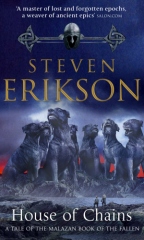
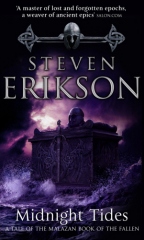
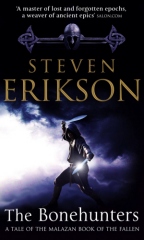
House of Chains – Midnight Tides – The Bonehunters – Steven Erikson (1015, 932 and 1202 pag.)

If I like to check thickness and wordcount, I can only be pleased of Erikson just by the sheer size. Soooo pretty massive tomes. And a saga of ten books, plus spin-offs. That’s another reason why I have to like him, there’s so much to read that I hope it will be all awesomely awesome. All three books use the exact same typeset, so the number of page is indicative of actual size. Not so much comparing them to other authors, as, oddly, there are just 37 lines of text on a page, compared to a standard of 40-42. So usually take about 150 pages from the total count to have an idea. Still impressive.

Erikson’s books also have the very best maps (and more than one for each book). I know the presence of a maps is debatable as there are both advantages and disadvantages, but in this case they probably help with the scope. You’ll be confused enough by the habit of Erikson of not explaining a damn thing that you don’t want to be confused by the geography and where-is-what as well. Just an example: the first book begins at the Mock’s Hold, on top of a cliff and in the city of Malaz. At the time I started looking for “Malaz” on the map for a long while without finding it. You would guess that the “Malazan” empire that gives the name to the series should be on the map. But it isn’t because it’s not even on the same continent the map in the book is about. Instead looking at other books you find out where Malaz really is, and, today in Bonehunters (book 6), I find a good map of the city itself. And while Erikson description were very good, it’s still refreshing to have a better and doubt-free look at it.

Does someone have the US version of House of Chains? Because as I expected looking at the maps online, that map is not printed exactly well, and it misses the central section. Since in the two US Erikson books I have the maps are printed better, I wonder if that map is too.

Anyway, I’m about to start from book 1. In the meantime I should also write some comments about that second book of the Black Company I just read. I can anticipate it was a bit deluding.

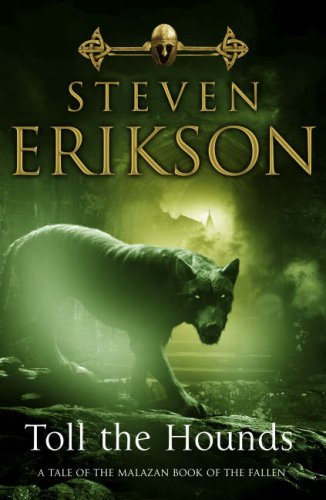
Oh, and the cover of Toll the Hounds is out. As I commented over there, I don’t like it much as it doesn’t present well the book. Looks too much like a spook/supernatural book. And Erikson needs something that shows the qualities of his books, so wide scope, scale, sense of wonder. Neither the US or the UK covers underline those qualities.

It also looks to much like the annoying Beast in that Witcher game.

No books at my door… Yet.

It looks my monthly shipment of books will take slightly longer than expected.

On the tracking page the package seems lost somewhere into Germany. On flight and waiting for delivery I also have a package with the American hardcover first edition of “The Darkness That Comes Before” (the one with the pretty cover), and some drugs (well, not really) I bought from here.

The plan is that I finish the second book of the Black Company in two/three days (I keep delaying it even if I’m just 80 pages from the end) and then start to finally *work* on Erikson. I want to keep a good pace even if I still read very slowly by other blogs standards. About a book every month, fitting that second book by Abercrombie somewhere, so that I can then order Abercombie’s third and Erikson’s seventh at the same time since they have similar release dates (March/April). Then continue the epic reading task of Erikson up to book 7 and in time for the Hardcover edition out for June/July of “Toll the Hounds” (book 8), as announced. Which should also be out along with the huge tome of Esslemont also set in the Malazan world.

Plenty to read, and even if I still haven’t read anything to Erikson, I HAVE TO like it, because he tries to do exactly what I want from fantasy. And if he fails I have little hopes to find it somewhere else. Not that the genre is arid, see my recent comments about “The Blade Itself”.

I read that Erikson is already well into book 9, and expects to complete it even before book 8 is out. I think this is the first case EVER of a writer who not only respects the schedule, but that is AHEAD of it. I have high hopes that the series will be complete by January 2010, and, no matter of personal tastes, Malazan will surely be the most ambitious fantasy project ever realized.

There’s also this aspect I wanted to discuss. You may think that when a writer pushes out books too fast they will feel rushed. While a writer like, say, Martin, takes his time and rewrite endlessly chapters till they aren’t absolutely perfect. So you have this different approach. From a side books that are made to last, going as close as possible to perfection (art). And then books that are considered like “consumables”, so they need to be pushed out in time, see a sudden, short-lived success, and then disappear (commodities).

Well, I have instead a very high respect for those writers who work their asses off, and don’t wait for “inspiration” before starting to write a word on a page. Writing is still “work”. It’s fatiguing, and if you aren’t fatigued it doesn’t work. As a matter of fact, it’s almost a rule that those books that come out quickly in a series are usually the best, and those that get delayed, and then delayed more, almost always finish to disappoint and reveal a dip in the quality. This, I think, because writing is a matter of complete immersion. Either you lose your life to be completely absorbed by it, or it doesn’t work. There is no other way to write a book than your blood.

When it comes to books it seems in practice that more time almost never equals to better quality. But the opposite.

I also noticed that my don’t-call-me-review of “The Blade Itself” was linked by Abercrombie himself. So I guess I’m losing my “covert”, low-profile purposes for the drift of this blog toward books. I like staying anonymous. On the other side I feel like I got more “validation” in two months writing sporadically about fantasy books than three years writing daily, and more competently, about MMOs. But then, who cares. Validation isn’t between the goals, and I’ll “reward” Abercrombie by being very harsh with his second book ;)

Anyway, to those landing here for the first time, remember that I’m not English native speaking. So I try to write as I can, hoping it can be at least interesting for an occasional reader.

The yearly bitching at Mark Jacobs

Since I already stepped outside my purposes by commenting on Vanguard I decided to add on top of it by commenting one recent post by Mark Jacobs I spotted. The reason is that for once I don’t have much that is edgy or bitchy to say. So I decided to do it for a change. And while I demonstrate to not respect my own rules, don’t expect any more comments about MMOs for a long while. Take this as an EXTRA.

The comment I spotted is on the WarhammerAlliance tracker, I’m going to nitpick it:

Truth #1 – In terms of sub numbers DAoC was higher than AC and around the same as UO. These numbers are a matter of record and have been cited by numerous people over the years. EQ and of course WoW were more successful but on the other hand, DAoC cost only 2.5M to make in 18 months and its earnings to cost ratio make it one of the most successful games, not just MMOs, of all time. Its profit margin is even higher and based on what I know of almost all the other studios out there, was the best of any of the aforementioned games because of the game’s lower costs for bandwidth, servers, etc. DAoC is 6 years old and still running.

Sure, DAoC was a success. Mythic deserved that success, put together a very good team, licensed some terrible middleware that still cripples the game today and will cripple Warhammer too, BUT that helped a lot pushing out the game so quickly and efficiently. It’s probably for that crappy middleware that DAoC was *possible*.

So, DAoC’s success should be measured on its own scale. As should EVERY game. Eve-Online has been MORE successful than DAoC, I’d argue. Measured on its own scale. And, measured on its own scale, WoW would have been a massive failure if it had just 400k subs all over the world. But it has nearly 10 millions. So it is not. Keep this in mind because I’ll return on this point.

Sure the (DAoC) numbers are going down as they have been since WoW but *every* MMORPG that was launched before WoW took a hit from that game.

It’s just too easy to argue this, but not too easy if the arguing isn’t as superficial as that claim. Eve Online is again the exception to a rule. It grew and didn’t sink.

I’d phrase that claim differently. MMOs whose numbers went down were all MMOs that presented the same gameplay WoW had (so most of all). WoW made a better work, so players moved there. It’s simple. DAoC, between all similar MMOs, was the game who lost MORE players overall. Why? Not so much because game design went down the drain after TOA (that’s another matter, not incisive here), but because WoW targeted those players and offered something better. While WoW’s PvP is still limited, it’s still the biggest effort since DAoC. And while DAoC still has a charm that wasn’t recaptured, WoW, as a whole package, is just better than DAoC as a whole package.

Truth #3 – DAoC was the most successful MMORPG in Europe prior to the “WoW era”. Nobody, not even EQ, had the same success in Europe that we did. This includes AC1, AC2, UO, EQ and all the other smaller MMORPGs that game out prior to WoW.

True. And it’s why licensing Warhammer was a good move on this front. Trying to strengthen your position in a field where you are already strong. Supposedly because Warhammer has a more European appeal.

Slight problem: we aren’t anymore “prior to the WoW era”. Rules are different now.

I wish I had saved all the snark from Sanya and others when they kept repeating that WoW was as every other MMOs launched and that it wouldn’t kill DAoC. Fact is that WoW killed DAoC and shapeshifted the whole market, entirely changed the rules. Only that MMOs don’t die in a day. They become just corpses that continue to struggle indefinitely. It still doesn’t mean they are alive.

2) Assertion – DAoC failed because of Trials of Atlantis and because we made RvRs do PvE.

Truth #1 – DAoC’s numbers were going down as expected even before ToA.

I call this false, even if I don’t have any factual number, while he has them.

I remember the numbers on the live servers well. During summer Mythic always lost some activity, but then it was stable. DAoC’s numbers weren’t going down prior to TOA. They just oscillated as it typical of every MMO without major updated. When TOA launched numbers went up significantly. Three months after TOA I think DAoC peaked on concurrent logins. So it actually was doing really well after TOA. I believe because TOA was an ambitious expansion, with lot of work and resources gone into it. Three months later and with the actual conscience of the flaws, players started to say “fuck it”. So the impact of TOA’s failure actually arrived after some time, and it then lasted for a veeeery loooong time. What TOA did was destroy Mythic’s reputation more than the game itself. TOA’s effects on the game were long term.

Truth #2 – If the PvE required for ToA had been better, the PvEing wouldn’t have been as big of a deal but as I just said above, and countless times before hand, it wasn’t so it made it worse. Burning Crusades required WoW’s people to PvE and yet less of a stink was made about it because they did a better job with it than we did and we paid the price for it.

I agree, even if “making PvE better” isn’t the real solution to a less superficial problem (relationship between PvP and PvE in a mixed game type).

But here Mark Jacobs misses Truth #3, the most important. It’s slightly before TOA (so where Mark Jacobs puts the start of DAoC’s decline) that Mythic started to move resources away from DAoC and over to new projects. Namely Imperator. DAoC suffered firstly from this shift of focus, that never ended as it moved smoothly through Imperator development, to its sudden cancellation, and right into the purchase of the Warhammer license. It’s not game design that killed DAoC. It’s management. And management is about choices.

Truth #2 – We listen more to our community than any other developer of a major MMO as our betas have proven.

I’m sure you can work for any other company and claim the same. I’d add “subjective” before “truth”. But then I was never in DAoC or Warhammer betas, so no first hand experience.

Assertion – We are keeping out the players because WAR isn’t ready

Truth – We have delayed beta and the game before, and will do so if necessary again, to make sure WAR is a great game. I will not apologize nor be sorry for doing so in the past and if it happens again, I won’t be sorry then either. So, guilty as charged. That’s what all the great developers do and we want to be considered in the same breath as people like BioWare and Blizzard and you don’t get there by cutting corners or releasing a game before its ready. We will take the time we need to make the game great, period, end of discussion.

And here comes the real truth, that Mark Jacobs tried to disguise.

He starts his post saying that DAoC was a success because, requoting:

DAoC cost only 2.5M to make in 18 months

And:

and its earnings to cost ratio make it one of the most successful games

Understood? So, as underlined above, an exceptional success on its own scale.

But how can be this justification valid when projected on Warhammer? Because Warhammer as a project BETRAYS BOTH those critical points:

1- Warhammer cost Mythic independence, had to sell out to EA to make it possible.
2- Warhammer is being delayed because not ready.

One wonders that Mark Jacobs sold out Mythic to reduce the risk. That’s his claim, Mythic was on edge after all the work wasted on Imperator and with DAoC going down, if Warhammer failed then they would have been in a very bad situation. Supposedly selling to EA bought them time and resources, so more living space. More hopes?

If only was that easy. Once again DAoC was a huge success because of its costs. If there’s a rule that was valid for DAoC and won’t be valid for Warhammer is that one. EA dumped on this new game a lot of money and resources. That comes at a price and the price is that expectations rise.

Consequently, if Warhammer is as successful as DAoC, it is a failure. Because its costs are not even comparable, and EA won’t leave Mythic its space if all they can do is make another 300k subs game. So this is where all Mark Jacobs post comes apart. You can’t justify Warhammer through the example of DAoC because DAoC was made under different rules.

As Lum repeats continuously, yes, you can be successful and profitable while still small. Problem is that the rule is not valid in the specific case of Warhammer. And it is not valid because the management decided to go big, sell out to EA, and overturn the principle on which Mythic worked (stay out of the radar, then come in and surprise everyone).

What will be of Warhammer?

I think Lum’s predictions are overly optimistic. The first batch of players will be of the unfaithful/jumpy kind. Those who go out and try every now MMO, last two months max, then lose interest. From my point of view the biggest competitor at this first stage will be LOTRO. The one game without strong bonds and already filled with that kind of jumpy players.

At this stage I know very little of Warhammer. I kind of expect an execution slightly better than LOTRO. The license may be strong, but stronger than LOTR itself? So my opinion is that the number of active subs will be on that scale. I stick to my old prediction. 400k or less in six months. As long it launches in US+EU at the same time. From there it’s hard to predict without having seen the game. If much more or much less will depend solely on the quality of the game. I doubt it will reach 1M.

Making better PvP is kind of easy. WoW itself would just need some more persistence and more guild involvement. Banners or something to display, some territorial control. Elements borrowed from strategy games and RTS, Blizzard should know them. Just empowering the players enough so that they don’t just fight anonymous faces or over continuously resetting objectives/achievements. Something that puts players together working on a shared objective, more than just a personal piece of power-up. Something more motivating and moving. And as always there are plenty of ways to achieve all this, you just need the WILL to go down that path. Start trying things and experiment progressively. PvP isn’t a system you get right all at once.

Warhammer is trying some of that. I’m skeptical mostly because the game design doesn’t seem to have found a clear direction yet. Just heaping together different game modes without a clear concept of how they should work together, or what drives the players progress.

One last remark for Krones. I don’t actually remember Mark Jacobs calling my ideas ‘rubbish and not worth piddly-shit’. I guess I would if it happened because it would be amusing. And I don’t think he did because I seriously doubt he ever read anything I posted on this site.

I’m not worthy to be what Lum was for Richard Garriott back in the day ;)

Posted in: Uncategorized |

Two words about the fireworks

The year starts refreshingly.

I noticed this old-style drama, yet about Vanguard, on both Plaguelands and K10R. Fun stuff, reminds me of old times.

Just a few words:

1- While I don’t believe every word written, I think there may be some truth and it is not a complete hoax.

2- The guy isn’t scared about burning bridges.

3- Comments about private life are always inappropriate and should be omitted. Those were gratuitous attacks.

4- I was the first to call Vanguard vaporware when Anyuzer started to drink the Kool-Aid, years ago. I spelled it out: it was vapid. Those comments, while poorly written and making me ashamed, are still mostly valid. Vanguard wanted to be a design innovation, but it didn’t innovate anything aside some very vague (almost valid) concepts that weren’t properly made a whole (as game design should be).

5- I would defend Brad McQuaid. I think he proved that he believed in the game and that he had a vision. Debatable, but still personal, strong and competent. I’m sure that he saw the thing sinking from far away and still blindly continued to hope in some kind of external intervention to make the miracle. If they say he didn’t do shit in the last year of development, I would believe. But I don’t believe that he didn’t care about the game and that he was slacking. I just don’t believe in this drug-addicted image of Brad McQuaid, careless and hands-off his game.

6- Vanguard, once again, was a failure for *technical* execution first. Programming. Graphic engine. Server stability. Art and animations. Controls. Game design comes after those, and in that Post Mortem there’s no mention of those flaws, as if the game’s faults were all about high-level design. The game didn’t fail because of Game Design, it failed because it was a POS close to Shadowbane. It was broken. Not because the newbie quests weren’t written by senior designers, but because it ran poorly even on powerful hardware and yet looked awful. You need the basics to work, then you can think about the rest.

7- If Vanguard had a good technical execution but poor game design, it would have survived. Not a success, but something viable (see LOTRO, a game with zero ideas but good execution overall). So it’s the technical execution the most relevant aspect of Vanguard’s failure. And the one that is still ignored the most in discussions.

8- Brad McQuaid has responsibilities as he wasn’t just responsible of the game design, but of the project as a whole. Including the technical execution. In particular: you have to bargain between ambition and concrete possibilities. Especially if you are forming a brand new studios. Start small and improve from there. Aiming too high is another relevant factor behind Vanguard’s failure (and probably others on the horizon).

9- Let’s talk about something else. Thanks. This drama is now about as relevant as Glitchless’ Dawn and Dave Allen’s Horizon. I hope we are past that swamp and that we can expect and bitch on a different level of quality and competence. Good and interesting discussions for the genre are somewhere else.

Posted in: Uncategorized | Tagged:

Ugh

Going from Abercrombie to the second book of the Black Company feels like crashing against a block of granite.

The prose… Glen Cook just seems to try very hard to not be easily readable.

Posted in: Uncategorized | Tagged:

The Blade Itself – Joe Abercrombie

Review in short:

Go buy and read it no matter of your personal tastes. This book won’t disappoint.

I have a bunch of notes scattered around and I’m not sure if I can put them together in a coherent way. In part because my opinion changed through the course of the book. I usually just need a few pages to form a good idea. 30 pages of Glen Cook’s Black Company were enough to give me a precise idea of what I was going to read, same for Donaldson’s first book in the Gap series (just to name two I’ve read recently). With this one instead it was different and only starting form Part 2 (about 200 pages into the book) I started to truly like it. Then it was a steady crescendo.

Some general infos: The Blade Itself is a first book in a trilogy already completed (the third book is due out soon in the UK) and a debut of a relatively young writer (early thirties). Kind of a “modern” fantasy. It has the different POVs written in third person but still as a subjective view, as is habit nowadays, and is (feels) very far from the “already seen”. Feels “fresh”, actual. The overall plot itself doesn’t shine in originality, but I think it’s a misleading element. I also read some reviews about the book before I start reading it and all of them said it was the old plot, old characters but with a funny and original twist. This is true but misleading. It’s not the way the book feels. It’s not just a critical approach to a tired and stale genre, it’s not a “what if” or a simple exercise revolving around a gimmick. You don’t have to have fantasy knowledge to appreciate the style Abercrombie gives to old ideas. Instead it stands on its own. This book is awesome and just doesn’t need and doesn’t want to be compared to something else in order to spill its own value. It’s not good in relation to something else, it is good on its own.

The point being that throughout the book I didn’t thought at this sublayer of wit. I didn’t felt detached enough to give it the cold analysis. Instead it worked on the emotional side. And moving toward the end I really cared for the characters, felt the story emotionally, and I couldn’t-care-less about the supposed academical exercise about “old fantasy cliches with new twists”.

I define it “modern” in the sense of mastery. Take for example the current TV series. Sometimes lacking in ideas, but the *writing* itself today is much more developed and effective. There has been tangible progress. The pacing, the sharp conversations, the wit. These abstract aspects taken from television carry over to this book. It is far from the archaic feel of Tolkien, of the evocation of distant worlds. It is instead modern, sparky, fresh. It is also written with the knowledge of the culture, so those kind of stereotypical situations that appear in the book are always surprising because you never know in which direction the writer will drive them. There was one review that said “It’s written with more wit than most writers use in their entire career” and it is true. There is no filler in the book and every page brings on something ingenious to the point that you wonder if the author can really keep up this pacing throughout.

So the pacing. When I started reading I was skeptical. Very skeptical. A new author, so I started to nitpick things, imagining flaws, criticizing in my head every page, every description. 100 pages in, I was not impressed. Funny, witty, yes. But not impressed. It seemed to go nowhere, the characters were interesting but I still looked at them with a very detached eye. I was amused, but not involved. You know, reading with a kind of air of superiority. The book didn’t seem that good. Felt a writer who was trying hard, but too hard. Like falling short of the point. Good try, slap on the shoulder.

Why it changed then? Is the remaining of the book so much better that it surprised me? Not really. There are no sharp turns or sudden improvements of quality. The book, as I said, is uniform and with a steady crescendo. What was different is that I started “caring” and felt there. I stopped criticizing, I stopped caring about picking (imaginary) flaws and just was carried away in the story.

Now this may be a personal thing, but there are some objective considerations to make. The beginning wants to be fast and catching, but suffers of its own structure. There are a few different POVs as is typical of “modern” fantasy but the scenes are brief so you read very small chunks of different stories and this makes kind of hard to get involved and absorbed into them. It feels fragmentary. You need to wait at least 200 pages before some threads come together, till you discover that the small chunks all belong to the same plot, like branches of a river. On the other side there’s something “catching” even if you don’t know enough of the story, the characters and the scenes. That pays back and entertains while you wait to grasp what is going on as the situations are fun and witty, with characters sharply characterized and so dissimilar that it’s hard to favor one or the other. They are just impossible to compare and seem to belong to entirely different stories and styles (which is a manifest purpose of the writer: give each POV its own style, even in the writing).

So this fragmentation didn’t help to get hooked into the story. It’s hard to feel there when you don’t see “the point” and the scenes feel disconnected. At the same time, now that I read the whole book, I don’t think it’s a “flaw”. It’s just a structural weakness of what the author wanted to do, but I don’t think it could have been done better. It even becomes a theme in the book. Quoting:

If you’re going to travel with a man, and maybe fight alongside him, It’s best to talk, and laugh if you can. That way you can get an understanding, and then a trust. Trust is what binds a band together, and out there in the wilds that can make the difference between living or dying. Building that kind of trust takes time, and effort.

This is a autoreferential metaphor for the reader and the book, how both need time to slowly develop that kind of “friendship”.

The other particular aspect is that the book feels like theater. This is a strong impression that I had while reading. There are writers, think for example Jordan, that follow their characters all the way. The narrative is continue and it’s like the writer never leaves them. It flows in detail. Abercrombie is the exact opposite of this. The whole book is structured in relatively brief scenes, with one setting. You don’t get to follow the various characters, instead you have small slices of their lives, taken at critical points. You don’t get to follow them, you read instead just about key moments and scenes that drive the plot and character development.

This aspect is important because it defines a particular approach that you read about in every other review. You can easily detach the characters (live actors) from the background scenography, that is static. Often the scenes take place into a single room or another symbolic space, and when the scene is over the whole setting disappears and is replaced. Ceases to exist. Feels like you are watching theater, live actor with scenery in the background, with relatively short but significant moments represented. Like Shakespeare made fantasy and prose, but with the distillation of meaning, so that you get no “filler” that is typical of epic fantasy plots. Everything superfluous is chopped off.

It is meaningful because, as others would say, Abercrombie isn’t the worldbuilder writer. You aren’t here to read about secondary worlds with complex history, you aren’t here for that emergent layer. That’s treated as scenery. It’s just the set-up, where the strong point is instead about the live actors. The characters, the introspection, the witty, sharp conversations, the black humor, the sarcasm. It’s all very effective and gives the classic fantasy setup a refreshing feel.

The story starts spread out, then gets together, spreads out again before the end. In the latter chapters the writer does some showmanship, instead of binding one scene and chapter to one POV, he chains them. This is fantastic. You basically see the exact same scene from the various POV (so short paragraphs) that you got to know through the book. One after the other, in the same scene. There’s no repetition, you don’t get the next POV re-telling the same you just read, but the time is instead continuous, flows, and yet you see how much the different POV completely twists the perception of the story. This is pure mastery, from a side you recognize how each character definitely has an unique voice and is perfectly defined, from the other it makes the read compelling, never slogging, and all part of the crescendo.

I start reading and thought the writer was good but average. When I reached the end I simply thought that I don’t have any right to criticize him. He isn’t a good writer, he is one of the very best. He isn’t a young writer trying to do something with his first novel, he’s already a worthy “first tier”. He is no rookie, no need to improve. He is an excellent writer and surprising too.

One critique I have on my notes and that I still find valid, from the perspective of the writing, is about the “retrofitting”. There are two different kinds of writers, those who give you just a summary of the action, and those who describe a battle blow by blow, precisedly described. Abercrombie falls in the latter and is rather good at it. Only flaw for me as a reader is that, while the action is consistent, I still had some difficulties to follow it, so had to reread a few passages to have them clear in my mind. The problem with this is a kind of uneven balance in the way he describes things. So sometimes there’s a lack of focus on what’s more important and not enough on some minor element, with the consequence that the “picture” in the mind of the reader comes confused if not corrected.

I can compare this quirk with Jordan as I recently read it. With Jordan I’m never confused. When I read I picture a scene in my mind, with the elements described. It’s something automatic. Sometimes I don’t notice consciously elements I put in my picture, then I go check and they are there in the text too. For example the book may described a scene in a big room, and I have it in my mind, then I notice the picture I have has the room with a domed ceiling. I don’t remember if I imagined it or read in the description but when I go checking the text I notice it’s there. As I said Jordan is always perfectly consistent. I never need to correct the picture I had, I never need to “reposition” characters on a scene because one I pictured on the right is instead on the left or behind. With Abercrombie instead I have some problems. While he is consistent, as I said, he is more confusing. Just as an example he may start to describe the rain in a paragraph, then describe the woods in the next. The characters are in the woods and it’s raining, but it’s more difficult forming the picture if you think of the rain, then have to add the woods. I’d give more “weight” to the woods. And this is a very small example of a writing habit that I found through the book and that not only applies to the descriptions, but also to the plot. The writer never gives more elements than those that are absolutely necessary for that immediate scene. Often you miss huge chunks of both descriptions and plots, that you read later in the book and have to “retrofit” into the Big Picture. It’s not a flaw per se, but I wanted to point it out.

In particular you can take one of the three major POV (but there are a bunch of characters in the book). Logen, as a main character, is vaguely described at the beginning. It’s like you see things in first person perspective. Wihtout a mirror you can’t see yourself (so Logen). And it’s in fact till the second half of the book that you actually have the character physically described. Through the reactions/eyes of other people. While this is again some writing showmanship, you also in this case have to “retrofit” things. You may have imagined Logen in your head in a way, but then only halfway through the book you have more elements that may contradict your arbitrary mental “image”. As a demonstration of this I didn’t like in a special way Logen, but in the second half of the book I was completely in love. One of the very best characters EVER. I was laughing out loud at some passages. He’s great. And yet he’s a kind of barbarian stereotype that you have branded in your memory, and yet he feels like something you never read before.

There’s also a very small POV. A party of characters. Just a few chapters here and there through the course of the book. But it is some of the very best shit I’ve ever read. The most fun fighting and BADASS party ever. I’m out of superlatives but these guys deserve more. Just a few pages and they deserve the price of the book, and I so hope they have more space in the progressing of the story. I don’t want to spoiler but once again they show how good Abercrombie is. Short scenes, a party of characters, and in just a few lines he gives each one splendid, awesome characterization. While the main, more complex POV had to grow on me, with these guys it was love on first sight. They are something special. It’s all about one word: charisma. And tons of it. Make you laugh, and some of the best, yet totally realistic fighting. Brutal, exciting.

So I think I’ve written down everything I have on my notes. The theatrical feel, top notch writer, focus on the character, great emotional involvement for me, but only starting with the second half of the book. Some (many) absolutely A-W-E-S-O-M-E characters, especially smaller ones (like Brother Longfoot and that “party”). One thing I forgot to point out, the “acting” isn’t overly realistic, but made slightly showy and excessive, exactly like theater works. At the same time the characters themselves are totally consistent with themselves, their situation and the setting. So while the whole pictures comes a bit bloated, it’s still absolutely believable.

Oh, and I have this image stuck in my head, Malacus Quai looking like Steve Buscemi.

By the way, the author has the best blog. Updated frequently, informative and funny.

Monday I order the second book through Amazon, along with more books from Erikson. But now I’m going to read something I already have on my pile. Still haven’t decided (likely the second book of the Black Company, as it is a short read).

Tolkien sucks and Goodkind is great!

Did I get your attention? ;)

I’m just skimming through other fantasy blogs and found some interesting tidbits (that will ultimately somewhat justify the title). The first is an article written by China Miéville, unconventional fantasy writer between the most praised and known for his books set in the city-state of New Crobuzon. Think Burroughs’ Naked Lunch mixed with urban fantasy, Starship Trooper’s bugs and a strong steampunk vibe.

Tolkien – Middle Earth Meets Middle England by China Miéville

He deliberately tried to sound antique and ‘epic’. Cliches constantly snuffle up to us like moronic dogs. Laughter comes in ‘torrents’, brooks ‘babble’, and swords never fail to ‘flash’. The dialogue sounds faintly ridiculous, like opera without the music. Even 50 years ago this cod Wagnerian pomposity was stilted and clumsy. ‘Fey he seemed,’ says JRR – in Middle Earth, rare the clause is that reversed isn’t.

The linguistic cliches are matched by thematic ones. The stories are structured by moralist, abstract logic, rather than being grounded and organic. Tolkien wrote the seminal text for fantasy where morality is absolute, and political complexities conveniently evaporate. Battles are glorious and death is noble. The good look the part, and the evil are ugly. Elves are natural aristos, hobbits are the salt of the earth, and – in a fairyland version of genetic determinism – orcs are shits by birth. This is a conservative hymn to order and reason – to the status quo.

The hobbits’ ‘Shire’ resembles a small town in the Home Counties, full of forelock-tugging peasants and happy artisans. Though he idealises the rural petty bourgeoisie, Tolkien treats them with enormous condescension. ‘It would be a grievous blow’, he says, if the Dark Power were to claim the Shire – to translate, if rural workers were industrialised. Because the good professor loves them so, with their hand-mills and their funny little rural ways. Not that he would want to be one, of course – good lord, no. He has a PhD, don’t you know.

The second piece is a very long Q&A with Terry Goodkind that I found while reading Pat’s Hotlist. He has a very gratuitous quote there but I wanted to read more about it and so followed the link to the whole Q&A.

I never read Goodkind, some of my friends read the first book and all agreed it was terrible. A fantasy soap opera with characters whining all the time. And on the westeros forums I read some truly abysmal excerpts that made me align with the very harsh critics you can read just about everywhere. Like this one that will remain in history:

The bird let out a slow chicken cackle. It sounded like a chicken, but in her heart she knew it wasn’t. In that instant, she completely understood the concept of a chicken that was not a chicken. This looked like a chicken, like most of the Mud People’s chickens. But this was no chicken. This was evil manifest.

So I went reading that Q&A with these kinds of bad expectations but I was surprised. He seems to answer each question with attention. While a bit pretentious in tone he seems to have very clear ideas in his mind, with very little left to the case and in a way that intrigued me. At least to delve and know more about those ideas. I’m always interested in those who seem to know all and do no show a doubt. I don’t need to agree with a vision to be interested, as long it is founded on something.

Reading from the forums I know that people bitch at Goodkind mostly because of rape themes and because he openly tries to shove his own philosophical ideas down the readers’ throats. And reading just the Q&A I can see from where it all comes. But at the same time I’m also intrigued and now willingly to try to read a series that is strongly subjective and that I know runs deeper than the level of the plot. The way Goodkind describes his work makes me believe that it was not superficial, and he motivates what he says, goes a great length into explaining it, so I’m rather sure it’s there.

For example those parts where he explain the real main theme of some of the books:

In a good novel the theme is the abstract, the plot the concretes that explain that abstract. They are inseparable.

The theme of CHAINFIRE, for example, is belief in one’s self. The plot is one man’s struggle to prove what he believes to be true when everyone else thinks he is wrong. The theme of NAKED EMPIRE is the existence of evil. The plot is the struggle to get men to recognize evil for what it is, fight for their own lives, and to deserve victory.

The theme of FAITH OF THE FALLEN is the role of free will in man’s existence — the abstract concept of the importance of freedom to man’s existence. The plot is the battle for individual liberty in a altruistic-driven collectivist society. The concretes of Richard’s struggle make the abstract concept understandable and clear. (And because it is so clear it enrages those who want to cloud the issue so as to champion altruism; the naked hate they exhibit and vicious methods they use only go to prove the book’s point that altruism breeds force and brutality and produces only suffering.)

Which is also consistent with what Erikson wrote about fantasy: the most effective way to deliver a symbol. Make it real.

And this is the part with the gratuitous quote:

In that book Richard learned that democracy does not make something right. People use democracy as a free-floating abstraction disconnected from reality. Democracy in and of itself is not necessarily good. Gang rape, after all, is democracy in action.

All men have the right to live their own life. Democracy must be rooted in a rational philosophy that first and foremost recognizes the right of an individual. A few million Imperial Order men screaming for the lives of a much smaller number of people in the New World may win a democratic vote, but it does not give them the right to those lives, or make their calls for such killing right.

Democracy is not a synonym for justice or for freedom. Democracy is not a sacred right sanctifying mob rule. Democracy is a principle that is subordinate to the inalienable rights of the individual.

Many of the issues in the series deal with these subjects. Sometimes when people read the books again after they have satisfied their frantic, desperate desire to know what will happen next, they discover many of these issues in a new light.

Without talking about that unfortunate example, I tend to agree with him. Democracy isn’t the truth. If you asked people if the earth was flat before Nicolaus Copernicus, they would answer that, yes, the earth is flat.

And people voted for Berlusconi and George Bush in the US. If that’s not the proof that democracy is flawed then I don’t know what it can be.

Democracy only works on a simple principle: mistake is reparable.

But in modern times not only we know that it’s not always the case (people would say, about ecology), but that it’s reparable only when there’s conscience of it. And nowadays all communication studies are dealing with the power of persuasion and make believe. The way to bend the consciousness, drive the mass culture, create meaning for a purpose. The use of strong symbols to obtain persuasion.

Today information is important because without objective information you can’t have consciousness. And without consciousness democracy just doesn’t work.

There are also other interesting parts, for example where Goodkind explains his view on the magic:

One of the reasons people get so technically absorbed in the magic in my books is because (as I’ve said in the section on my philosophy — please go back and read it if you haven’t) I use magic very differently than most other authors. The magic in my books is treated as an existent — a thing that exists. Things that exist have their own identity and therefore behave according to the laws of that identity. That’s the way I make magic in my books behave — by the laws of its own identity. I treat it almost as a mathematical equation. People don’t close their eyes and grunt and wish to make it work, but rather they must discover the natural laws by which it functions, just as they must learn how to make a bow and arrow.

I think I’ll give it a try as I’m the kind of reader who easily moulds the taste to the author’s purpose. In the meantime my to-read list grows to scary levels. I should finish “The Blade Itself” before the end of the year, so I’ll write about it next. I’m truly loving it. I’m not going to show much integrity if I keep praising just every book I read (but then I’m also picking carefully what is laregly recognized as best), we’ll see if things change with Goodkind.

By the way, when on a forum everyone agrees something sucks, and yet dedicate to it no less than 32 threads, there must be something wrong.

Posted in: Uncategorized | Tagged:

You bloggers, have failed

On other MMO blogs I read sometimes that there aren’t anymore arguments to talk about, or discussions to have. If you feel so, it’s because you failed.

I remember clearly why I started this blog. At that time it wasn’t simple to voice opinions. The Waterthread community didn’t have a good opinion of me and liked to ban me periodically and good discussions were going to be invariably lost just because they also periodically wiped the boards.

I started a blog because I wanted to voice my own opinions and build something on them. Not because I wanted to boost my ego, or because I thought my own opinions were indispensable for the world, but because what I wanted to say was different. In a similar way I was also looking for other voices out of the chorus. I started to read Lum when he was the voice out of the chorus. I continued following the community when he became the chorus. I continued looking for and reading those blogs with people who had something to say. I started my blog because I had something to say. A lot.

You may agree or not with what I wrote along the years, being interested or not, think it was utterly stupid or pointless. But it was different. I always looked for other points of view, then make my own opinions. There was this First Rule that made blogs interesting in their own way: THE HATE.

Today people will say that ‘teh hate’ is a thing of the past. The unconstructive hate. I always thought that the hate stood for something valuable: the critical point of view. *I* read blogs, Lum in the first place with his site and community, for a very simple reason. The voice out of the chorus was critical. It was subjective. But it was also honest and without filters. That was the point.

At the time mmorpgs were such a clusterfuck that you needed both consciousness of the thing, and find new solutions. Those “critical”, “hateful” communities figured out things way before the market itself recognized and adapted. They were AHEAD of everything.

So I sneaked there because it was extremely interesting, stimulating. It was alive. There were things to figure out, to study, to find solutions for. It was a “field” that was growing, becoming more important. And it was necessary to learn from those communities.

When I stopped writing about MMOs it was not because I was bored or because I ran out of things to write. But because life pushed me in another direction when instead I wanted to invest MORE time in this thing. The more I wrote the more I had things to say. Different things to say. Relevant in my mind, so on a blog to be offered to whoever was interested.

And today I read of bored bloggers, or complaining that they ran out of interesting arguments. Why are you writing on blog? I always knew my answer.

Today we have an higher number of bloggers. This will always be a good thing. Many are gamer blogs specialized in one game, mostly a tale of experiences in the game more than game design ideas. This doesn’t make them worse or better but from my point of view the today blogs are lacking what yesterday blogs had aplenty: the critical point of view. The desire to change. Make things better. Participate.

As with everything, the culture absorbs subversive attempts and makes them a popular trend shallow and alike. That’s my view on the blogs of today: shallow and alike.

Posted in: Uncategorized | Tagged: