On building false hype

I’m strongly against this new habit across game companies of announcing the announcement. Hype should be built on the merit of things, not on false expectations or projections. I say this not as a personal preference, but because I believe that hype built without a foundation is hype that will hurt in ALL cases, even the best ones.

Mythic will announce something next week. Dunno if it’s a free expansion, a patch or whatever, but these are the small expectations Mark Jacobs is building:

While our patch notes for the next version are certainly worth reading, I think the new content is pretty good as well. Now, whether players consider them totally over-the-top, mega brilliance or simply, kewl, interesting, next generation stuff will be interesting to see. There are other options of course, but I’ll stick with those for now.

Imho, things should be talked about in two cases. Before the fact, if devs want to participate in a discussion and and confront and integrate players feedback. After the fact, to discuss the merit of things.

But announcing and hyping the announce, without anything concrete and objective to say. Why? What for? It’s since release that MJ hypes patch notes, only to have real patch notes out deluding players and him ready to hype the next. This policy operates at a loss, every time it’s a little worse. You’re training customers to not trust you.

Especially when your customers have a critical eye for what you do and you keep going with blind self-praise. It creates a disconnection with the players that won’t bode well at all. There isn’t anything worse than self-praise in the face of your customers.

Posted in: Uncategorized | Tagged:

The worst horror movie ever made

Sometimes you have to recognize some merit in being exceptionally crap (and without ANY redeeming feature).

From a review with which I absolutely agree:

I like watching snakes eat mice just as much as the next fella, maybe even more, but “The Strangers” turns the gobble-’em-up into an ordeal. It’s a fraud from start to finish.

In the film, three strangers in campy Halloween masks stalk and torment two handsome 30-somethings in a well-appointed summer home. The two victims are all but defenseless in the face of the assault, so they never acquire much respect from the audience; though if the movie’s a hit, you can bet Smith & Wesson’s profits go through the roof. The unfortunate couple, played by Liv Tyler and Scott Speedman, are initially presented as somehow dysfunctional; they mumble morosely and act like they’ve wandered in from a Bergman movie about anomie in suburban Stockholm. Like everything else in the movie, this is never explained.

When, in the middle of the night, someone knocks on the door, domestic problems are forgotten and survival becomes an issue, though both are completely incompetent. Writer-director Bryan Bertino leaves no stone unturned in his quest for cliche and his unbelievable depictions of behavior. For the latter, try this: A fellow passing by the house has his windshield blown out by a shotgun. Does he step on the gas? Does he call the cops on his cellphone? No, he gets out of the car and walks into the house showing clear signs of violent disturbance without announcing himself. A tragedy soon follows, but not as big as the one that compelled me to sit through the whole thing.

What a wonderfully craptastic movie. If it was like the usual mediocre horror movies I wouldn’t talk about it here, but this is outrageously bad, to the point you develop some spontaneous hatred toward the director.

It starts with a mood full of unmotivated pathos even if the situation presented is conventional. You keep wondering what are the reasons behind all that but the truth is that there are no reasons, it’s just done badly. Since the beginning there’s a constant use of shaky cam even for normal dialogues, after a while you figure out that it is meant to give the impression that the protagonists are “being watched” but the effect continues to be used out of context throughout the whole movie to the point it becomes just annoying. Not only it’s a bad movie, with not even a pretense of story or internal consistence, but it is even enormously pretentious. There are no motivations gives for anything happening, the stalkers have super-powers just to excuse freaky situations (disappearing all at once) or easy ways out (dodging bullets) and everything else is smoothly driven and pre-planned as the characters move around as puppets just because the screenplay wants things happening without any effort to justify it or make it even remotely believable. It’s just for the effect as the director can’t be arsed to explain what’s happening or even make scenes consistent. Why? Just so. Edgy. Manneristic.

I blame who gave the director the money. A talentless narcissist.

P.S.
I want to save some of it. To make things even worse this movie was marketed as a real story when it’s obvious while watching it that there’s nothing of it that may be even remotely true. In fact it’s not. When the director was a child someone came to his house asking for someone unknown. The day after he discovered that some houses in the neighborhood were robbed and he was deeply impressed. This is the whole “real” story.

The movie lacks any motivation and consistence because it’s the product of wild imagination. Just an elaboration of childhood nightmares that obviously don’t need justifications but that are actually more disturbing because of the lack of them. The movie is, simply put, a representation and projection of irrational fears.

Posted in: Uncategorized | Tagged:

On Seagate hard disk clusterfuck

There’s a problem potentially affecting the great majority of Seagate Barracuda 7200.11 hard disk, including models based on the same series (Maxtor).

Since these were in the last year the best performing drives on the market and with low prices as well, I also bought two. The problem is a most pleasant one, instead of presenting issues that you can recognize and fix, the drive simply stops working one day and you can’t do anything anymore about it. If at the time of shutdown the internal drive journal has the magic cumber of 320 entries in it, when you power on the computer again the drive will be dead.

This event is clearly rare, but you can also understand that every time you turn off your pc there’s a small probability that it happens. The more time passes, the more the chances.

From this originated the whole clusterfuck. Since the problem was affecting most of the drive models, a huge number of typical anxious computer users started to storm Seagate with mails to get their fixed firmware before it was too late. With this big tide coming to them Seagate decided to break their usual policy of only offer firmwares via dedicated mails and instead made the “fixed” firmware public.

Only that this broke their usual safety processes and lead to the majority of people getting a wrong firmware for their drives. The huge number of people started giddily flashing their drives to prevent the problem and only obtained to have the problem executed. What was before a rare risk, became certainty after flashing the bios. All drives went dead. A huge number of people with suddenly dead drivers thanks to a fix that was supposed to prevent exactly that rare risk. A funny implementation of reciprocation.

The story goes on Slashodot and the tide continues to rise. From a side all the users that got to know about the potential failure, from the other all the early adopters who were rewarded of their zeal with a dead drive. Both asking for a fix. Now.

Today the fix arrives, with model versions clearly spelled. On the forums people are reporting that they seem to work.

I’m here wondering if taking the risk of flashing my drives (no space for backups), or live with the other of one day turning on my PC and see all my stuff gone. Sure this was good advertising for Seagate.

Posted in: Uncategorized | Tagged:

On MMO’s recent numbers

I’m the first to say Xfire numbers are unreliable. If you look at Eve-Online the game had a HUGE increase of active players during the holiday, that now seems dying down. This coincides to when they reactivated all canceled accounts for a period of time, so it may explain the surge of activity.

But the “real” numbers looked almost unaffected by that. Look at these graphs. These measure the activity in the same way of Xfire, only of all the players instead of a smaller sample. It is weird that the huge activity increase that Xfire showed is only very slightly reflected in the other graph. The recent weeks also aren’t showing the same consistent dip on Xfire. How can this be explained? Maybe they had a special promotion through Xfire that rigged those results, maybe some bug on the client or database.

In any case Eve-Online seems to have stalled during the last year, maybe reaching its full potential within the constraint of game design that sure isn’t made to be appealing to the large public (along with basic flaws that they simply decided to not address). Now it is slightly growing again, but probably as result of momentary situation related to promotions or launch of expansions. They have already another in the works where they rewrite for the 10th time the tutorials (hint: it’s gameplay that should be reworked, not the tutorial text).

Hard numbers: currently Eve-Online has 250k subs. Putting it head to head with DAoC at its peak.

Now lets see Warhammer. No real numbers to see, beside it vanishing from forums discussions and relevance overall. Xfire is all we have. Not meaningful or reliable, but reasonable. The game is relatively stable, slightly dropping as players burn out. We don’t have real subs numbers, not even projections. Sure is that we won’t have them as EA is likely not too pleased to the point of publicizing them. MJ public “target” was at least 500k, but from other interviews it was quite obvious that his and EA target potential started from 1M going up (or better, a target to reach. didn’t mean to have 1M in 1 month).

Warhammer doesn’t likely have 1M now, I doubt it has 500k. I doubt it has 400k. From Xfire and general reception it is likely that by now its success is set. Meaning that I doubt it will see a relevant increase or even a sudden relevant decrease. It is whatever it is. We can only guess that number, but we know that to sway it now it will take some “extreme triggers” that it is not realistic to expect (especially from Mythic’s righteous game design).

On Warhammer potential subscribers I’ve said a whole lot of different things. Now I’ll explain so people won’t accuse me of writing all kind of things to the different forums and then only link those that were right (I’m not one who wants to win arguments when in fault). When Mythic decided to sell out to EA, I said that Warhammer would have never surpassed DAoC at its peak. 250-260k then. This was as a reaction to the sellout. I explained that I thought it was a bad move. Mythic needed money to be more “secure”, so they went with EA that was working like a guarantee and put them out of troubles. My point was that this transition also had negative aspects to not underestimate. One of them is that if you get much more money to make the product, then this product also HAS TO be much more successful. So if Mythic could be successful by reaching a certain target, with EA’s acquisition that target would become much, much bigger. It’s like as if going from 1 to 10 Mythic didn’t want to go through all the steps, but make a big leap and find itself at 10. I’m against those sort of things.

This year, in August, I got the occasion to try Warhammer. I was surprised, found a game much better than how I was expecting. Good execution, good artistic talent and direction, overall well done and strong in potential. Under these conditions and in a moment favorable for MMO market (no matter what you are going to argue), I thought that the potential subscriptions would climb from my own first “blind” guess. So I wrote on F13 that I expected it to be between 250-500k, with the potential for more if they solved some basic problems (irony: look two posts down and there’s another revelatory in retrospective question).

Well, not too shabby for a prediction. Four months later Warhammer didn’t solve those basic problems, but made them worse in some cases. As I wrote in various occasion I don’t think the game moved in a positive direction, but actually did a number of counterproductive and wrong moves. Pretty obvious that all the potential I saw wasn’t and isn’t going to be realized. The game’s real performance seems rather close to my view.

Today, it is a meaningful thing to notice Eve-Online is probably going to be more successful than Warhammer. We won’t know when exactly since we don’t have numbers. But it is happening.

It is also an obvious defeat for all those who thought EA’s marketing power was enough to attract the big numbers.

P.S.
About showing numbers and naysayers: this will never affect the market in a relevant way. Sure, forum warriors use numbers all the time to prove validity of their opinion (I did it here), but they do not influence results. If there’s a site who shows a chart of a game population going down the game won’t continue to go down because of that chart. The numbers are consequences, not causes. So: fire all marketers, hire competent game designers with eyes that can see.

R(yan) (Andr)ew

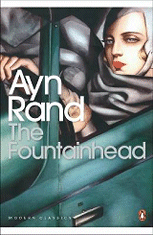
One of the two books I was waiting has arrived:

The name of the writer was obviously inspired to the main character of a popular computer game released in 2008.

The first cover is the book I actually received. The second is the version I decided to order later (after deeming the book worthy), as I explained that I like to hunt on the internet particular editions of the books. First the UK paperback from Penguin Classics, and next the centennial US edition that is just too classy to not buy. Hoping that Amazon doesn’t mess up and sends me the other ugly cover.

I have a lot of curiosity for the book and the introduction already won me over. Thought provoking and ambitious. Culturally and ideally I can’t be further from the objectivism philosophy, so it’s a kind of challenge.

The introduction is written by Rand herself, 25 years after the book was first published. It starts explaining that most writers write “on the range of the moment”, meaning that most books are meant to vanish shortly after. While her intent was to write through Romanticism to reach some universal concepts and values of human existence that would stay actual.

I do not mean to imply that I knew, when I wrote it, that The Fountainhead would remain in print for twenty-five years. I did not think of any specific time period. I knew only that it was a book that ought to live. It did.

Particularly impressive as I’m holding the book in 2009, so more than 65 years after the book was first published.

The whole introduction, spanning eight pages, is interesting and thought provoking. I’ll quote a few short passages and the whole last page, that is a masterpiece on its own:

I want to see, real, living, and in the hours of my own days, that glory I create as an illusion. I want it real.

There was one evening, during the writing of The Fountainhead, when I felt so profound an indignation at the state of “things as they are” that it seemed as if I would never regain the energy to move one step farther toward “things as they ought be”.

I have been asked whether I have changed in these past twenty-five years. No, I am the same – only more so. Have my ideas changed? No, my fundamental convictions, my view of life and of man, have never changed, from as back as I can remember, but my knowledge of their applications has grown, in scope and in precision.

This view of man has rarely been expressed in human history. Today, it is virtually non-existent. Yet this is the view with which – in various degrees of longing, wistfulness, passion and agonized confusion – the best of mankind’s youth start out in life. It is not even a view, for most of them, but a foggy, groping, undefined sense of raw pain and incommunicable happiness. It is a sense of enormous expectation, the sense that one’s life is important, that great achievements are within one’s capacity, and that great things lie ahead.
It is not in the nature of man – nor of any living entity – to start out by giving up, by spitting in one’s own face and damning existence; that requires a process of corruption whose rapidity differs from man to man. Some give up at the first touch of pressure; some sell out; some run down by imperceptible degrees and lose their fire, never knowing when or how they lost it. Then all of these vanish in the vast swamp of their elders who tell them persistently that maturity consists of abandoning one’s mind; security, of abandoning one’s values; practicality, of losing self-esteem. Yet a few hold on and move on, knowing that that fire is not to be betrayed, learning how to give it shape, purpose and reality. But whatever their future, at the dawn of their lives, men seek a noble vision of man’s nature and of life’s potential.
There are very few guideposts to find. The Fountainhead is one of them.
This is one of the cardinal reasons of The Fountainhead‘s lasting appeal; it is a confirmation of the spirit of youth, proclaiming man’s glory, showing how much is possible.
It does not matter that only a few in each generation will grasp and achieve the full reality of man’s proper stature – and that the rest will betray it. It is those few that move the world and give life its meaning – and it is those few that I have always sought to address. The rest are no concern of mine; it is not me or The Fountainhead that they will betray; it is their own souls.

EDIT: A day later and I received the other book this edition of Atlas Shrugged. Uhm, do not buy this edition. They crammed 51 lines of text on the same page, and some pages don’t even have line spacing. Just solid rectangles of tiny text. 1000+ pages of dense text. In mass market this is just not readable, I’ll have to find the centennial paperback for this too, but it can wait.

Posted in: Uncategorized | Tagged:

New mmorpg(?) I might try

It’s here.

Two things:

– Good mindset.
– Good dev presence (and not just for shit and giggles) on the forums.

The downside is that it’s not cheap for a “game” so low on bandwidth and related maintenance costs.

Posted in: Uncategorized |

GRRM and the neverending delays

With the beginning of new year I was at least expecting an update about the status of the book. Good news, bad news, even the same rhetorical lines, I was only hoping in some kind of update to know where he stands. I expected it because the last one was written the 1st January 08, where he wrote he was hoping to finish the book before the summer. Then the summer arrived and it became obvious that he was not yet done (like Iktovian). One year later, not yet done still. But I was at least hoping that he would write us a page. Not of apologies, just of honest update.

As always there are plenty of fans that defend GRRM and the books, and justify every kind of delay as something ultimately good. The arguments are usually two. The first is that more time equals to a better book. The second comes right from GRRM, saying that in the next years it won’t matter when the books came out or how long it took to write them, but just their quality. Meaning that he wants to write for future readers as he wants for current ones, and he cares more about doing the thing right than do it in time.

I write about this because I kind of disagree with both arguments. Against the first I already argued many times. Statistically it seems that the best books from an author or in a series are the ones that took LESS time to write. When the author starts to struggle and need more and more time to complete a book, said book is usually disappointing and below expectations when it is out. Specifically I also believe that more than time = quality, the more meaningful equivalence is: necessity = quality. If you look at the past of Fantasy and Science Fiction genre you see a number of writers that at the time wrote for specialized magazines. They wrote to make money and eat, out of necessity. This means that they HAD to write quickly and favor quantity over quality. Today that time is considered a Golden Age. Only few writers have the luxury to break deadlines without worries and I believe that this can be useful as it can be detrimental. Sometimes better things come out of a scarcity and strong determination, opposed to the whimsical, fickle inspiration.

The other aspect is about considering the book outside its time. Tolkien is still popular today, as are plenty of other classics. It’s the vocation of every writer to transcend time and embrace immortality. The book is in itself immanent and defying time. But at the same time I consider this an unrespectful claim. If you truly like a genre, you hope it to flourish. You’ll try to write books the best you can, you’ll hope to reach people and have success, but you ought also to be willingly to see it exist and flourish WITHOUT you. I don’t know where the genre will go, if it will expand or slowly fade into a niche. A lot depends on how the culture goes. As long there’s a focused interest, good things will continue to come out. So, sure, let’s hope that Martin finishes the book and it kicks ass, and then completes the series in the way he wants. But I also sure hope that in the next years new writers will come that will try to match and even surpass Martin. I think that ultimately that should be the hope, that the apprentice surpasses the master.

If that doesn’t happen then the genre is as good as dead, and the role of the master diminished.