(Mis)adventures in roguelike development: Why now?

If you don’t know what’s a roguelike you can start here, or even go straight to play one of the most sleek and recent games in the genre: Brogue.

The definition usually covers a wide range of games but usually a roguelike is associated with the idea of an ASCII RPG where you generate a character and then go exploring randomly generated dungeons. Why should you care, tho? What is that is good and unique in these prehistoric-looking games? Is it just nostalgia?

My interest in this is because I don’t believe that it’s just about nostalgia. This interest was sparked a few months ago, when I spent several weeks going through old and magnificent Amiga games, and then more weeks on roguelikes. It was almost a frantic search. I do believe that something of value is lost and that those games had aplenty, and a roguelike is an opportunity to mess with that stuff directly. Mixing old sensibilities with the new. But nowadays roguelikes are a lot more than that. The lack of graphic let these games focus on very deep and complex mechanics that you simply cannot find in other genres. So roguelikes aren’t just old looking games with unintuitive interfaces, but also offer a kind of gameplay and complex interaction that is extinct in other games. These games are pioneers, not rearguard.

The other side of the medal is that you can mess with this stuff. Some 14 or so years ago I started in C and under ancient MSDOS an attempt to write a RPG from scratch, using the Allegro library (that is still around) and DJGPP (the Gnu compiler for dos). I wanted to build a simple foundation like the first Final Fantasy games, and then roll into that kind of engine a more deep interaction with NPCs and environments. Without the internet to look stuff up it was an incredibly hard task, even setting up the environment with the IDE, compiler and all the rest. After messing with this for a while and creating a rudimentary skeleton of a game that showed a sprite moving on a tile map (and then getting completely stuck when I tried to convert it to interrupt-based timing so that it wouldn’t run at different speeds on different hardware), I figured it would take me more than a year JUST to write the engine, and then I could have started, maybe, actually making the game, design and content, the stuff that I actually considered interesting. I realized that you either dedicate yourself fully to such a project, in a totalizing way, or it’s just impossible to make something even barely worthwhile. That’s where I stopped. I just couldn’t afford to plan things so long term and sink into that all my time. It just couldn’t be realistically done, even if I only wanted to make my own project without any intention of selling it or whatever.

If I’m back attempting a similar project is because I see in roguelikes (and in the different context, because of the internet offering so much material you can look up) the possibility to quickly get to the “meat” of the game. All the standard roguelikes build the whole game by reusing a few output functions, so the “engine” is almost directly covered. It’s like the possibility to quickly write prototypes the way you want, without the baggage of graphic. So a possibility to remove as much as possible the overhead and busywork of engine programming, and do instead game programming, design, content.

Programming is actually one of the most addicting experiences you can have. More than playing a good game, once you are in the groove. But it is also immensely frustrating if you hit a roadblock and have no way to get over it. That’s when projects usually fail. This time I’ve got the illusion that the path is viable. Because there are good libraries that cover most of the stuff I need, specifically for what I need, because the internet overflows with documentation that you can use, because I can purchase good books on programming, and game programming, and because there are plenty of roguelikes out there that are open source, so you can go into them and see how they work. Pilfer hundreds of games of their good ideas, and put them in your game. The accretion of these parts, and the original, odd mix I want to make is what I’m looking for. I will go back playing those Amiga games and classic RPGs, parse their game design, as well as taking stuff from modern, perfectly designed games like Dark Souls, and then cross-breeding all that with pen&paper RPG rule systems and classic modules. I have already a feature list planned that will take me several centuries to implement, but that’s what makes it fun ;)

I can’t say how far I’ll go, or if I’ll be even able to start. I’m essentially learning programming from zero, starting from the very bottom. My mathematical skills are also abysmal, so the perspectives are bleak. But whatever. The intention is to keep some sort of diary to document my (lack of) progress. An anti-tutorial on top of a tutorial. Whatever I make, in the short or long term, will be open source. Though it will likely take me years before my source is of any interest to someone beside me. But again, I’ll write even the diary for myself, so I can see what I’m doing and all the stuff I get wrong. The thing I hate the most is when I bump into a problem I already solved before, but can’t remember how I did it.

Obviously it all depends on how much time I can allocate to this, and with how much continuity. That’s not entirely in my control, but given the chance I’m extremely stubborn and so I’ll keep going at it.

(since you can’t post comments on this blog, use this just in case)

Posted in: Uncategorized | Tagged:

Guild Wars 2 and ass-backwards game design: why we have lived and fought in vain

This is a leftover. I already ranted well before Guild Wars 2’s release anticipating the problems about overflow servers, long queues in PvP and difficulty for social play in general. My point: this was not only obvious to see ahead (which mmorpg doesn’t have launch issues?), but also avoidable for the most part, if they rearranged the game spaces.

The post where I wrote about this at that time is here.

What drew my attention is this:

During this initial surge of high concurrency, and especially while most characters are low-level and thus playing in the same starting areas, it’s common for players to be directed to overflow servers. To play with a friend on a different overflow server, form a party together, then right-click on the friend’s portrait in the party list and click “join”. We expect the use of overflow servers to naturally subside as players spread out more through the world.

The interesting part to me is how bad game design has a naturally tendency to surface on its own. Guild Wars 2 was designed (deliberately AS OPPOSED to Guild Wars 1) as non-instanced PvE.

The game launches and the norm is: instanced PvE. Because overflow servers are the norm, and overflow servers are an instancing mechanic.

When in practice you get (instanced PvE) the opposite of your ideal (non-instanced PvE), then it means your design is quite broken. I say it surfaces on its own because it just won’t take the form you wanted. It misbehaves. Why? Because the patterns you designed are wrong.

Now the line I underlined is also a wrong assumption. Players’ activity will never balance on its own. It doesn’t happen with linear progression games. At the game’s start all players swarm the starting zones and the rest’s empty. Six months down the line there’s no better balance: the end zones are crowded and the rest of the game’s empty. It’s the exact same situation but upside down.

So their assumption (that the use of overflow servers subsides BECAUSE players spread out) is WRONG. What actually happens is that the use of overflow servers subsides, but simply because it’s the high concurrency that also subsides.

This is not nitpicking, because the problem is that you’re designing a PvE that relies on large public events, that will be essentially broken when six months down the line those zones will be almost completely empty (the right answer here is “who cares” since these days mmorpgs are designed to make money fast and become irrelevant in less than a year, as disposable as single-player games. And in GW2’s case players’ retention is actually a THREAT since they don’t have a monthly fee).

The analysis and consequence about GW2 PvE is this:

– RIGHT NOW: lots of problems for people trying to play together. Public events are popular but PvE is instanced.

– SIX MONTHS LATER: PvE is finally non-instanced but there are not enough players to enjoy the public events.

This is what I call “ass-backwards design”. It’s when PvE is finally non-instanced that you want it instanced. Why? Because instancing can be used so that if there are a few players they are put together. And when there are too many, they are split so that gameplay is always optimal.

Guild Wars 2 realized only the first part: that instancing is essential to avoid overcrowding (overflow servers), but they haven’t realized that instancing is also essential later on, to avoid the depopulation of players outside the endgame.

When you realize also that point, you arrive to a simple conclusion: if instanced PvE is a good thing both early (to avoid overcrowding) AND later (to avoid depopulation), then instanced PvE = good.

It’s that simple.

But Guild Wars 2 designers think game design ass-backwards. They try to design PvE non-instanced. And they try to design PvP instanced. Result: queues EVEN on PvP because their PvE server structure doesn’t actually allow to load-balance PvP. They have the WORST in both worlds.

See the post I linked above for a scheme that solves both problems (by putting players into non-instanced PvP server first, and load-balance PvE through instances).

This is the stuff that was being discussed in 2005 and before, try to search the blog for “mudflation” if you want more. Or see Raph Koster, Brad McQuaid and Scott Jennings go at it. Not to say that things at that time were gloriously good, but the fact is that these problems were being at least discussed and today mmorpg game design has seen an enormous decline that is only offset by the technological progress.

Hence, we have lived and fought in vain.

P.S.
I wanted to add some of the reasons why I won’t buy/play Guild Wars 2. Beside all the above:

– I prefer a consistent personal style (like Dark Souls) to the rainbow colored and theme park oddball settings of GW2 or WoW.
– Zone design looks once again as elaborate cardboard cutout scenery instead of focusing on content that you use and usability in general.
– The combat I’ve seen in videos is overblown with effects of all kinds, from particle effects that obscure your screen to heavy highlights. Whereas I prefer a combat system with tactical transparency (where you can see what happens and can strategize appropriately, even when it gets crowded) and UIs designed to be subtle and unobtrusive.
– PvP in Guild Wars 2 sounds more like enhanced Alterac Valley than enhanced DAoC. No thanks. Too late, not enough.

Mentioning Dark Souls, that’s a game with almost perfect game design on shameless display. Western game design has gone the way of ding, bling, DLCs and trivialities, and looks, honestly, pathetic and unrecoverable.

loopingworld.com

Books/mythology/metaphysics discussions moved to: loopingworld.com

This means that the site here won’t (usually) be updated and I’ll eventually copy all of book-related posts over there. The rest of the stuff will stay here for as long the site stays up (not planning of pulling it down for the foreseeable future).

UPDATE: I’ll sporadically still post here, but it will be for writing about roguelike development, tracking my own (lack of) progress, or other quirky gaming things.

Kabbalah VS other religions

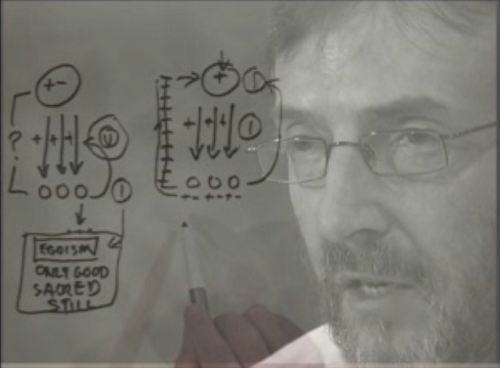
This post has no answers and only doubts, but reading it you’d see what is that Kabbalah is (or wants to be). This is an “answer” to the 12th self-study lesson (a introductory study) and it contains my doubts about it. To see the self-study you’d have to register here, for free. There are 14 lessons in that self-study.

I’ve also included the 12th lesson (about 25 minutes) if one doesn’t want to go through that registration, but I actually encourage you to register and watch the rest as it’s all quite interesting and at least enriching.


I was rewatching lesson 12 of the self-study and got some doubts. I know that Kabbalah can’t be understood simply logically, but as long I’m not “there” I still have to relate to it with my own logic and the ideas I get from the lessons.

It seems to me that the difference between Kabbalah and other religions is not the one described in that video. The difference I understand is that Kabbalah is entirely about spirituality, so it isn’t interested about the physical world. This marks a true difference with all other religions as all religions (as far as I know) do have systems of rules that apply to corporeality. From what you can or can’t eat to when and how you should pray. Even anthropologically all religions were “meant” to regulate the corporeal world and build a certain society.

But instead I can’t stop my doubts about what is explained in the video. I only know well Christianity since it’s where I’m born but, while the people could certainly believe that it’s about “bribing God”, that’s not a good representation of that religion, and the real one isn’t very different from how the Kabbalistic model is described.

The part that gives me the doubts is that one could say that the Kabbalistic process is equally “delusional”. As long the upper light is invariable and the events also invariable (so what changes is solely the self), then it means that the pain itself can’t be stopped or diverted. The pain is instead “understood”, as one, through bestowal, would perceive the “long range”, so the wider purpose beside the egoistical self.

Which essentially would lead one to “endure” the pains of life in the name of a greater purpose that says: there’s indeed a purpose, and it is good willed. One could see his sons killed in front of him, or go through great pains, but always knowing that there’s a “meaning”, and that life is eternal.

So it is true that the suffering is always relative to a perspective, and if one shifts the perspective a momentary suffering becomes bearable. Through life eternal all suffering is bearable as it is momentary. But both these ideas are essentially “consolatory” and Kabbalah would be defined itself as consolatory, as it is all based on two principles that regulate the rest:

1- That life is eternal (and so suffering momentary)
2- That God is good willed, and everything happens for a purpose

If one had the CERTAINTY of those two points, then it is true that pain would be bearable. But isn’t this perspective consolatory and delusional? As you can’t change what happens to you (invariable upper light and events) you have to “endure” it, hoping there’s a good willed purpose even when everything looks very bleak.

The other difference between the Kabbalah and religion is that in religion the salvation or the enlightenment, more often than not, happen after death. So they are “promises” of salvation or enlightenment, and one lives with the “hope” that they are true, clinging desperately to these ideas as they can only justify the pain of life, and give life a sense.

Kabbalah is different as the promise of attaining the “upper world” is here and right now. You say it’s a “science” as it has to be experienced and attained personally, first hand. It’s not a theory or an abstract idea. But the skepticism here is about “when”. One listens to the video courses, reads the books and slowly understands what is Kabbalah, but what’s that ideal point that brings back up to that “tangible certainty”? The distinguishable certainty that Kabbalah is a science and not a consolatory delusion?

I’m explaining the subjective point of view: one comes to Kabbalah trying to learn, but learning leads me to define these ideas of life eternal and purpose as “consolatory”. This can only be solved through a certainty. In other religion you achieve that certainty through “faith”, but in Kabbalah faith is not required, as having doubts and asking questions is encouraged (as in science). I am right there.

Posted in: Uncategorized | Tagged:

A fairy tale escapism

Some quotes from a randomly found article.

What does cultural materialism do? It seeks “to allow the literary text to ‘recover its histories’ which previous kinds of study have often ignored” although the “relevant history is not just that of four hundred years ago, but that of the times (including our own)

The cultural materialist is likewise “optimistic about the possibility of change and is willing at times to see literature as a course of oppositional values”—oppositional, that is, to the “structures of feeling” that are the “dominant ideologies within a society” (Barry 183-4). This creates a need to consider “ALL forms of culture” (183), or in other words to climb deeper the way Oedipa does.

Oedipa’s paranoia could well be called optimism, faith that she is not crazy, but that a structure exists in which she CAN find answers. In fact, she can hardly afford NOT to believe it, with so many showcases of that structure materializing around her.

This cultural materialist optimism about “the possibility of change” would suggest, in both cases, that the disinheritance serves the characters for the better, directing them toward a more enlightening epiphany of their place in the world.

In fact, this theme persists in many examples that find room in those branches of that tree. This theme is better defined as a fairy tale escapism, the classic stepping into another world in hopes of a higher understanding. Could it be that, for example, THE MATRIX of the Wachowski brothers has more in common with LOT 49 than just postmodernism?

Like Neo of THE MATRIX, she seeks an escape from isolation and ignorance into a Wonderland where if nothing else she might feel free.

Everything from a rabbit hole and a looking glass to a wardrobe and a vision becomes a doorway into an underworld, or simply ANOTHER world in which the characters at least hope to find clarity.

Wonderland, the Matrix, Never Land, Narnia…these are only advantageous to their guests so far as they can provide a better way for them to see themselves.

This is an escape and indoctrination into a world to the extent that the visitors become “aliens” to their own original setting, no longer contributing to its dominant morality. Alice cannot forget Wonderland, Neo chooses to remain separate from the Matrix, and Oedipa, apparently, cannot continue unless as “unfurrowed, assumed full circle.”

The cultural materialist would best identify with the question Oedipa asks herself: “Shall I project a world?”

In this case, the theory and the texts do not simply validate each other, but instead confirm the structure to which they belong. This structure, in its very essence, seeks to “project” in a variety of ways new worlds by which to interpret reality.

Posted in: Uncategorized | Tagged:

A “key” to unlock the mystery of Fringe’s Observers

This will have spoilers for Fringe, that you should watch if you haven’t already.


One point that Fringe seems to underline is that the Observers observe the flux of time, as from an external position. Looking from the outside in. What triggered the whole disaster is the fact that the Observers observe “time” without perceiving themselves in it. That’s why September messed everything when Walter(nate) saw him and was distracted from finding a cure for Peter. This intervention from the Observer was accidental (and everything else was an attempt to try to “fix” it). And again this is because the Observers can observe everything but make mistakes because they don’t perceive themselves (and so the impact they have on reality). This is again confirmed (episode 1, season 4) by how naively the Observer replies to the guy asking him for what he needed those TV parts (to make the machine needed to erase Peter from time).

Now bring all that within our reality, take Heisenberg’s uncertainty principle: “observations affect the observed so as to obliterate the observer’s hope of prediction. i.e. his uncertainty is absolute”

“Given these changes in scientific thinking, we are now in possession of the truism that a description (of the universe) implies one who describes (observes it).”

“Implies” as: in the picture. A kind of recursive loop (for more on this read: “Godel, Escher, Bach”):

So the Observers in Fringe are like a metaphor of what is going on in our world. Those Observers are incapable of seeing themselves in the picture and so make an “objective” observation. With the point being: we also are observers who are incapable of perceiving reality for what it is.

There’s actually an “happy end” though, as these theories seem to ultimately lead to an amplification of freedom.

I mean, these Observers are fucking retarded. It wouldn’t be that hard to put on a wig, or even make an invisibility cloak.

P.S.
About this and everything below on this blog. I found out that Bakker is miles ahead of me. As I should have expected. Maybe I’ll write about that next.

Posted in: Uncategorized | Tagged:

Something bordering the impossible just happened

Nope, not about neutrinos breaking the speed of light. As you can see from previous posts, while watching Fringe I noticed some books ideally belonging to William Bell that I recognized. Between these, there was “Gödel, Escher, Bach” and two of Castaneda’s books. Now, it’s Fringe writers that put these two together, because these books are ABSOLUTELY NOT RELATED. One is about math and logic, also having won the Pulitzer, the other is about spiritualism and considered by many a fraudulent anthropological study. It’s the TV show that took elements from both to build its own science fiction mythology. So, the two are unrelated in the “real world”.

Now, while reading some reviews of the GEB on a Italian internet book shop, I found one that said that the book was a fundamental read on the nature of knowledge to put right next to “Observing Systems”, by Heinz von Foerster, another must-read classic. Since I’m curious I went on to research this other guy and realized that his fundamental ideas were similar to Niklas Luhmann, that I studied and appreciated during university. So I put an order for that book.

Today I receive the book. I flip the first pages and I find an introduction written by some Italian guy. In the very first page Castaneda is mentioned.

That’s the sort of “coincidence”. Not coincidence as in supernatural “sign from above”. It simply means that the links I see between these ideas are not my own hallucinations. These themes have a lot to share and you’ll find often that they recall each other even when not consciously. In this case the link was repeated three times, each concretely unrelated. One by Fringe writers, one by me in the previous post (before receiving the book), and one by the book’s introduction.

This was a mention of Castaneda in relation to the GEB in a Italian Preface, so not directly part of the original text and its purpose. In a book I bought because it was mentioned in a random review on the internet that was on a completely different argument. So we have this relation repeated twice, where each instance of it is UNRELATED to the other. One instance is about Fringe writers that have their own ends to fill, and put the two works together (GEB and Castaneda) as their own personal creative effort in making a fictional TV show. The other instance is an Italian Preface to a von Foerster book mentioning Castaneda, whose (the book) link to the GEB was because it was recommended in a review.

The spurious element is von Foerster. It never entered the picture in the TV show, its mythology, or, likely, the writers’ mind. Yet it marks the link between fictional creative/speculative needs AND actual scientific studies.

And so the objective proof of the outward expansion of culture countered by the inward force that determines that ideas eventually “return home” and reveal the same origin. Or this, probably consolatory and delusional, idea of mine that all these are pieces of a puzzle that is up to me (or whoever else) to put together, to reveal the Grand Design.

Posted in: Uncategorized | Tagged:

Beyond Post-modernism

Chasing red herrings in the hope they lead somewhere. But the number of overlapping analogies and returning ideas is quite amazing. As usual, when things make TOO MUCH sense, I label them as “consolatory”, and so unreliable and most likely false.

The journey through Post-modernism led me beyond, then back in, as in a loop. Another starting point was again provided by mass-entertainment, Fringe (the TV series). This time it was a frame, specifically episode 12 of the third series. It briefly shows some books belonging to William Bell (a character in the series). The first and last are too out of focus to recognize, but the others are explicitly shown and one of these two is a recurring book, as it was also shown in LOST. The curious fact is that I also owned some of those books:

– A Separate Reality – Carlos Castaneda
– The Second Ring of Power – Carlos Castaneda
– In the Wake of Chaos – Stephen H. Kellert
– Gödel, Escher, Bach – Douglas R. Hofstadter
– The Tao of Physics – Fritjof Capra

I own “Gödel, Escher, Bach” and a book of Castaneda not on that list: “The Art of Dreams”. The interesting part is the links between these books and some of what I wrote in my previous post. Chasing after magic, spirituality and metaphysics means getting lost very easily, waste a lot of time and get sidetracked without gaining anything really useful. I’ve always been a curious skeptic, and so I’ve dabbled here and there with these kinds of studies in my life, without getting a whole lot out of them. Often they are empty lures. This time I think I have a better orientation system I’ve built. I know where to place things and I can separate better between the garbage and something that has some deeper relevance.

I discovered that “Gödel, Escher, Bach” has now a preface by the author done for the anniversary. My copy of the book is very old and doesn’t have it, but I’ve figured out it can be read online. Amazon preview has it, but it misses some pages, but by mixing the amazon.com preview with the amazon.co.uk one it’s possible to read the whole of it (which now resides complete in a folder on my desktop, in the case they decide to “fix” it). This preface is extremely useful, as it explains concisely “what the book is about”, and its purpose is far more important and pivotal than the title may suggest. It’s a research on consciousness, and perception as consequence (bringing back to the essence of postmodernism, as way to read and portray the world).

This book sits right beside some other studies of mine that are at the very foundation of my (scientific) “beliefs”, and they earned this position. One is Niklas Luhmann, the other, that I discover now, is Heinz von Foerster. Both build a logic system that works like math. It explains the world outside through rigorous rules that are meant to be unassailable, still very close to the original methodology of GEB (the book above). They deal directly with the partiality of the observation. They know human limits and so their systems have to exist wholly within. Systems that recursively observe themselves (which is, the recursion and “strange loops”, where the GEB believes the consciousness emerges). Two books of Heinz von Foerster I have already on the way, another I found online.

A step back to Japanese Anime. Relevant quote:

“How about I observe. Therefore the universe is. Therefore, we can say if the human beings who observe the universe hadn’t actually evolved as far as they did, then there wouldn’t be any observations and the universe wouldn’t have anyone to acknowledge its existence. So it wouldn’t really matter if the universe existed or not. The universe is because human beings know it is.”
— Itsuki Koizumi, The Melancholy of Haruhi Suzumiya

This will recur. Now follow the trail to this, skip to page 37 (this book was published in 1865 and about the ideas of a philosopher who lived at the end of 1600, someone truly postmodern then):

Everything exists in the mind that perceives it; and apart from the perceiving mind nothing exists. The real place and form of existence is in the idea. The desk I write upon, the paper I feel – they exist in my ideas, and nowhere else; and they may exist in the ideas of all others, if they only saw and felt them, at the same time. If the perceiving ego did not exist, the desk and the paper before me could not have existed. Ideas are objects of perception, and their existence is in the fact that they are perceived. Ideas are different from the mind, and yet they exist in the mind.

[…]

If it is not perceived by anybody, it does not exist; for its real existence is in the fact it is perceived by some intelligent mind.

Now something more recent. “Radical constructivism: a way of knowing and learning” By Ernst von Glasersfeld.

What is radical constructivism? It is an unconventional approach to the problem of knowledge and knowing. It starts from the assumption that knowledge, no matter how it is defined, is in the heads of persons, and that the thinking subject has no alternative but to construct what he or she knows on the basis of his or her own experience. What we make of experience constitutes the only world we consciously live in. It can be sorted into many kinds, such as things, self, others, and so on. But all kinds of experience are essentially subjective, and though I may find reasons to believe that my experience may not be unlike yours, I have no way of knowing that it is the same. The experience and interpretation of language are no exception.

Heinz von Foerster follows similar ideas:

”Objects and events are not primitive experiences. Objects and events are representations of relations. Since ‘objects’ and ‘events’ are not primary experiences and thus cannot claim to have absolute (objective) status, their interrelations, the ‘environment’ is a purely personal affair, whose constraints are anatomical or cultural factors. Moreover, the postulate of an ‘external (obective) reality’ disappears to give way to reality that is determined by modes of internal computations.”

Only he clings more to mathematics and sometimes the (my) brain can’t compute:

Assume a finite universe, U0, as small or as large as you wish, which is enclosed in an adiabatic shell which separates this finite universe from any “meta-universe” in which it may be immersed. Assume, furthermore, that in this universe, U0, there is a closed surface which divides this universe into two mutually exclusive parts: the one part is completely occupied with a self-organizing system S0, while the other part we may call the environment E0 of this self-organizing system: S0 & E0 = U0.

Bu lets keep it to ideas that the brain can try to grasp. This from another book (whose name fits: “The Dream of Reality“):

The constructivism of Heinz von Foerster is concerned with the convergence of two central themes: 1) how we know what we know, and 2) an abiding concern of the world and its humanity. For the constructivist, the dreams of reason denote a common denominator running through our language and logic, manifest as a wish for what we call “reality” to have a certain shape and form. The wish has several dimensions.

First we wish reality to exist independently of us, we who observe it. Second, we wish reality to be discoverable, to reveal itself to us. We wish to know its secrets, i.e., how it works. Third, we wish these secrets to be lawful, so we can predict and ultimately control reality. Fourth, we wish for certainty; we wish to know that what we have discovered about reality is true.

Radical constructivism challenges this wish, thus taking on the unpopular job of shattering the fantasy of an objective reality. Constructivists argue that there are no observations — i.e., no data, no laws of nature, no external objects — independent of observers. The lawfulness and certainty of all natural phenomena are properties of the describer, not of what is being described. The logic of the world is the logic of the description of the world.

Constructivism identifies, for all who care to look through the lens of its epistemology, the limits of what we can know.

But is this “bias” just the result of subjective, limited perception (and so the impossibility of breaking the shell and see what’s outside), or there’s a method to it, a purpose? That’s exactly the point that divides science from metaphysics. But it is the science itself leading to that edge and then leaving you alone. Science has a direction, it leads there and then surrenders. So I make this leap and cross to a less orthodox book: Initiation Into Hermetics, by Franz Bardon.

Man is the true image of God; he has been created in the likeness of the universe. Everything great to be found in the universe is reflected, in a small degree, in man. For this reason, man is signified as a microcosm in contrast to the macrocosm of the universe. Strictly speaking, the entire nature manifests itself in man.

It forms itself a loop, a recursion. Bringing back to that pivotal idea of conscience revealed by the GEB. The “strange swirl”. It is in nature and it is in us.

Kabbalistic ideas essentially rely on the same tenet.

These ideas can even be brought to their limits. For example by von Foerster himself:

”At any moment we are free to act toward the future we desire. In other words, the future will be as we wish and perceive it to be. This may come as a shock only to to those who let their thinking be governed by the principle that demands that only the rules observed in the past shall apply to the future. For those the concept of ‘change’ is inconceivable, for change is the process that obliterates the rules of the past.”

And while I’m unsure to what extent he intends this, there are some (tapping from Kabbalistic ideas, that are at the foundation of reality as a “fake” illusion) that intend it literally: Neville Goddard.

The Power of Awareness

I AM is the self-definition of the absolute, the foundation on which everything rests. I AM is the first cause-substance. I AM is the self-definition of God.

I AM hath sent me unto you.

I AM THAT I AM.

Be still and know that I AM God.

[…]

Can man decree a thing and have it come to pass? Most decidedly he can! Man has always decreed that which has appeared in his world and is today decreeing that which is appearing in his world and shall continue to do so as long as man is conscious of being man. Not one thing has ever appeared in man’s world but what man decreed that it should. This you may deny, but try as you will you cannot disprove it, for this decreeing is based upon a changeless principle. You do not command things to appear by your words or loud affirmations. Such vain repetition is more often than not confirmation of the opposite. Decreeing is ever done in consciousness. That is; every man is conscious of being that which he has decreed himself to be. The dumb man without using words is conscious of being dumb. Therefore he is decreeing himself to be dumb.

When the Bible is read in this light you will find it to be the greatest scientific book ever written. Instead of looking upon the Bible as the historical record of an ancient civilization or the biography of the unusual life of Jesus, see it as a great psychological drama taking place in the consciousness of man. Claim it as your own and you will suddenly transform your world from the barren deserts of Egypt to the promised land of Canaan.

But in his own thinking this omnipotent “free will” is not everything. Beside “The Law” (what I’ve quoted), there’s another part: “The Promise”. “Not one shall be lost in all my holy mountain.” Meaning that there’s a purpose that drives all things. In the end God is waiting at the end, waiting that you learn and go through that path, however long it will take you (another idea coming from Kabbalah).

And this idea, of two kinds of perspective (and realities), one short term, the other long-term, recurs into that wonder that is The Red Book, by Carl G. Jung (this requires youtube).

The overall theme of the book is how Jung regains his soul and overcomes the contemporary malaise of spiritual alienation. This is ultimately achieved through enabling the rebirth of a new image of God in his soul and developing a new worldview in the form of a psychological and theological cosmology.

Jung:
If I speak in the spirit of this time, I must say: no one and nothing can justify what I must proclaim to you. Justification is superfluous to me, since I have no choice, but I must. I have learned that in addition to the spirit of this time there is still another spirit at work, namely that which rules the depths of everything contemporary. The spirit of this time would like to hear of use and value. I also thought this way, and my humanity still thinks this way. But that other spirit forces me nevertheless to speak, beyond justification, use, and meaning. Filled with human pride and blinded by the presumptuous spirit of the times, I long sought to hold that other spirit away from me. But I did not consider that the spirit of the depths from time immemorial and for all the future possesses a greater power than the spirit of this time, who changes with the generations. The spirit of the depths has subjugated all pride and arrogance to the power of judgment. He took away my belief in science, he robbed me of the joy of explaining and ordering things, and he let devotion to the ideals of this time die out in me. He forced me down to the last and simplest things.

The spirit of the depths took my understanding and all my knowledge and placed them at the service of the inexplicable and the paradoxical.

To note that Jung was convinced that what he wrote and drew was not a product of his own conscience and imagination, but that it was some kind of alien or external knowledge that seeped in, to the point that he questioned his own sanity.

In 1913 at the age of thirty-eight, Jung experienced a horrible “confrontation with the unconscious”. He saw visions and heard voices. He worried at times that he was “menaced by a psychosis” or was “doing a schizophrenia.” He decided that it was valuable experience, and in private, he induced hallucinations, or, in his words, “active imaginations.” He recorded everything he felt in small journals. Jung began to transcribe his notes into a large, red leather-bound book, on which he worked intermittently for sixteen years.

In the end, he believed that this book came out of the “collective unconscious”, or Akashic Record. Make of this what you will, but it is interesting how many ideas in it recur and resonate with the rest.

All this oddly brought me back to Malazan and Erikson’s work. Because that’s not truly “fantasy secondary world”, but more an internal, symbolic landscape. Something of the mind. And in particular, it is not “alien” or fabricated as we may naturally intend it. It mimics and reflects more our world than what one assumes. One tenets of that work is about the disparate number of mythologies and beliefs specific to each population. “Systems” that seem quite hard to conciliate with each other. Appearing contradictory. And often things reveal a common root, that was disguised by limited, blind perception. More often than not, those branches are revealed having shared origins.

Without thinking how all this applies to the Malazan world, lets think to how it applies to ours. We also have as many “mythologies” and belief systems as different populations. As this blog post makes a meager example, culture develops outwardly. It ever expands, seemingly limitless and infinite. The more you know, the more you perceive how much you miss. But counter to this outward expansion there’s another force. Which returns. You can study Castaneda’s spirituality, Yoga or other eastern philosophies, Hermeticism, the Kabbalah or whatever else, and there are often ideas that essentially recur and are only slightly refracted and distorted from one mythology to the other. A sort of common root that gives me the illusion (or possibility) that there’s a “point”. That consolatory sense of “purpose”, or idea of “God” ordering the world and having a “plan”.

The patterns of culture move outward, following an idea of progression, ever expanding knowledge. But in the end they have to return, as this Grand Design has a center, and that is “man”. We cannot transcend ourselves (as illustrated above). And through ourselves we perceive everything. Sometimes I imagine the world as an endless loop. It (itself) recurs. And every cycle is some desperate attempt to reach a “solution”. I have this idea that if God created the world, then there are essentially two possibilities. The first is the cynical one. The aquarium. The world is created to amuse. A quirk. The other is that if God created something, it is because he wished to be surpassed and not simply obeyed. That what he created could be better than himself. As a father hoping his son will have something more than he had. And so this idea of the looping world set in motion by God, trying to find the answer, and carefully programmed for that task.

Which brings back to Fringe. One theme is how the “wounded”, broken Walter is a better man. Because he’s vulnerable and so is able to better weigh his choices and their consequences. This leads to another general idea about the pains and difficulties of the real world. Without them we would all live in stasis, because there would be no stimulation (Infinite Jest also uses this theme at its core). The rules and boundaries are needed to give things a structure and establish a reaction. Relationships that bring you forward, sometimes forcefully.

I was reading Proust yesterday and this particular idea was strong. What Proust became and what made him write “In Search of Lost Time” was the product of “wounds” and weaknesses. He was suffering for the death of his mother and for his illness. But that “heightened awareness” is what gave him his sensibility and why we remember him today. Something similar could be said about David Foster Wallace. They were both great men because they were broken. Neither of them feeling privileged because of this, obviously. But this leaves also this consolatory idea of progress. That the world outside hurts so that we can eventually be “aware” and learn. It seems there are infinite paths through this kind of journey, but it is also possible they all lead to the same destination.

Proust’s work is also a world, an internal landscape with incredible complexity. Itself a microcosm explored through involuntary memory.

(here I’m doing a translation of a Preface and Proust’s words, so excuse the suckyness)

He was then choosing isolation, after his life deemed to leave him alone; he was withdrawing from the world, so that another, the internal one, would freely take shape; he was shutting himself, like Noah, inside an ark, to save himself from the Great Flood outside, but also to be able to observe and understand better what was outside. He was examining obsessively a number of themes about his soul and his body, memory and oblivion, waking life and dreams, will and inactivity.

[…]

He had to cohabit with his illnesses. After all, if that intermittence of death, presented to him as suffocation, was stealing from him the hope of life, it is also true that it was giving him a kind of second sight that let him see what others couldn’t. “Only pain lets you observe and learn and break down those structures that otherwise you wouldn’t understand. A man that, every night, would fall asleep like a stone on his bed and wouldn’t live till the moment he had to wake up, would that man think of making, if not big discoveries, at least some small observations about sleep? He’s barely aware of the act. Some insomnia wouldn’t be useless to appreciate sleep, to throw a ray of light in such darkness. A memory without flaws wouldn’t be a powerful stimulant to study the phenomena of memory.”

So seclusion and sickness, freeing him from the world and social life, offered Proust the occasion to analyze his life and the human passions. And the moments of oblivion, the emptiness, the confusion of the past, far from thwarting the memory, would infuse it a new impetus and a rare expansive strength.
Posted in: Uncategorized | Tagged:

Descent into Post-modernism

In general, postmodern writing involves a blurring of boundaries.

I’ve been quiet but I haven’t been idle. This post is going to be more like a personal agenda so that I can track stuff without getting utterly lost. The point is I have a point, or at least trying to chase it.

This “post-modern” thing is fascinating, but also elusive. The real question is to get a grasp of at least what it does mean on a very general, but shareable, level. I had ideas but I wasn’t sure they were correct and fitting, and they were also too blurred to offer a good grasp.

In the end I discovered TvTropes and that offered a concise, pragmatic guide (especially how it applies to the variety of the media of today). Many of my ideas were proved sound and could be better positioned.

This kind of journey is across mediums. I’ve been moving through TV series, movies, games, anime, books and more. There’s a reason and it is relevant. A few months ago I was looking into Jonathan Lethem after watching a documentary and this excerpt from the wikipedia is fitting:

Nowadays, I’ve come to feel that talking about categories, about ‘high’ and ‘low’, about genre and their boundaries and the blurring of those boundaries, all consists only of an elaborate way to avoid actually discussing what moves and interests me about books—my own, and others’.

A lot of what I like is innately postmodern, so discovering what the term refers to is like discovering what’s the rule I answer to. It is so wide not because empty of value so that you can fit in whatever you want. The patterns are specific, and the patterns are what interests me.

This habit of “tracing” stuff through the wikipedia or TvTropes is typical of the superficial glance at “everything”, but that superficiality isn’t the important trait. The important trait is to recognize patterns that link the most disparate stuff. For example I’m watching Fringe. A TV series I recommend, very similar to X-Files yet better on certain aspects. It sits well with the postmodern angle as it plays quite blatantly with perception and “frames” (two things that are at the core of what I look for in Post-modernism). Its mythology is extremely straightforward and that’s not what draws my attention the most. What’s in the show is quite blatant and often clumsy, but there’s an extremely fascinating “dark side of the moon”, of ideas suggested but not played. So I watch it with interest more for those ideas suggested but not played with directly. What is not shown. That part of the mythology that is not canon.

So looking at the frames of things, not the details within. The relationships between the frames, relative positioning. You recognize patterns that maybe aren’t “true” (like the ideas that a Fringe episode may suggest you, but that aren’t really part of the plot in any explicit way) but that help move you closer. An idea close to another trope, the Death Of The Author in its more extreme and postmodern definition:

Just because you wrote it, what makes you think you have the slightest idea what it’s about?

Take a little leap of faith, and it leads to Not in Heaven. It’s our right and even duty to take up the thing and understand or interpret it our own way.

This summer I have enjoyed quite a bit going through Final Fantasy XIII’s plot. It’s quite awesome (despite the actual game being rather subpar) and filled to the brim with those kinds of reveals and reversals I love. I’m not even sure I “read” the story the same as everyone else. For example Vanille is the typical FF airhead character. Utterly naive, clueless, cutesy, high-pitched voice to the point of annoyance. Not much clothes on her because she has to fit that male-titillating role. Oddly enough, they give her the narrating role, and this introspective voice she gets is already quite a bit different than the Vanille shown in the rest of the game. One wonders why they picked her this kind of role. At this point the plot is about a bunch of disparate characters who don’t know each other and are brought together by events. They are completely clueless about what to do, so they merely stumble along in their blindness. Some 15 hours in there’s one image. A sudden reveal that puts, without even using words, Vanille as a pivot and origin of the whole clusterfuck. Not the hapless victim, but the one who started it all. Suddenly all appearances are overturned, the reveal is enough to change everything literally. That flimsy, naive character was all a ruse, because SHE KNEW. She faked being ignorant like everyone else so that she could manipulate them and push them along as required (it’s a female Kruppe!). The airhead had been the master manipulator, so that the others were doing exactly what they were expected to without even the slight suspicion. This is a rather great pattern that then reiterates and escalates a number of times. I love this stuff because every loop doesn’t just overwrite the previous, it just… expands (like what’s good in Fringe, every season adds a whole new layer that BUILDS on the previous and contains it). In the end Vanille was only a small piece, herself being also manipulated in a much wider picture. Add in dreaming statues, inner worlds, manipulative gods, the end of the world and the deceit of deceits and this becomes pretty much Malazan, the game.

Within there, the themes I’m chasing. Awareness, the perception, manipulation, the distinction between dreams and reality, the possibility of choice, the place of god, revelations, delusions, and so on. Postmodernism is all that, plus the bending of the medium. The fabric itself where you write your pattern of meaning, that can also be twisted and manipulated. Where’s up? Where’s down? (look at Evangelion, episode 26). One of the most representative writer dealing with stuff is obviously Philip K. Dick, especially the latter works (quoting TvTropes):

When the novel begins, Dick opens by saying that it is a fictionalized account of his own encounters with Gnosticism/his schizophrenia, and he is writing the book to get a perspective on himself. The fictionalized version of himself is named Horselover Fat (“Philip” being Greek for “horse lover” and “Dick” being German for “fat”), and the book begins from Fat’s perspective. Over time, however he begins to write in the first person including excerpts from his unpublished Exegesis. Eventually, Dick becomes the main character of the story and he interacts with his own fictionalized clone.

From there I discovered a writer I had never heard of despite he’s been around from quite some time: Christopher Priest. He and David Cronenberg go hand in hand.

I managed to order an used copy of A Dream of Wessex, whose plot is a distillation of what I’m looking into:

A Dream of Wessex can be read as a straightforward story about a group of twentieth-century dreamers who create a consensus virtual-reality future. Once they enter their imaginary world they are unable to remember who they are, or where they are from. On another level, the novel is itself an extended metaphor for the way in which extrapolated futures are created.

The obvious link here is to “Disciple of the Dog”. Bakker is a writer that fits perfectly into all this, including the root of his fantasy work:

If you are the movement of your soul, and the cause of that movement precedes you, then how could you ever call your thoughts your own? How could you be anything other than a slave to the darkness that comes before?

Is a call for “awareness”, it reminds me of DFW commencement speech, also, in its own way, a call for awareness. And here we cross another medium and we arrive to Japanese Visual Novels: Steins;Gate. The Prologue (you could then also watch Fringe, season 3, episode 3 for another of those links).

For some reason Japan is the cradle of Post-modernism applied to popular culture, and the Visual Novels are possibly the most suitable medium for playing with mind screws (and so symbolism) and perception. Another “frame” with so much good stuff that you can lose yourself within (and I will).

Steins;Gate opens its own category. The Visual Novel (30 hours total playtime according to ErogameScape) is finally being translated and imminent. It has the reputation of being absolutely awesome and one of the best Visual Novels ever made. The Drama CDs are also being translated (γ, α, β, about one hour each). The anime was completed a few days ago and received many praises despite adaptations from VNs don’t usually turn for the better. Steins;Gate also exists in the same Verse of another VN, also available in English and considered quite good on its own: Chaos;Head (20 hours playtime). If you are a completist like me you’ll want to go through the whole thing even if these stories are unrelated.

“Mind Screw” is basically synonymous of Visual Novel, so there are a number of more titles, thankfully available in English through fan-made translations, that are worth looking into. In the end an handful of titles dominate the genre. One is the Nasuverse. Specifically the most known title (among all VNs) is Fate/Stay Night (53 hours playtime), preceded by Tsukihime (35 hours playtime). Tsukihime is interesting in its own right, especially a kind of sequel, Kagetsu Tohya (25 hours playtime), that is a crazy dream sequence that loops over and over till you are able to find a way to escape it. I love just looking at the flowcharts. Even here, for the complete journey beside Tsukihime, sequel, fan disk, and Fate/Stay Night (they tell me to stay away from the anime adaptations of all these), there’s also a series of seven anime movies, considered to be quite excellent. Kara no Kyōkai, being actually the first piece of the three-parts creation and worthy in its own right: “While considered by many to be the prototype of Tsukihime, it is much, MUCH more complex, sometimes to the point of being Mind Screw.”

Between that and Chaos;Head (and later on this post, Lain), I’m also reminded of this (director: Sion Sono).

Another chunk of relevant Visual Novels is represented by another writer, Romeo Tanaka. Whose only two main works are available in english: Yume Miru Kusuri (15 hours playtime) (whose subtitle fits well with the theme: “A Drug That Makes You Dream”), and especially CROSS†CHANNEL (25 hours playtime). The latter, along with another title, Ever17: The Out of Infinity (30 hours playtime), being the signature “mind screws”.

What’s left? Umineko. An 8-parts Visual Novel (about 10 hours every episode, so a total of 80 hours, the script is HUGE) that thrives on mystery and speculation. A kind of detective story heavy on supernatural elements. This got quite a big following and only the last chapter is waiting an english translation. As a whole is one of the hugest works (it passes easily the million in wordcount), “epic” in its own right. And finally Muv-Luv. Considered the greatest of the VNs along with (the ancient) YU-NO (44 hours playtime) (with another insane flowchart and also with an imminent english translation). Muv-Luv being a kind of special case as it is a product of “genre shift”. Divided into three parts (consider 30 hours for the first two, and 40 for the last) where only the last is where it builds its reputation, and going from harem comedy to hardcore mecha. The trope “Anyone Can Die” is a synonymous of Muv-Luv. This, and other stuff, is being translated by the excellent Ixrec (where you can also find other very good reviews). Other good reviews I found on The Escapist. Especially Deskimus Prime and NeutralDrow (check their posts for more).

There’s another mecha series with an high reputation that’s still untranslated (it would be another huge effort) and that even has some insane gameplay included. This pretty much closes the chapter “Visual Novel”. Playing five minutes of Chaos;Head would give a very good idea why these all righteously belong in Post-modernism.

Stepping slightly aside, I’m now watching Serial Experiments Lain. A Japanese anime that again fits perfectly, including stuff I previously mentioned on the blog, from the wikipedia:

Likewise, the series’ Deus ex machina lies in the conjunction of the Schumann resonance and Jung’s collective unconscious (the authors chose this term over Kabbalah and Akashic Record).

Enough keywords in there to find more stuff and more interesting links. The anime is packed with symbolic meaning and it will be fun to parse (and to watch alongside Fringe).

This reminds me I’ve just ordered Thomas Pynchon’s The Crying of Lot 49, which also has a companion book, like The Gravity’s Rainbow (that I own already). Also sitting, if not leading, righteously in the Post-modern genre.

Another book to look into is Breakfast of Champions, by Kurt Vonnegut:

Breakfast is a personalized account of the phrase “perfect paranoia is perfect awareness.” Pontiac salesman Dwayne Hoover becomes obsessed with the work of sci-fi writer Kilgore Trout, eventually spiraling into acute eruptions of anxiety when he believes that he is the sole human combating a world of reificated humanoids. Black satire at the peak of its powers.

Or TvTropes:

It’s taken to it’s logical extreme in Breakfast Of Champions, in which the author, Kurt Vonnegut Jr., appears at the end of the book, is attacked by a dog from a previous novel and apologizes to one of the two main characters for making his life so miserable.

But I was talking about anime and forgot to mention the pinnacle of Kabbalah and Post-modernism. Not Evangelion (that is so blatant that it’s implicit in the list, like Infinite Jest) but The Melancholy of Haruhi Suzumiya. It’s so sublime (and postmodern) that I refuse to spoil. This just has to be experienced. Trying to find a correct watch-order for the anime is already an impossible task (all episodes are “scrambled” chronologically, and then across two series). And it goes to extremes (Endless Eight) that are utterly unbelievable and masochist.

Then, maybe, watch π (the guy best known for Black Swan). I haven’t yet seen The Fountain, but they are closely related. In a certain way The Tree of Life too, but of that I already written on the blog.

I was forgetting, I found Christopher Priest because Adam Roberts reviewed his recent book (whose link to ergodic literature is another fascinating discovery).

And to cap this journey, another movie: Synecdoche, New York.

For thousands of years, fiction made no room for characters who changed. Men felt the need for an explanation of their baffling existence, created gods, and projected onto them the solutions for their enigmas. These gods of course had to be immutable, for they stood above the foibles of men

Rogert Ebert thinks it’s the best movie of the last ten years. It’s Charlie Kaufman directorial debut and he’s known for penning the scripts of some utterly crazy (and awesome) works, like: “Being John Malkovich”, “Adaptation” and “Eternal Sunshine of the Spotless Mind” (these all movies being great). Working often with Spike Jonze, but also Michel Gondry, whose The Science of Sleep deserves to be on this list (including the Dream Argument).

Last namedrop is Richard Linklater, probably best known for Dick’s “A Scanner Darkly”, but it’s Ebert review of Waking Life that draws my attention.

To not have the answers is expected. To not ask questions is a crime against your own mind.

Posted in: Uncategorized |